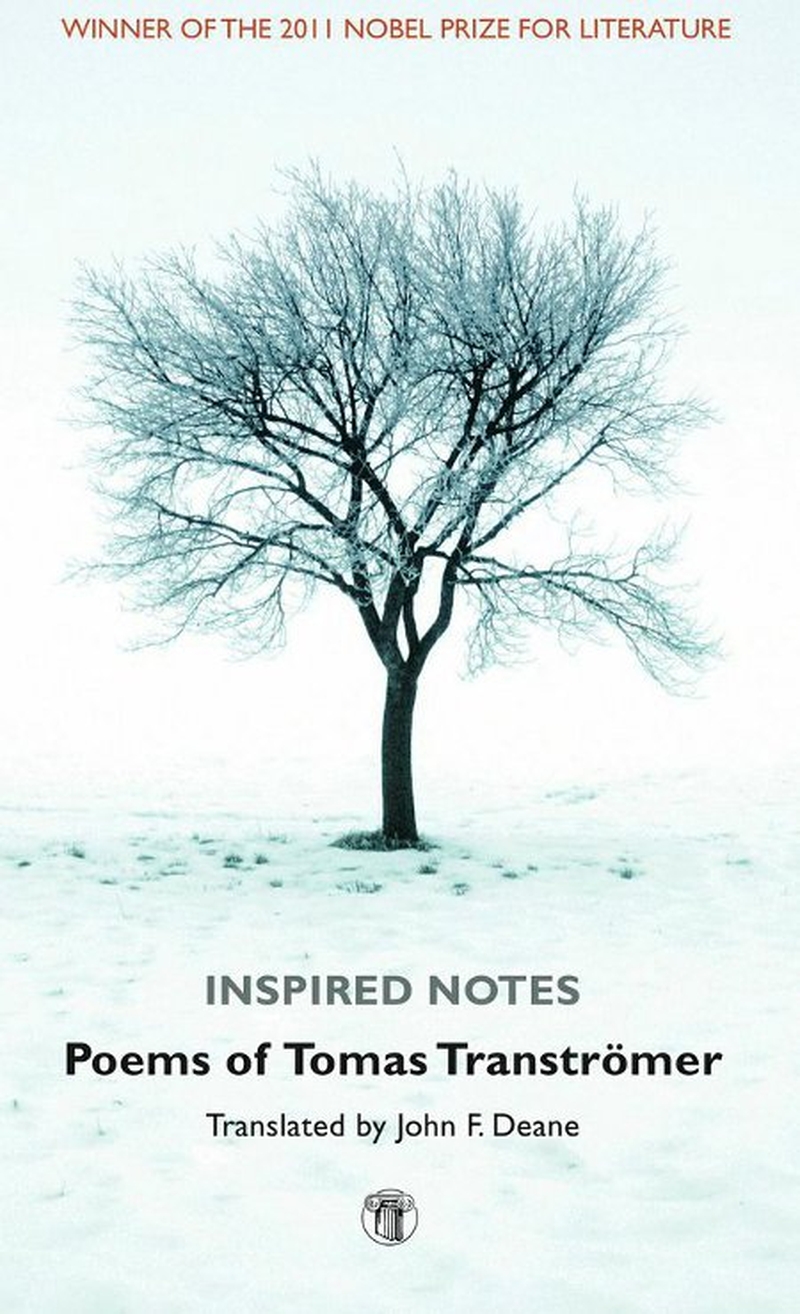
The renowned Swedish poet Tomas Tranströmer - who died on March 26 last, aged 83 - won the Nobel prize for Literature in 2011, the citation referring to his “condensed, translucent images” which give us “fresh access to reality.” The reader fortunate enough to discover Tranströmer will warm to his profoundly humane sensibility.
The Irish poet John F Deane had previously translated two of his books from Swedish into English as separate volumes, collaborating with the poet on the second of those. Following Tranströmer’s Nobel Prize win in 2011, the two volumes were gathered as one, under the title Inspired Notes. The resultant 68-page volume is as good a place to start as any for readers interested in immersing themselves in the work of this extraordinary poet, who published over 15 collections of verse.
He often catches you out, like Paul Celan, mixing and matching images as he follows his own star. There is too sometimes a touch of that surreal surprise and word torrent that is second nature in the best of Bob Dylan. You glean it - coincidental or otherwise- in the following lines from Golden Wasp, rendered into English as follows:
I saw a TV preacher, true to name, who had collected /lots of money./But now he was weak and needed the support of a/bodyguard/ a well-tailored young man with a smile stiff/as a muzzle. /A smile that choked back a scream./The scream of a child left behind in a hospital bed when/the parents depart.
John F Deane in his introduction, refers to “a mystic strain without any of the overt implications of the term `religious.’ “ Tranströmer was an atheist - one imagines with a lower case ‘a’ - but religion and its after-effects run as a vein throughout the work. Thus you get God and the believer’s unavoidable doubt about his existence in the poem Many Steps and there is an early mention of the concept of Jihad in the poem Nineteen Hundred and Eighty.
It seems gratuitous to summon the name of another great Swedish artist to make a tenuous comparison. However, this reviewer instantly saw one of Ingmar Bergman’s tormented black-and-white dreamscapes in the opening lines of The Station:
A train has rolled in. Carriage after carriage stands,/but no doors open, no-one gets off or on./Are there no doors to be found at all? In there it is/crowded/ with locked-in people who are moving to and fro.
Many of the poems here are operating in the dark recesses of the psyche and the poet worked for most of his life as a psychologist. I go slowly into myself/through a forest of hollow suits of armour, concludes the short poem Postlude. The attitude to the world is deeply personal, but not familial, and there are no elegies for friends, or tributes to anyone, with the exception perhaps of the love poem, Firescribbling.
He uses empirical reality as an escape hatch into self-examination. The poem Dream Seminar presents a bright array of images that appear straight-forward but the job of stringing them together and elucidating their import is - well, once again - down to the reader.
Read the almost Larkinesque Romanesque Arches and you sense a poet with an innate sensitivity to – and respectful acknowledgement of - the great 'vaults' of mystery in each human being. While his stance here is towards the ordinary tourists who crowd into a Romanesque church, not all humankind is presumably eligible, not least fanatics to whom he would likely give short shrift.
An angel without face embraced me/ And whispered through my whole body: don’t be ashamed that you are human, be proud!
Paddy Kehoe