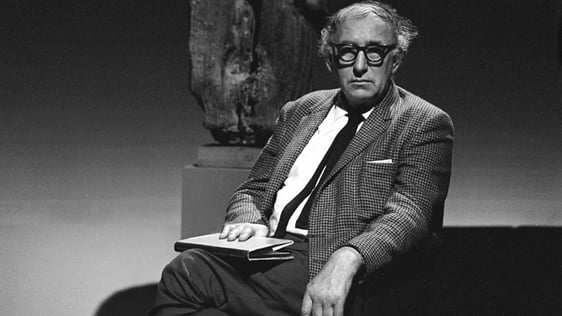
Seán O'Casey looks back on his life and offers thoughts on Ireland's national identity.
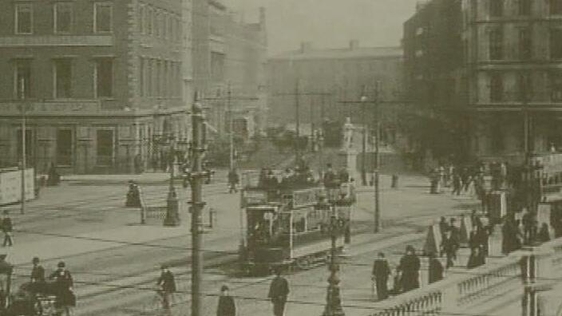
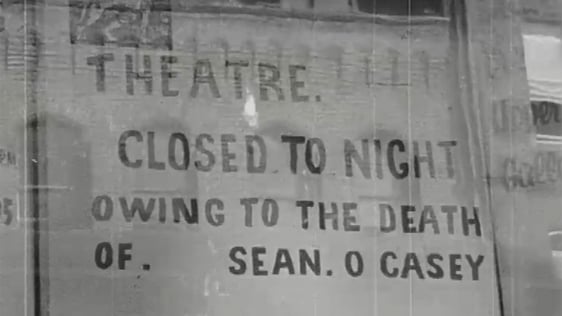
Writer and dramatist Seán O'Casey (1880 – 1964) was born and brought up in north inner city Dublin.
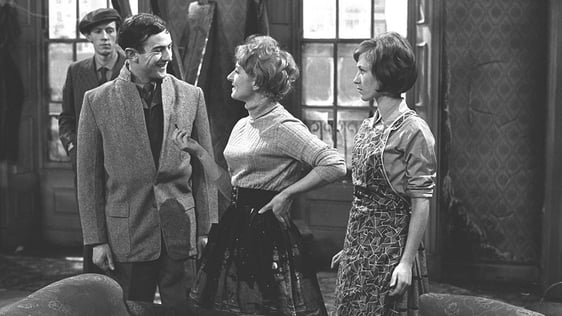
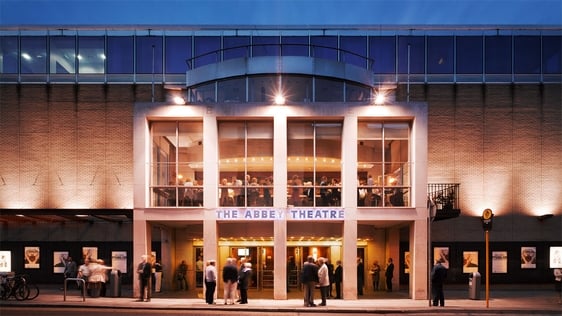
Three of his most well-known plays (often referred to as his 'Dublin trilogy’) premiered at The Abbey Theatre: ‘The Shadow of a Gunman’ (1923); ‘Juno and the Paycock’ (1924); and ‘The Plough and the Stars’ (1926).
They were written and performed during turbulent times for Ireland - The War of Independence, Civil War and emergence of the Free State. Set in the tenements that were home to many working-class Dubliners the plays examine the destructive effects of armed conflict and societal upheaval on ordinary people.
In 1926 Seán O'Casey left Ireland for England, eventually settling in Torquay. During his life, he produced over twenty five plays and six volumes of autobiography, as well as essays and was a prolific letter writer.
At the age of seventy five, he finds himself as busy as ever, and reflects on the speed with which a full life has passed.
So much time left to keep on living, that we hardly have any time left to live at all.
Ireland’s national identity and the long struggle for independence is the subject of the nineteenth century patriotic verse 'Cushla Ma Chree' (a chuisle mo chroí as Gaeilge, meaning 'beat of my heart') by John Philpot Curran, lawyer, politician and orator.
Written during a dark period in Ireland’s history, Seán O'Casey understands Curran’s desire to set Ireland on a par with other countries, and believes that Ireland can become,
The greatest nation, if we let wisdom sit on our banners.
'O'Casey : A Quartet of Plays and a Trio Of Talks' broadcast on 15 May 1955.
Seán O'Casey recorded a series of talks in 1955 from his home in Torquay for Radio Éireann. On three consecutive Sunday nights they were broadcast immediately prior to radio productions of four of his plays, the first of which was 'The Shadow of a Gunman'.