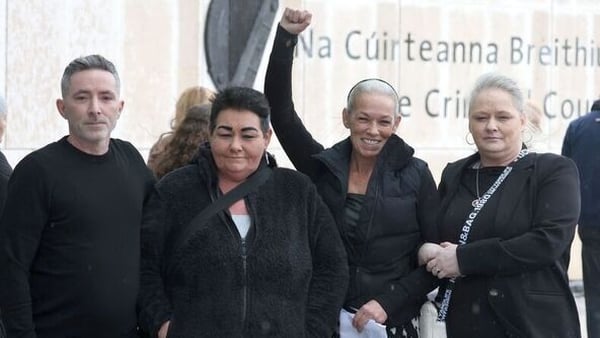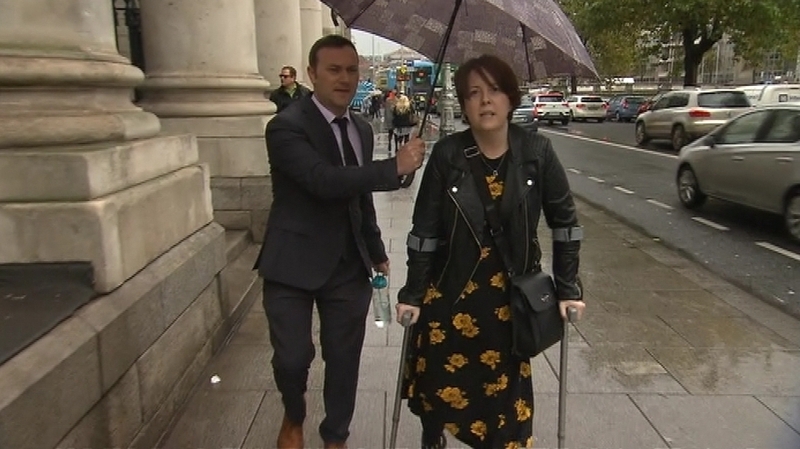
The Supreme Court has begun hearing an appeal against the High Court judgment in the case of Limerick woman, Ruth Morrissey, who is terminally ill with cervical cancer.
A key issue is the High Court's finding that screeners should have "absolute confidence" that a smear test has no abnormalities before passing it as clear.
Lawyers for the HSE and two laboratories say the High Court judgment had far reaching consequences for cancer screening services and medical diagnosis generally as well as for the CervicalCheck tribunal and other litigation relating to cervical cancer.
Lawyers for Ms Morrissey and her husband - who were awarded €2.1 million in damages by the High Court - said the High Court judgment does not have the consequences argued by the labs and the HSE, and was widely misunderstood.
Earlier this year the Supreme Court agreed to hear the so called 'leapfrog' appeal and allow the case to by-pass the usual route of first being heard by the Court of Appeal.
The Chief Justice Frank Clarke noted there was no financial urgency to the case as the Government had agreed, irrespective of the outcome of the case, to make the full award of damages to the Morrisseys.
He said however that counsel for the Morrisseys had quite properly pointed out that Ms Morrissey is ill and early closure of the proceedings would be of benefit.
This morning lawyers for the HSE argued the description of a screener needing to have "absolute confidence" before passing a slide as clear was not of itself a legal standard.
Senior Counsel Patrick Hanratty said the phrase was described in previous cases as "no more than shorthand' used by professionals to describe in general a degree of confidence, belief or conviction. It had been incorrectly "elevated to a standard much higher than mere shorthand," he said.
Mr Hanratty said the consequences of adopting such a legal standard could intrude into other medical decision making processes such as making a diagnosis or choosing between different treatment options.
On the issue of liability Mr Hanratty said there was a distinction between the HSE arranging for the screening to be carried out rather than being involved in it.
He said it arranged for the interpretation of the slides by the laboratories but had no direct control over the individual cytologists, he said.
He said there no identifiable rationale as to why the High Court imposed "a non delegable duty" on the HSE in this case.
Ms Justice Iseult O'Malley said the HSE could carry out the tests itself or arrange for them to be carried out by someone else.
The judge said if the HSE carried out the tests itself it would be liable so the question may arise as to why there should be no liability when it has arranged for someone else to carry the testing.
Counsel for Quest diagnostics Michael Cush told the five judge court the addition of a test of "absolute confidence" was wholly inappropriate.
To suggest that any person required to exercise judgement is legally required to have absolute certainty was contrary to logic but for screeners in particular it was illogical.
The upholding of the absolute confidence test would have serious implications for screening programmes and would result in re screening, he said.
In reply to questions from Ms Justice Iseult O'Malley, Mr Cush agreed that if the High Court had instead used the term a "high degree of confidence" it could still have gone on to find negligence.
However he said the court did not and one of the objectives of this appeal was to bring about legal certainty.
He said people would be pouring over the judgement in this case and asking is the new test really absolute confidence. "It could never be logical to require a screener to be absolutely confident," he said.
Ruth Morrissey was diagnosed with cervical cancer in 2014. She was not told until May 2018 that a review carried out in 2014, showed smears taken under the CervicalCheck screening programme in 2009 and 2012 had been reported incorrectly.
Her cancer returned early last year and she now faces a terminal diagnosis. She and her husband were awarded €2.1m in damages by the High Court.
The Supreme Court was told the Government had confirmed to the Morrisseys that they would retain the damages irrespective of the outcome of the Supreme Court appeal.