


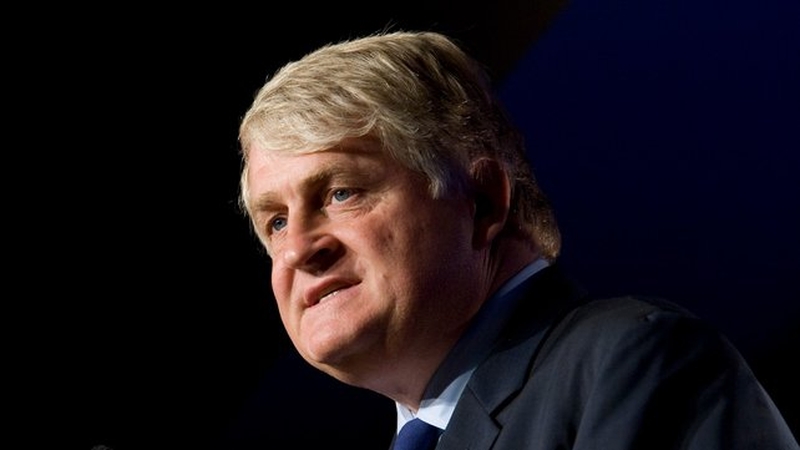
Denis O'Brien has said he will suffer irreparable harm, personally and financially, if RTÉ broadcasts a report on his private banking arrangements with the Irish Bank Resolution Corporation.
He has begun his application to the High Court to stop RTÉ broadcasting the report, which was originally due to go out at the beginning of this month.
In sworn documents submitted to the court, he said there was nothing untoward in his banking affairs.
But he said, in principle, it would be a clear breach of his constitutional right to privacy to broadcast his personal banking affairs.
His lawyers told the court the information Mr O'Brien wanted to protect was private and confidential.
Mr O'Brien was described as a major debtor of the IBRC.
Mr Justice Donald Binchy granted an application by lawyers for Mr O'Brien and by the IBRC to impose limited reporting restrictions on the case.
He said it would fly in the face of common sense for reportage to be permitted unabated in an application such as this.
He said it would render the application entirely pointless.
He said he noted that Mr O'Brien had not asked for the case to be held in camera and was not seeking anonymity.
He said the fact that Mr O'Brien was seeking the restrictions only until the proceedings had finished was a further significant factor.
He said he also noted the restraint with which RTÉ had dealt with the matter.
The court heard the reporting restrictions apply to certain matters highlighted in the documents sworn by RTÉ's Business Editor, David Murphy. But that there are three caveats.
The court ruled reports could refer to Mr O'Brien as a major debtor of IBRC.
It was also permitted to report what Deputy Catherine Murphy said about Mr O'Brien in the Dáil.
She said his loans had expired and he had apparently written to Kieran Wallace in his role of special liquidator seeking the same terms as IBRC had allowed - that is to pay off his loans in his own time, with low interest rates.
The court ruled it could also be reported that RTÉ did not know how the issue was resolved.
Senior counsel Michael Cush said there was no dispute between the sides but that the information was private and confidential.
He said there was no suggestion by RTÉ that Mr O'Brien was guilty of any wrongdoing or that he had done anything wrong in any way.
He said RTÉ had emphasised that the intended broadcast was not really about Mr O'Brien personally but he said it proposed to disclose personal confidential information about his banking affairs.
He said the reporter, Mr Murphy, had said the focus of the report was not so much on the personal finances of Mr O'Brien but on the governance of IBRC.
He said RTÉ could have published that story without naming Mr O'Brien.
He said the suggestion being made by RTÉ was that Mr O'Brien was collateral damage.
Mr Cush said that in responding to Mr O'Brien, RTÉ had decided through the documents sworn by Mr Murphy to make public the entire script of the proposed report and additional personal information.
He said this was a wholly unnecessary approach. And he said it was a conscious and deliberate approach by RTÉ.
He said RTÉ was a statutory body and this approach to the defence of the application was "less than what one would expect of RTÉ".
Lawyers for RTÉ said they had approached the case in a responsible manner.
Senior counsel David Holland said RTÉ had been very forthright and was not seeking to make any allegation of wrong doing.
In documents sworn by Mr O'Brien, he said he had received a letter at the end of last month, making assertions about his private banking facilities with IBRC and that it was intended to broadcast the report a few days later.
He said there was no allegation of wrongdoing and no public interest in the broadcast.
Mr O'Brien said there was nothing untoward about his banking affairs. But in principle to broadcast his personal banking affairs was a clear breach of his constitutional right to privacy.
Mr O'Brien said it was regrettable that there had been a certain amount of speculation in relation to his banking affairs with IBRC which had made it into the public domain without his consent.
But he said the precise details of those affairs had never previously been disclosed.
He said if the report was broadcast, he would suffer irreparable harm, personally and financially.
He said he was a businessman with extensive interests and had extensive dealings with national and international financial institutions.
He said if the details of how a financial institution dealt with customers like him made it into the public domain, it would impact on the willingness of other financial institutions to engage with him in relation to banking arrangements.
He said there was not sufficient public interest to displace his right to privacy and confidentiality and his contract with his bankers.
He said the disclosure of this information would cause his personal standing irreparable harm.
His senior counsel, Michael Cush, said rich and powerful figures were entitled to their privacy as much as anyone else.
