


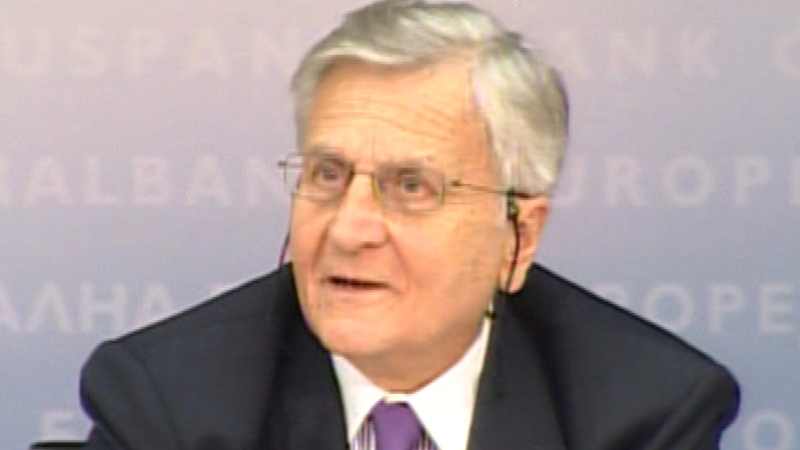
The President of the European Central Bank has called for much tougher and intrusive levels of scrutiny of the budget policies of countries in the eurozone, especially those with debt problems.
In a speech on reforming economic governance, he called for the creation of an early warning system to identify unsustainable economic policies in eurozone countries.
Speaking in New York, Jean-Claude Trichet said the economic crisis highlighted the need for broader surveillance of macroeconomic policies, and called on member states to go far beyond the current European Commission proposals for reform of the rules of the single currency.
Mr Trichet said a new more intrusive system of surveillance should concentrate on countries with vulnerabilities, losses in competitiveness and high debt levels, as these countries face the greatest sustainability challenges.
He said that where early warning indicators show potential problems they should automatically trigger in depth investigations, including visits from Commission and ECB staff.
The process should be backed up by what he called graduated sanctions, which kick in at an early stage to reinforce compliance with recommendations.
Mr Trichet also said that fiscal consolidation was essential for economic growth.
He said experience shows that the short-term costs of consolidation can be contained if the consolidation strategy is effectively designed and includes a comprehensive programme of structural reform.
He said that a number of Euro area states are in 'uncharted waters' given the size of their deficits and that this weakened confidence among forms, households and investors, making consolidation 'imperative'.
He said the projected aggregate deficit for the Euro area next year is 5.1% of Gross Domestic Product, compared to 9.7% in the US, 8.1% in the UK and 8.9% in Japan.
Europe 'will not interfere'
Earlier, a spokesman for the EU Commissioner for Economic and Monetary Affairs has said the European Commission would not interfere with the concrete measures the Government is to lay out in its four-year budgetary plan.
However, Amadeu Altafaj Tardio added that Ireland must reduce the deficit by 3% by 2014.
Mr Tardio said the commission did not want to take any particular stance on the 12.5% corporation tax rate and said it respected the national debate on how Ireland should deal with the economy.
Speaking on Morning Ireland, Mr Tardio said there would have to be a reduction in the deficit each year, as agreed with Europe.
