


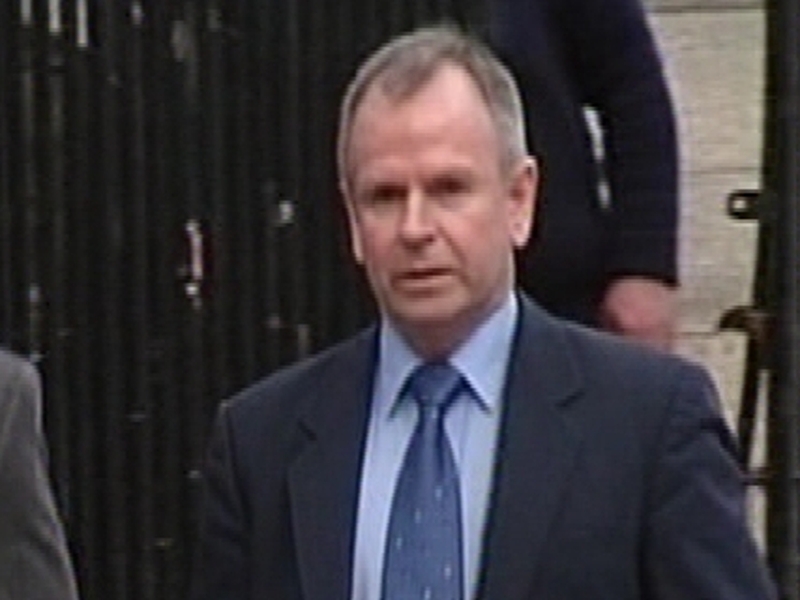
The trial has begun at the Special Criminal Court of a 57-year-old man accused of conspiracy in connection with the Omagh bombing.
Lawyers for Colm Murphy, of Ravensdale in Co Louth, have objected to graphic detail of the Omagh bombing being outlined in the opening of the case to the non-jury Special Criminal Court.
Mr Murphy pleaded not guilty to conspiring with another person to cause an explosion likely to endanger life or cause serious injury to property between 13 August and 16 August 1998 in the State or elsewhere.
Prosecuting counsel Tom O'Connell told the court that Mr Murphy's mobile phone was active in Omagh at a time consistent with the explosion at Omagh on August 15 1998.
He said that 29 men, women and children were killed in the explosion, over 300 people were injured and hundreds more traumatised.
Defence counsel Michael O'Higgins said he would be making submissions on the admissibility of certain evidence. He said his client was not charged with the Omagh bombing and said the opening of the trial should not be 'front-loaded' with prejudicial horrific evidence.
He said it was already accepted by the prosecution that Mr Murphy had no knowledge that the bomb was to be set off in Omagh.
In 2002, Mr Murphy was convicted of conspiracy to cause an explosion and jailed for 14 years but that conviction was overturned by the Court of Criminal Appeal in 2005 and a retrial was ordered.
First trial at couirt's new location
The retrial is the first trial to be held at the Special Criminal Court's new location at the Criminal Courts of Justice complex at Parkgate Street.
Mr Murphy, a building contractor and publican, who is a native of Co Armagh but with an address at Jordan's Corner, Ravensdale, Co Louth, was freed on bail in 2005 after his conviction was quashed.
He was the first person to be convicted in either the Republic of Ireland or Northern Ireland in connection with the Real IRA bombing.
In January 2005, the Court of Criminal Appeal found that the Special Criminal Court had failed to give proper regard to altered garda interview notes and that there had been 'an invasion of the presumption of innocence' in the judgment on Mr Murphy.
During a 25-day trial in 2001 and 2002, Mr Murphy had pleaded not guilty to conspiring in Dundalk with another person not before the court to cause an explosion in the State or elsewhere between 13 and 16 August 1998.
Mr O'Connell said today it was prosecution's case that Mr Murphy loaned two mobile phones to a person he knew wanted the phones to carry out a bombing run to Northern Ireland.
He said it was accepted by the prosecution that there was no evidence that Mr Murphy knew exactly where the explosion was to take place. However, he said this was characteristic of terrorist activities where those involved 'know what they need to know'.
Mr O'Connell said the prosecution would be relying on evidence of mobile phone traffic on the day of the Omagh bomb and the day of a bomb in Banbridge on 1 August 1998.
The same code word was used in the warning calls about both bombs. Mr O'Connell said the prosecution would also be relying on certain admissions made by Mr Murphy during garda interviews.
The defence will challenge the admissibility of interview evidence because of the appeal courts finding that notes of some interviews had been altered.
