


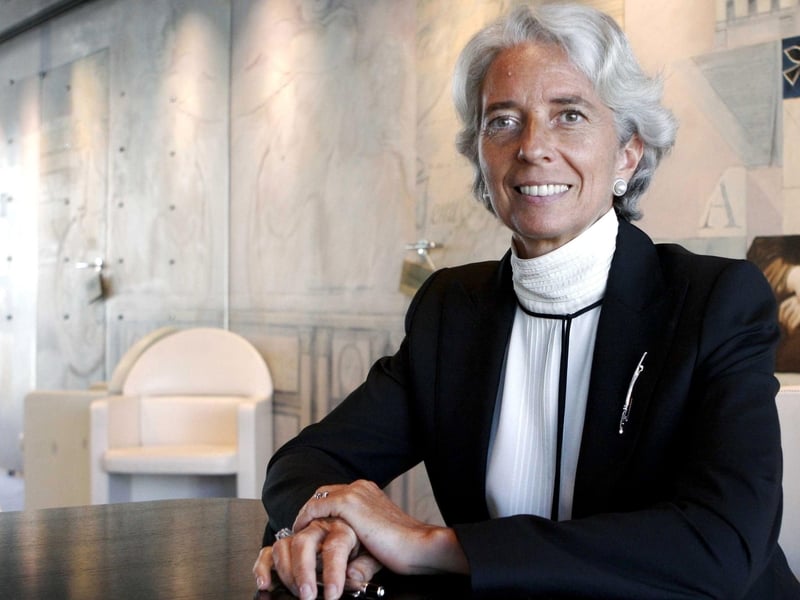
 Sean Whelan, Europe Editor, looks at the issue of corporation tax and the Lisbon Treaty, after the recent comments by France's Finance Minister.
Just when the Government thinks it is dead and buried as a referendum issue, up jumps the corpse of the Common Consolidated Tax Base (CCTB) to frighten the good folk of Ireland.
CCTB was given the French kiss of life last Monday, when Nicolas Sarkozy's finance minister, Christine Lagarde, said the French presidency of the EU in the second half of this year would press the issue. (Watch)
This provoked more than the usual allergic reaction in Ireland because we are now in the midst of a referendum campaign on the Lisbon Treaty, and the order had gone out across political Europe not to say anything that might frighten the horses. Thus the Commission agreed at the December summit not to publish a draft directive on a harmonised corporate tax base until after the Irish referendum, even though the taxation Commissioner Laszlo Kovacs said last year his preference was to publish it in the spring of 2008. (Watch)
Madame Lagarde's enthusiasm for CCTB was raised the next day with French President Nicolas Sarkozy by Fianna Fáil MEP Brian Crowley. Afterwards Brian Crowley told RTE Radio's Drivetime that President Sarkozy was none too impressed with his finance minister's remarks. (Listen)
Libertas, the anti-Lisbon campaign group, was quick to pounce on the issue as proof that Ireland's relatively low corporate tax rate is threatened by the Lisbon Treaty.
 Minister for European Affairs, Dick Roche, roundly attacked Madame Lagarde, saying her intervention was unhelpful. But he also said the proposal will be vetoed by Ireland and several other states. It was an issue that came up at meetings he addressed of the American Chamber of Commerce in Dublin on Wednesday, and a gathering of multinational companies and trade associations in Brussels on Thursday. (Watch)
There was even the unusual sight of Labour Party leader Eamon Gilmore coming to Brussels and pledging to support the Irish Government in its efforts to stop the CCTB plan in its tracks. (Watch)
But what is all the fuss about? Firstly, as even Commissioner Kovacs accepts, the Irish Government, amongst others, will veto this proposed directive, which nobody has seen yet, when it is tabled. Under existing EU treaties, taxation matters are decided by unanimity - any one member state can block a proposal. Taxation is an area jealously guarded by nation states. It was one of the two absolute red line issues for Ireland during the negotiations for the Lisbon Treaty and its stillborn close relative, the EU constitution. (The other Irish red line was on defence).
In the Lisbon Treaty taxation continues to be a unanimity measure, where every country has a veto on tax policy. So whether Lisbon is accepted or rejected by the Irish electorate, it will not change the legal position on tax policy. The veto stays.
So why is Commissioner Kovacs bothering to draw up a proposal he knows will be shot down?
The answer lies in a hitherto obscure procedure known as enhanced co-operation. This was introduced in the Amsterdam Treaty, fleshed out in the Nice Treaty, and further refined in the Lisbon Treaty. It sets out the rules under which a group of EU member states can push ahead with a proposal on their own, if they find that the proposal is blocked by the whole EU. It has never really been used, but is the route to what some people call a 'two speed Europe', in which a lead group of countries work closer together on an issue or issues, and other countries are free to join, or not, over time. The Single Currency and the Schengen free movement area are cited as examples, but they did not use the formal enhanced co-operation procedure.
CCTB might be the test case, as the holder of the EU presidency can propose an enhanced co-operation, and that will be France when Commissioner Kovac's CCTB directive is tabled in the autumn.
 So what is he planning to do? Is he trying to force Ireland to raise corporation tax rates, as critics charge? The official Commission view is that competition in tax rates is good for Europe, as it stops governments loading too much tax onto businesses.
But CCTB is not about the tax rate, it is about the tax base. It is about how the taxable profits of a company are calculated, and because every state allows companies to write-off different things at different rates when arriving at their pre-tax profit figure, it means it is very hard to compare like with like. Corporate profit in Ireland is different to corporate profit in Germany, which is different to corporate profit in Romania. If the basis on which taxable profit is calculated is different, then the difference in the tax rates applied to that profit becomes less meaningful for comparing the actual tax charge on companies operating in different states. (European Commission CCTB site)
Proponents of the system say it will increase transparency and make it easier to eliminate what they call 'harmful or unfair' tax policies. Opponents say it is unworkable, that it will drive business away from Europe, and lead to higher tax rates. Worst of all, they say it will lead to a harmonised single tax rate for business right across the EU.
Win, lose or draw on the Lisbon referendum, this issue is still going to be out there, and is not going to go away anytime soon. I believe it is not going to make it as an EU policy, because the current system suits too many governments and companies, both of whom see advantages in a lack of transparency. In the Irish case, I cannot see a change in Government policy, unless the multinational companies see advantages in a harmonised system: if they threaten to pull out of Ireland because it is not using CCTB, then expect a change. But right now there is no sign of that, because this draft directive has not even been published, let alone put into action.
A French led enhanced co-operation, a group of 8 or 10 countries, might agree to adopt the Kovac plan for a CCTB themselves, but only if the Commission backs the idea, and the other governments agree, and it is supported by the European Parliament.
That is a lot of variables.
