


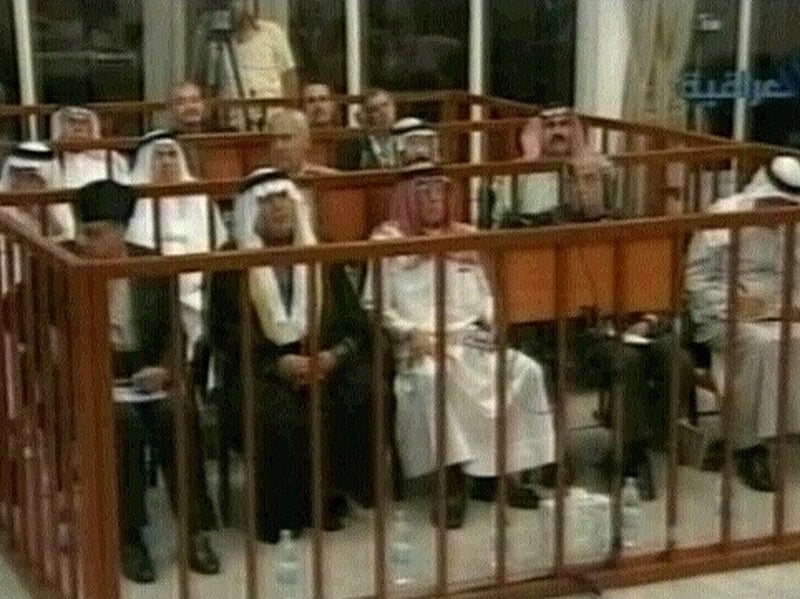
Fifteen aides of the former Iraqi dictator Saddam Hussein have gone on trial in Baghdad, charged with crimes against humanity.
Among those standing trial is Hussein's first cousin Ali Hassan al-Majid, the man the US dubbed Chemical Ali, who is accused of the execution of Shia prisoners.
It is the third trial of former regime officials; some of the accused, including Mr Majid, have already been sentenced to death on previous charges.
The charges laid before the Iraqi High Tribunal relate to crimes committed in the aftermath of the first Gulf War in March 1991.
As Hussein's defeated army was driven out of Kuwait, Shia in the south of Iraq staged an uprising.
It was suppressed by the Iraqi army using tanks and helicopters to shell the holy cities of Najaf and Karbala.
Prosecutors claimed in court today that Mr Majid shot detainees at detention centres. They were then buried in mass graves.
It is estimated that up to 100,000 Shias were killed during that time.
In recent years dozens of mass graves have been found but there are believed to be many more as yet undiscovered.
Sadr claims credit for British pullout
Radical Iraqi cleric Moqtada al-Sadr has congratulated his supporters for the imminent withdrawal of British forces from the southern city of Basra.
The troops are due to leave their last base in Basra and move to an airbase outside the city in the coming weeks, after coming under daily mortar and rocket bombardment from local Shia militias.
British commanders insist they are not being forced out and will leave the city in the hands of the Iraqi security forces.
Last August, when British troops left their base in the southern town of Amara, it was immediately looted by local citizens and militia held a small-scale victory parade.
Moqtada al-Sadr's Shia militia fighters are among the strongest opponents of US and British forces in Iraq, and have taken the lead in the daily attacks against British bases and convoys in Basra.
US commanders and many independent observers warn the British withdrawal will leave the city, the centre of Iraq's multi-billion-dollar oil industry, in the hands of warring local gangs.
Britain still has 500 soldiers in central Basra and 5,000 more at Basra Airport, which also comes under regular attack and will soon be the sole British base.
Large fall in US news reports on Iraq
US media reports related to the war in Iraq fell dramatically in the second quarter of this year, according to a new study.
The report by the Washington-based Project for Excellence in Journalism found that in April, May and June, reports on Iraq tumbled from 22% to roughly 15%.
The study attributed the fall to a decline in coverage of the Washington-based policy debate, which slumped by 42% after Democrats failed to impose timetables in legislation of the war.
Coverage of the war was divided into three strands - events in Iraq (7%), Iraq policy debate (7%) and other Iraq stories in the US (2%), according to the survey of 13 newspapers, eight radio outlets, cable and network television.
