


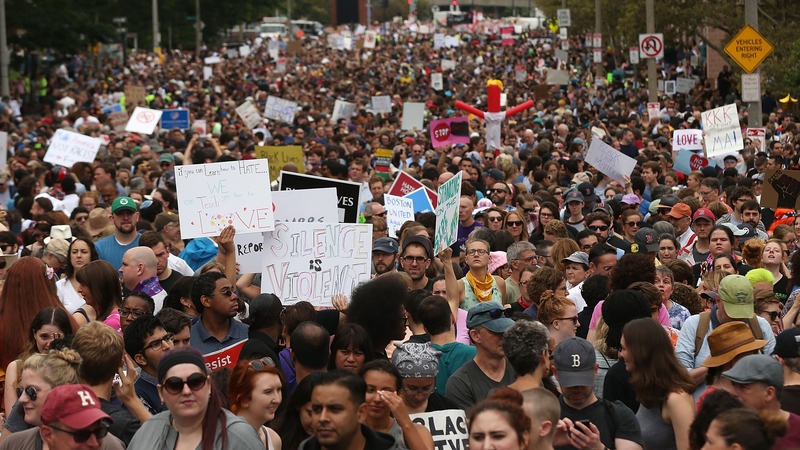
Thousands of people took to the streets of Boston today to protest against a far-right rally a week after a woman was killed at a Virginia white-supremacist demonstration.
Organisers of the "free speech" rally had invited several far-right speakers who were confined to a small pen that police set up in the historic Boston Common park to keep the two sides separate.
The city largely avoided a repeat of last weekend's violence in Charlottesville, Virginia, where there were bloody street battles and one woman was killed.
The rally never numbered more than a few dozen people, and its speakers could not be heard over the shouts of those protesting it and due to the wide security cordon between the two sides.
Protesters surrounded people leaving the rally, shouting "shame" at them and occasionally throwing plastic water bottles.
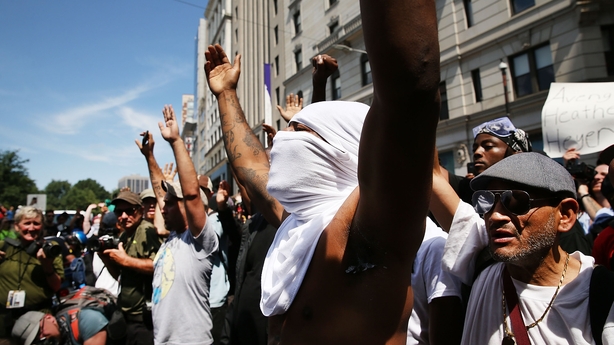
Police escorted several rally participants through the crowds, sometimes struggling against protesters who tried to stop them.
Some 500 police officers had placed barricades, including large white trucks, to prevent vehicles from entering the park.
Last weekend's clashes in Charlottesville, Virginia, where one woman was killed in a car rampage after bloody street battles, ratcheted up racial tensions already inflamed by white supremacist groups marching more openly in rallies across the United States.
White nationalists had converged in the Southern university city to defend a statue of Robert E. Lee, who led the pro-slavery Confederacy's army during the American civil war, which ended in 1865.
We need your consent to load this rte-player contentWe use rte-player to manage extra content that can set cookies on your device and collect data about your activity. Please review their details and accept them to load the content.Manage Preferences
A growing number of US political leaders have called for the removal of statues honouring the Confederacy, with civil rights activists charging that they promote racism. Advocates of the statues contend they are a reminder of their heritage.
Duke University removed a statue of Lee from the entrance of a chapel on its Durham, North Carolina campus today, officials said.
The violence in Charlottesville triggered the biggest domestic crisis yet for US President Donald Trump, who provoked ire across the political spectrum for not immediately condemning white nationalists and for praising "very fine people" on both sides of the fight.
Beyond the Boston rally and march, protests are also expected in Texas, with the Houston chapter of Black Lives Matter holding a rally to remove a "Spirit of the Confederacy" monument from a park and civil rights activists in Dallas are planning a rally against white supremacy.
Confederate monuments can no longer be celebrated, says mayor
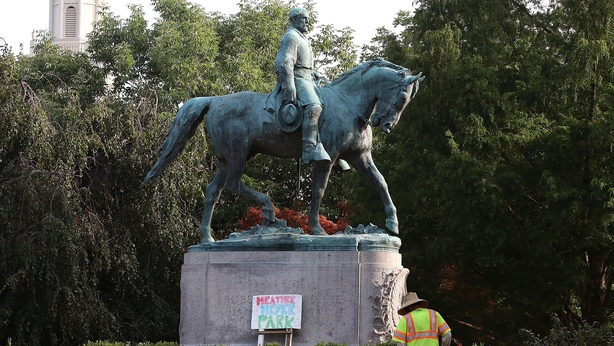
The mayor of Charlottesville has called for a special session of Virginia's legislature to let localities decide the fate of Confederate monuments like the statue at the centre of a far-right rally last week that turned deadly.
Mayor Mike Signer issued his appeal amid an increasingly contentious debate over what to do with memorials to Confederate figures, who fought for the preservation of slavery during the US Civil War, that are seen by opponents as offensive.
In what has become the biggest domestic crisis of his presidency, Donald Trump has been sharply criticised, including by fellow Republicans, for blaming Charlottesville's violence not only on the white nationalist rally organisers, but also the anti-racism activists who opposed them.
"Whether they go to museums, cemeteries, or other willing institutions, it is clear that they no longer can be celebrated in shared civic areas," Mr Signer said in a statement.
"We can, and we must, respond by denying the Nazis and the KKK and the so-called alt-right the twisted totem they seek."
