


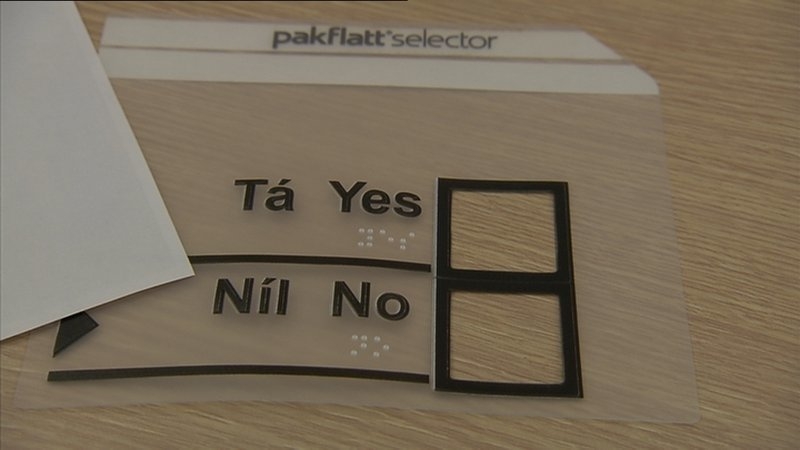
A group has expressed concern that visually impaired people will not be able to vote in secret and without assistance in the forthcoming Presidential Election in three weeks' time.
A special ballot paper template will be provided to facilitate secret voting by visually impaired people.
However, a member of the Blind Legal Alliance claims that a prototype of this template designed by the Department of Local Government for the forthcoming election is unsuitable.
A prototype of this template was sent to the National Council of the Blind in Ireland in early September.
It was also tested by Robbie Sinnott, a visually impaired man who took a High Court case against the State about the issue last year. Mr Sinnott said the template was not fit for purpose.
A template was used successfully by visually impaired people in the referendum on the Eighth Amendment, but the one proposed by the department for the Presidential Election is more complicated.
In the referendum, it was a simple 'Yes' or 'No'. However, the system of proportional representation in the forthcoming election has created a bigger challenge.
The department said that the new template was designed in consultation with the National Council for the Blind of Ireland and was currently in production.
However, a spokesperson for the NCBI said it also had concerns about the prototype template and it has made recommendations to the department.
A spokesperson for the department said this was the first time a template of this sort was being used and was being seen as a trial run.
He said the department was open to further recommendations on the matter.
Mr Sinnott also discussed the issue with the department this week.
Although he has not seen the final template, Mr Sinnott said that it was clear from talking to the department the final template would not be fit for purpose.
He said the department had failed to take on board his recommendations.
Mr Sinnott said he was prepared to give the State one chance of getting things wrong, i.e. the upcoming Presidential Election.
However, if he still cannot vote in the next election after that, he said he would have no option but to go back to the High Court to help enforce the pre-existing court order, which states that the State has a duty to ensure people’s right to vote in secret and without assistance in referendums and elections.
