


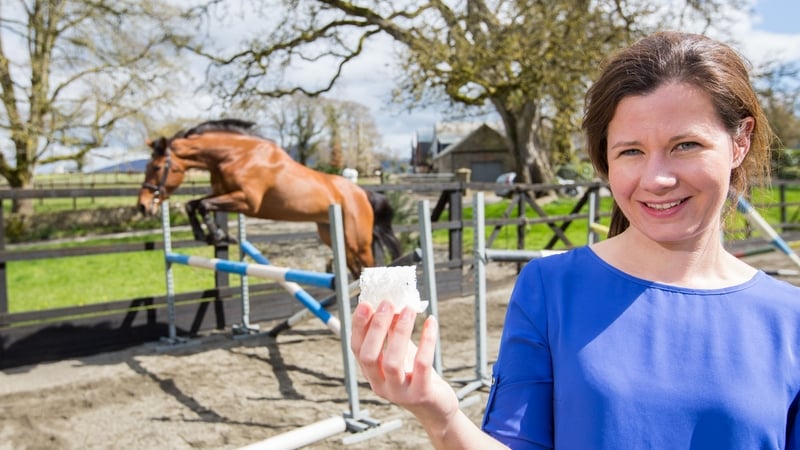
Irish scientists have developed a novel biomaterial that can repair damaged cartilage.
The material has already been successfully used to repair a knee injury on a thoroughbred showjumping horse and will shortly undergo its first trials in humans.
Developed by researchers at the Royal College of Surgeons in Ireland and the AMBER materials science centre, the multi-layered 3D porous material called ChondroColl acts as a scaffold, encouraging and directing the body's own cells to regenerate damaged joints.
It is composed of layers of collagen, hydroxyapatite and hyaluronic acid - all materials that can be found in joints.
ChondroColl was recently used clinically on Beyonce, a 16-month-old thoroughbred filly whose left and right knees had been extensively damaged by a disease known as osteochondritis dissecans.

A disorder of the joints, it can lead to cracks in the cartilage and the bone beneath it.
In most cases, animals with the disease cannot be treated, and are often put down if the condition is severe.
But following an operation at the UCD Veterinary Hospital, which saw the damaged cartilage removed and the biomaterial inserted, the cartilage and underlying bone was repaired successfully.
Clonmel-based Beyonce has returned to competitive showjumping, much to the relief of owners Patricia and Will Lalor.
Promising results from a number of other lab based studies of the effectiveness of the material have also been published in peer-reviewed journals, Acta Biomaterialia and Biomaterials.
The research has been led by Dr Tanya Levingstone, Honorary Research Lecturer at RCSI, who said they were delighted with the results, given the complexity and severity of the case.
Prof Fergal O'Brien, Professor of Bioengineering and Regenerative Medicine at RCSI and AMBER, said the research team would now move to trial the material in humans in the coming months.
Human trials are also due to begin shortly on another biomaterial produced by the team, which is capable of repairing damaged bone, and has been licensed to a spin-off company, SurgaColl Technologies.
The research group is also working on other variants of such materials, which could potentially be used to repair eye tissue, cardio-vascular problems and even damaged nerve cells.
