


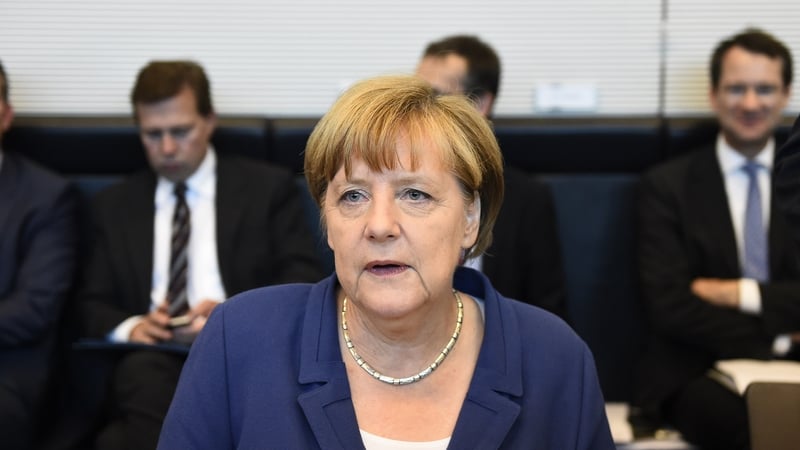
German Chancellor Angela Merkel offered Turkey the prospect of support for faster progress on its bid to join the European Union today, in return for cooperation in stemming the flow of migrants and taking back those rejected by Europe.
Speaking in Istanbul at a joint news conference with Turkish Prime Minister Ahmet Davutoglu, Chancellor Merkel said Germany could help accelerate the path to visa-free travel to the EU for Turks and push forward Ankara's protracted EU membership talks.
In return, she expected Turkey to agree more promptly to take in migrants sent back by the EU, so-called "read mission agreements" that Mr Davutoglu has said he will sign up to only if there is progress on liberalising the visa regime for Turks.
"I think we have used the crisis we are experiencing, through a very disorderly and uncontrolled movement of refugees, to again achieve closer cooperation on many issues, both between the European Union and Turkey, and between Germany and Turkey," Chancellor Merkel said after meeting the Turkish premier.
Chancellor Merkel, who only ten days ago reiterated her opposition to Turkey joining the EU, said the talks were "very promising".
Faster Turkish accession may be hard for some in her conservative party, long opposed to Turkish membership, to swallow.
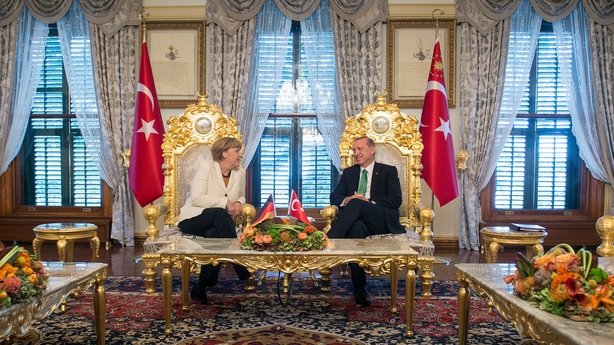
Dubbed a "punch-bag" for her own party by some German media due to frustrations over the refugee crisis, Chancellor Merkel wants to cement a European deal with Turkey on aid and closer ties in return for help in encouraging refugees there to stay put.
She has resisted pressure to tighten Germany's border controls and turn away refugees arriving from Austria, even as Germany expects 800,000 to 1 million new arrivals this year.
Both the Turkish and German leaders said they had agreed there could be no lasting solution to the migration crisis without resolving the conflict in Syria, from where more than 2 million refugees have now fled to Turkey.
A "safe zone" in northern Syria, a proposal long championed by Turkey but which has gained little international traction, is badly needed, Mr Davutoglu said.
"Our priority is to prevent illegal immigration and reduce the number of people crossing our borders. In that respect we have had very fruitful discussions with the EU recently," he said.
But Mr Davutoglu said while progress had been made on an EU offer to Turkey last week of an action plan including"re-energised" talks on joining the bloc, several issues remained to be resolved.
"Firstly, the sharing of the refugee burden should be fair.The amount of aid ... is secondary. What is more important is the common will to tackle this issue. Turkey has been left alone in recent years," he said.
Visa-free travel for Turks should be brought forward to July 2016 instead of the current planned 2017 in exchange for Turkey signing up to the readmission agreement, he said. He also said Turkey should have a seat at EU summits.
"Germany is ready to offer support," Chancellor Merkel said. "If we take the question of visa liberalisation, we can talk in the German-Turkish working group ... about specific possibilities to push through visa facilitation."
Mutual benefits for Merkel and Erdogan
Just two months ago, Chancellor Merkel was practically able to dictate terms to Greece over an aid plan to tackle its debt crisis. Over neighbouring Turkey she has far less leverage.
President Tayyip Erdogan, whom Chancellor Merkel also met, said he had asked her - as well as France, Britain and Spain - for support on accelerating Turkey's EU membership bid.
President Erdogan discussed with Chancellor Merkel the opening of five so-called chapters of the accession process, concerning harmonising rules on energy, economic policy, fundamental rights, justice and security policy.
Chancellor Merkel said Germany was ready to open the chapter on economic and monetary policy this year, and make preparations for opening the chapters on rights and justice.
President Erdogan and his ruling AK Party, which faces a general election on 1 November, have an interest in avoiding any suggestion of a sellout to help ungrateful Europeans. He has used the opportunity to grandstand, on Friday accusing the EU of insincerity in talks on Turkish membership.
In truth, both President Erdogan and Chancellor Merkel know there is no near-term prospect of Turkey joining the EU. But both can still gain something from today's meeting.
For Chancellor Merkel, nailing down Turkey's commitment to the action plan is important to stemming the refugee flow and relieving the political pressure on her at home.
For President Erdogan and the AKP, winning the promise of an accelerated path to visa-free travel to the EU for Turks could be an election boon.
Croatia transfers 1,000 more migrants to Slovenia
Meanwhile, hundreds of migrants travelled to Slovenia today aboard a special train from Croatia, the day after some 3,000 were forced to take the same route after Hungary's new border closure.
The train crossed the border with around 1,000 migrants aboard this morning, a Croatian Railways spokeswoman told AFP.
Elsewhere, some 1,000 migrants arrived in Austria overnight after travelling on from Slovenia, Austrian police said, adding that most were expected to proceed on to Germany.
Hungary closed its frontier with Croatia to migrants early yesterday in a bid to block the path of streams of refugees fleeing war and poverty in the Middle East, Africa and Asia.
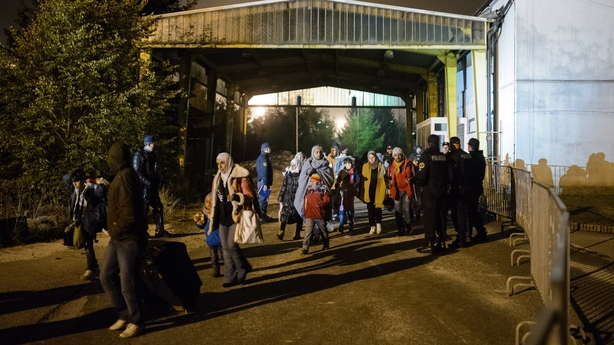
Budapest had sealed its border with non-EU neighbour Serbia a month earlier.
The number of migrants entering Hungary dropped to 870 yesterday, down from 6,353 the previous day, following the border closure with Croatia.
Hungarian government spokesman Zoltan Kovacs said late last night it was "still too early to say, the measures which were introduced in the interests of defending the Hungarian as well as the European borders... clearly worked on the first day."
More than 6,000 migrants entered Croatia from Serbia yesterday, an average figure since the influx started, official figures showed.
They were being transported by train and bus to four border crossings with Slovenia. Those who were not transferred were temporarily housed at a refugee centre in eastern Croatia.
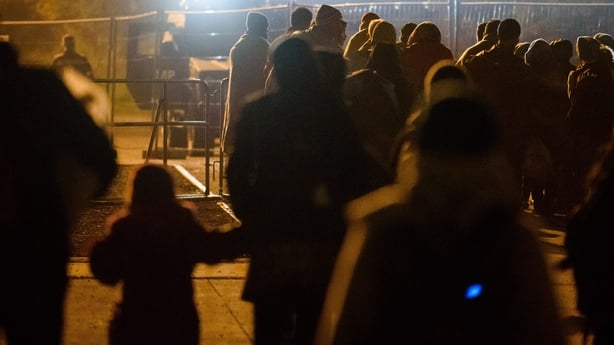
Croatian Prime Minister Zoran Milanovic, who has repeatedly denounced Budapest's policy towards migrants, said that the government was "successfully keeping (the migrants situation) under control".
Since the influx began here in mid-September, nearly 200,000 migrants have transited through Croatia, crossing mostly to Hungary and a smaller number to Slovenia.
Slovenia said it would be able to cope with between 2,000 and 2,500 migrants per day as long as Austria and Germany did not strengthen their border controls. Croatia said it would respect Slovenia's constraints.
Five more migrant deaths in Aegean: Greek coastguard
The Greek coastguard said five more migrants including a baby and two boys have died trying to cross the Aegean Sea from neighbouring Turkey.
Most of the deaths occurred near the island of Kastellorizo, where an American-flagged sailing boat said it had rescued nearly a dozen people, with a dead infant among them.
A subsequent search by coastguard vessel recovered the bodies of a boy and two women and crews are still searching for a missing man, the coastguard said.
In a separate incident, an eight-year-old boy of apparent Iraqi origin was confirmed dead on arrival on the island of Farmakonissi.
The boy's parents told officials that he had fallen out of a boat containing another 110 people, and was unconscious when they plucked him out of the water.
Nearly 300 people trying to escape conflict and poverty in their home countries have died in the Aegean Sea this year according to the International Organisation for Migration (IOM).
With winds in the Aegean now reaching 50km (30 miles) an hour, deadly sinkings occur nearly every day.
The UN refugee agency UNHCR has reported an increase in the number of migrant boats arriving from Turkey this week.
"The surge in arrivals could be the result of a temporary improvement in the weather, a rush to beat the onset of winter, and a fear that European borders may soon close," the UNHCR said on Friday.
