


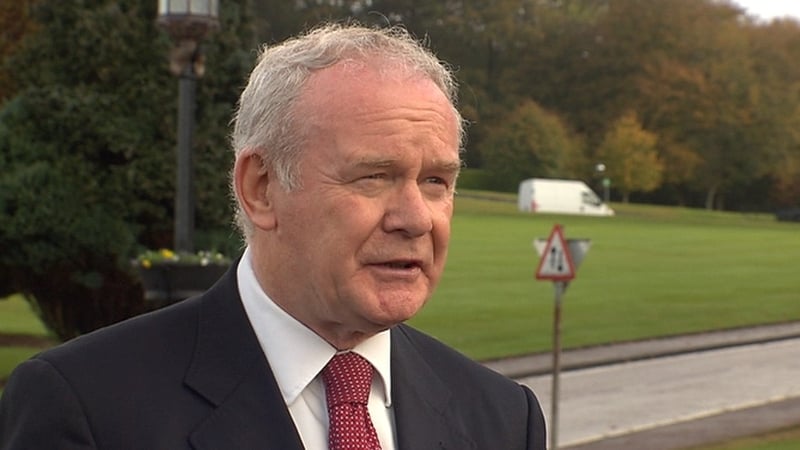
All participants engaged in talks to save Northern Ireland's power-sharing political institutions must adopt a spirit of generosity, Stormont's Deputy First Minister has said.
Sinn Féin's Martin McGuinness said there was a "huge responsibility" resting on the five parties in the coalition Executive in Belfast and the Irish and British governments to push themselves to find a resolution.
Acting First Minister Arlene Foster said cross-party discussions had to be postponed today to facilitate Question Time.
She said: "Today there was meant to be a round table meeting of the talks at 1.30pm but it had to be put off because I had to be in this place answering questions on OFMDFM (Office of the First and Deputy First Minister).
"Already it is having an impact in terms of the intensity of the talks and I regret that."
The Democratic Unionist Party had requested an adjournment or suspension of the devolved Assembly at Stormont to focus solely on the negotiations about paramilitary activity and welfare cuts.
MLAs rejected the motion.
Ms Foster added: "I regret the fact that other parties did not agree to an adjournment so that we could focus exclusively on the talks process."
Unionists have resigned all but one of their ministers from the powersharing Executive with the DUP insisting it could not be business as usual.
Sinn Féin's Caitriona Ruane said the policy of appointing and resigning ministers was doing a "disservice" to the public and was leading to a lack of decisions in key departments.
Four to six weeks have been set aside for the talks process.
The administration is teetering on the verge of collapse due to a crisis sparked by a murder linked to the IRA.
However, its future viability had already been in doubt as a consequence of long-standing budgetary disputes, with the row over the non-implementation of the UK government's welfare reforms the most vexed.
Northern Ireland Secretary Theresa Villiers described exchanges today as "focused and productive".
"All parties committed themselves to an intensive process aimed at dealing with the impact and legacy of continued paramilitary activity and securing the full implementation of the Stormont House Agreement," she said.
"Tomorrow the talks will concentrate on finance and welfare issues.
"Implementing these aspects of the Stormont House Agreement is essential if the Executive is to have a workable and sustainable budget so that it can continue to deliver essential frontline public services."
The devolved Assembly has been thrown into disarray following the murder of Kevin McGuigan last month.
The 53-year-old was shot dead in a suspected revenge attack for the murder of his one-time associate and IRA commander Gerard 'Jock' Davison, 47, three months earlier.
A police assessment that individual members of the PIRA were involved alongside dissident republicans and criminal elements has rocked the political establishment and prompted unionists to remove all but one minister from the Executive.
The DUP and Ulster Unionists had said the issue of paramilitary activity was crucial to their participation in any talks process.
On Friday, the British government announced an independent assessment of paramilitary criminality and pledged increased funding to tackle cross border organised crime such as fuel laundering and smuggling.
Mr McGuinness expressed concern that the report had the potential to "derail" the negotiations.
Many of the disputes in the Executive seemed to have been resolved last December when all the parties and the two governments signed off on a deal titled the Stormont House Agreement.
However, that accord is in danger of unravelling over the welfare reform issue. UUP leader Mike Nesbitt said his party would be "positive and imaginative" in the talks.
"We enter the talks with some concerns, not least about whether there will be a two party carve up (DUP and Sinn Féin) in a parallel process, but the glass is half full and we see opportunities," he said.
"We have an opportunity to see if there is a collective political will to rid society once and for all of organised crime linked to paramilitary organisations.
"There is also the big challenge of seeing whether we can actually get over the hurdle of implementing the Stormont House Agreement."
