


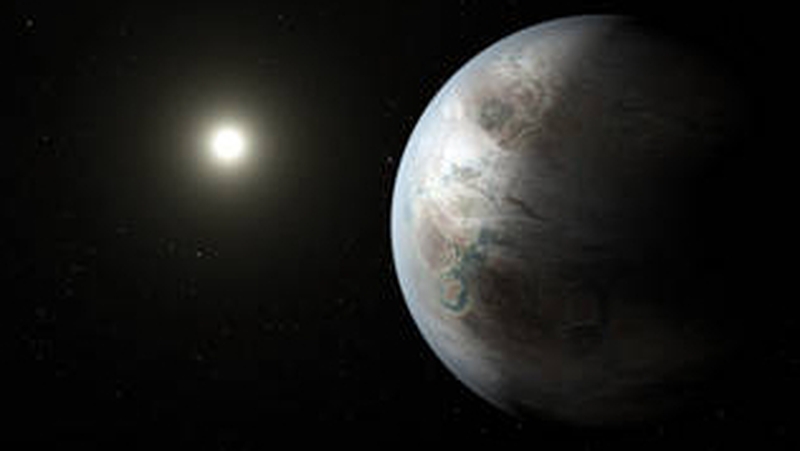
NASA has said its Kepler space based observatory has found the closest twin to Earth so far.
The near-Earth size planet, which has been called Kepler-452b, is the smallest planet found to date which has been discovered to be orbiting in the habitable zone.
The habitable zone is the area around a star, like our sun, where liquid water could pool on the surface of an orbiting planet.
According to NASA, Kepler-452b is 60% in diameter than Earth and is considered a super-Earth-size planet.
Its composition is not yet known, but based on previous research scientists think there is a good chance that its surface is rocky.
The planet's parent star, Kepler-452, is six billion years old, which is 1.5 billion years older than our sun.
That means the planet has had a long opportunity for life to arise if ingredients and conditions exist on it to allow that.
Researchers estimate the parent star is 20% brighter, 10% bigger, and has the same temperature as our sun.
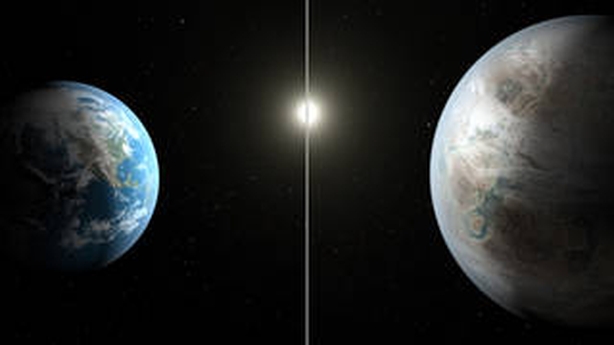
The planet itself is larger than Earth, with a mass five times larger, and its orbit of its sun is 5% longer than Earth's, at 385 days long.
Scientists working on the mission say we should think of it as an older bigger cousin to Earth, and if studied further could give us an insight into how our planet might evolve.
It is situated 5% further from its parent star than Earth is from our sun.
The system in which Kepler-452 is located is 1,400 light-years away in the constellation Cygnus.
The research paper reporting the discovery has been accepted for publication in The Astronomical Journal.
NASA also revealed that the team behind Kepler has increased the number of new exoplanet candidates by 521 since 2013, with the number of planet candidates rising to 4,696.
12 of them have diameters of between one to two times that of Earth and orbit in their star's habitable zone.
Of these, nine orbit stars with a similar temperature and size to our sun.
So far Kepler has found 1,030 planets since it was launched in 2009.
Kepler discovers exoplanets by looking for them as they pass between their star and Earth.
During that period, there is a dip in brightness, which allows the exoplanet to be seen.
Just over a year ago the team announced the discovery of Kepler-186f, which was in the habitable zone of its star, although that star was in an end stage.
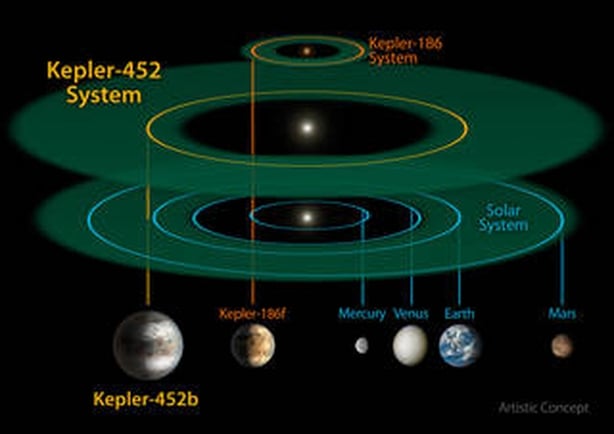
(Pic: NASA/N. Batalha and W. Stenzel)
