


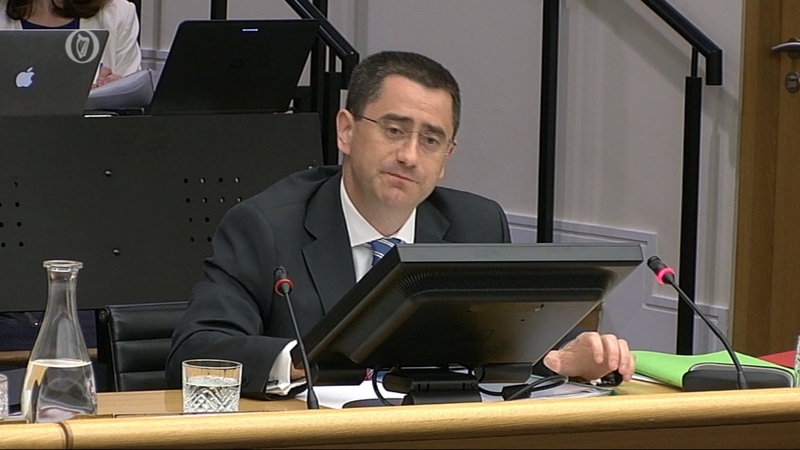
An official in the Department of Finance has told the banking inquiry that he got an email draft government press release confirming the guarantee some hours before the decision.
William Beausang said his email records show that at 9.11pm on the night, he received a document intended to be a draft government press release announcing the introduction of a guarantee for the domestic banks.
It appeared to have been authored earlier in the evening in the Central Bank in advance of the meeting in Government Buildings.
He also said nationalisation legislation was ready at short notice by September 2008 to cover a bank or building society.
The inquiry heard the email draft was for a six-month guarantee only covering deposits and not mentioning any bondholders or other types of debt.
It was authored by the Central Bank and forwarded by the Secretary General of Finance, David Doyle.
Earlier, the Chief Economist at the Department of Finance told the banking inquiry that implementation of fiscal policy was poor.
John McCarthy said this weak implementation, especially on expenditure, resulted in frequent overruns.
Mr McCarthy said that in six out of seven budgets, an already generous initial spending allocation was exceeded, with the overshoot very large in some cases.
Insufficient consideration was attached to such overruns, given that these were typically offset by higher-than-anticipated revenue flows.
Part of the unexpected temporary revenue buoyancy was used to finance higher public expenditure rather than debt reduction, ultimately leading to a deficit that was mostly structural in nature.
He also said there was an over-politicisation at the department.
Asked by inquiry Chairman Ciarán Lynch where the instructions came from, Mr McCarthy said they came from beyond his pay grade within the organisation.
Former secretary general at the Department of Finance Kevin Cardiff has told the inquiry that in 2008 he made inquiries about how Ireland could enter an IMF programme.
He said he asked a colleague, as a precaution, how Ireland could go into a programme.
However, he said there was no huge advantage in going into a bailout at that time as there was no issue with getting funds for the State, the problem was the banks.
Mr Cardiff gave a second round of evidence to the committee, focusing on the 2010 bailout.
He said the department worked on contingency plans for a euro exit but it was "dynamite stuff" and kept to a small group of people.
The notion that it could be declared publicly was ridiculous, he said.
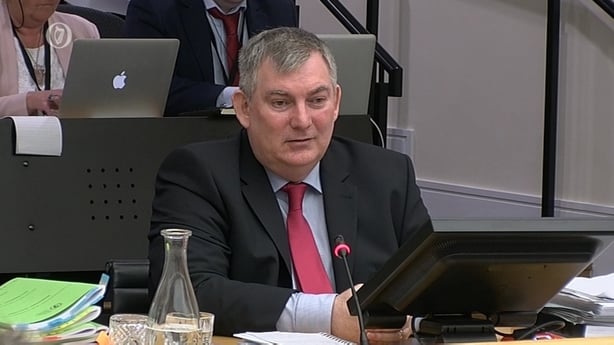
Asked about evidence given to the inquiry by former ECB president Jean-Claude Trichet, Mr Cardiff said that some was accurate and other bits were "those kind of truths where every word was true but the impression was not".
He said the idea that the ECB was just giving advice was not accurate.
On the merger of certain banks and whether this was a pointless, cosmetic exercise wanted by the Troika, Mr Cardiff said: "If they're giving you €67 billion and they want something pointless and cosmetic, if it doesn't hurt you, you say 'yes'."
Mr Cardiff said Mr Trichet was trying to hold together the entire EU project and what was really important to Ireland, may not have been to him.
He said his heart went out to Greece which he said was in a much worse situation.
He said comments he made on Greece last week were reported in newspapers there and the country was in the middle of a really "s***e" problem.
Regarding an interview with Central Bank Governor Patrick Honohan on RTÉ's Morning Ireland on conversations Ireland was having with the IMF on a bailout, Mr Cardiff said Mr Honohan took a view that was different to the minister and to himself about when he should speak openly to the Irish public.
He said what Mr Honohan said on the Thursday morning, the minister would have said on the Friday evening.
He said he was not especially upset by it. He said he would not have done it and it would have liked an extra hour of notice about it.
Mr Cardiff said a lot of the negotiations had been done by the time the interview was conducted and it did not make an enormous difference to the end point.
Inquiry to hear details on press release outlining guarantee
Labour Senator Susan O'Keeffe said Mr Honohan will tell the inquiry tomorrow that €950m in deposits left the country the day before he went on RTÉ's Morning Ireland to confirm the bailout.
She also said an official in Finance would tell the inquiry that he got an email at 9.11pm on the night of the guarantee from the Central Bank. It was a draft press release confirming a guarantee would be given for six months.
She asked why it was ready so early in the night before the reported time of the decision.
Mr Lynch asked if it would have been possible to design a guarantee which would not have led to a bailout.
Mr Cardiff said the bailout happened because of the economic and fiscal difficulties; it was not caused by banking.
They might have saved a small number of billions if done differently, but it was speculation.
Mr Cardiff also told the inquiry it was clearly the case that the design of the guarantee did have a bearing on Ireland entering the bailout.
It put the sovereign credit behind the bank credit.
The problem was that the end of the guarantee coincided with a huge "risk-averseness" in the markets so they could not get credit.
Asked by Mr Lynch if the bailout would have been larger had the government delayed, Mr Cardiff said it probably would have been bigger with stricter conditions attached.
