


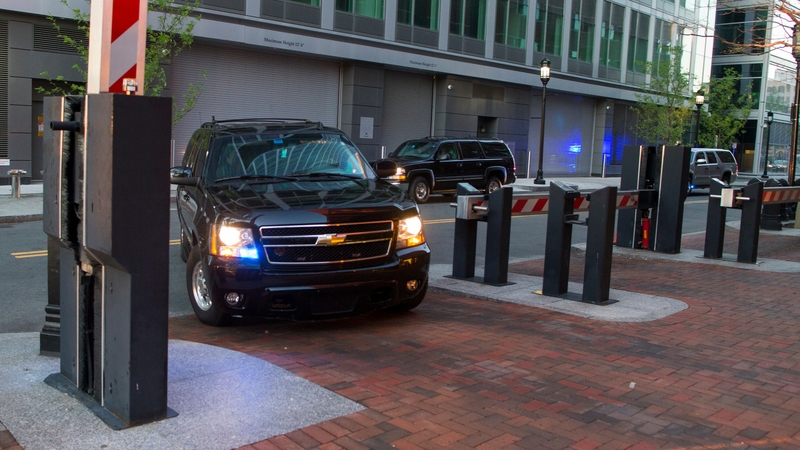
Boston Marathon bomber Dzhokhar Tsarnaev has apologised at a hearing to formally sentence him to death for the deadly 2013 attack.
"I am sorry for the lives I have taken, for the suffering that I have caused you, for the damage I have done, irreparable damage," the 21-year-old ethnic Chechen told a federal court.
It was the first time Tsarnaev, who did not speak in his own defence at trial, had addressed the court.
Tsarnaev was found guilty of killing three people and injuring 264 in the bombing on 15 April 2013 on the world-renowned race, as well as fatally shooting a police officer three days later.
Earlier, parents of the dead and some of the scores wounded in the 2013 attack confronted Tsarnaev.
Rebekah Gregory, who lost her left leg in one of the highest-profile attacks on US soil since 11 September 2001, addressed Tsarnaev directly.
"Terrorists like you do two things in this world. One, they create mass destruction, but the second is quite interesting," Ms Gregory said.

"Because do you know what mass destruction really does? It brings people together. We are Boston strong and we are America strong, and choosing to mess with us was a terrible idea.
"How's that for your victim impact statement?" she asked.
Ed Fucarile, whose son Marc lost his right leg in the attack, stared at the bomber as he read a statement.
"The first time I saw you in this courtroom, you were smirking at all the victims for your unspeakable cowardly act. You don't seem to be smirking today," Mr Fucarile said. "Your sentence today should be severe as possible."
Ms Gregory and Mr Fucarile were part of a stream of two dozen survivors of the attack and relatives of the slain who discussed the pain they had suffered as a result of the blasts.
Several runners, some tearful, addressed the guilt they suffered for the injuries suffered by friends who had come to cheer them on.
The mother of one of the three people killed in the bombing said the convicted bomber made "despicable" choices.
"You went down the wrong road," Patricia Campbell, whose 29-year-old daughter Krystle was killed, told Tsarnaev.
"I know life is hard, but the choices you made were despicable and what you did to my daughter was disgusting."
Formal sentencing takes place
A jury earlier this year found Tsarnaev, 21, guilty of killing four people and injuring 264 in the bombing and its aftermath, and voted in May to sentence him to death by lethal injection.
Today US District Judge George O'Toole ordered the punishment.
The trial brought back some of Boston's darkest living memories.
Jurors saw videos of the twin pressure-cooker bombs' blinding flashes and the chaotic aftermath on 15 April 2013 as emergency workers and spectators rushed to aid the wounded, many of whom lost legs.
In addition to Krystle Campbell, the bombing killed Martin Richard, 8, and Chinese exchange student Lingzi Lu, 26.
The parents of Martin Richard, directly addressed the defence's claim, saying the younger Tsarnaev could have prevented the attack.
"He could have stopped his brother," said William Richard, who testified during the trial about the agonising decision he made to leave his son to die in his wife's arms so that he could save the life of his daughter, Jane, who lost a leg in the attack.
"He could have changed his mind the morning of 15 April 2013, walked away with a minimal sense of humanity and reported to authorities that his brother intended to hurt others," Mr Richard said.
"He chose to do nothing, to prevent all of this from happening and he chose to accompany his brother and participate in this hate."
Tsarnaev and his 26-year-old brother, Tamerlan, shot dead Massachusetts Institute of Technology police officer Sean Collier, 26, three days after the bombing.
Tamerlan Tsarnaev died following a gunfight with police after Collier's shooting.
During the trial, federal prosecutors described the ethnic Chechen brothers as adherents of al-Qaeda's militant Islamist ideology who wanted to "punish America" with the attack on the race.
Tsarnaev's lawyers admitted their client had played a role in the attack but tried to portray him as the junior partner in a scheme hatched and driven by his older brother.
The Tsarnaev family came to the United States from Russia a decade before the attack.
Tsarnaev is expected to appeal.
Even after the sentencing, the legal wrangling over Tsarnaev's fate could play out over years, if not decades.
Just three of the 74 people sentenced to death in the United States for federal crimes since 1998 have been executed.
