


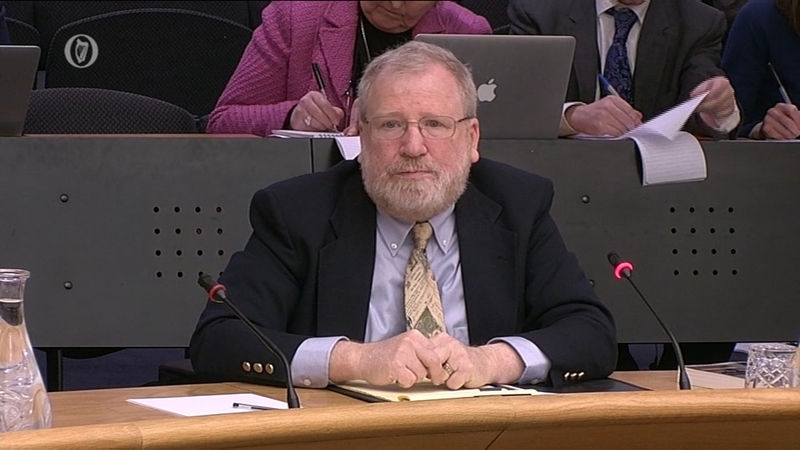
A banking regulation expert has told the Banking Inquiry that the government's response to the banking crisis was the "most destructive own goal in history" by giving an unlimited guarantee which turned a banking crisis into a fiscal crisis.
Prof Bill Black of the University of Missouri-Kansas City said the inclusion of subordinated debt was not done by anyone else and that was why the response was the worst in history.
He said the bank guarantee was a product of terrible anti-regulation with regulators saying there was only a temporary liquidity problem and the government must act within 12 hours.
Prof Black said the banks had also supplied hopelessly false statements but even then "you never ever ever bail out subordinated debt".
Inquiry committee member Joe Higgins asked whether financial markets exerted pressure and lobbying to slow down regulation.
Prof Black said Wall Street always pointed to London and thought it must not regulate.
The City of London won the race to the bottom in terms of regulation with Wall Street a close second, he added.
He said the bank guarantee was an insane decision and the worst possible one but he acknowledged the role of what he called "lying bankers and incapable regulators" and he said this was likely to lead to terrible decisions.
Prof Black said he agreed with the testimony of Governor of the Central Bank Patrick Honohan on this.
He said though that he would have made a different decision, as he knew banks and would not have relied on regulators.
Insufficient safeguards to prevent future banking crisis
Prof Black said that sufficient safeguards have not been put in place to prevent a banking crisis in the future.
Speaking on RTÉ’s Six One, he said that regulation supervision died in Ireland many years ago and that while there has been some improvement, the necessary steps have not been taken to be effective financial regulators in Ireland.
He added there was no regulation, no supervisory actions, zero-enforcement actions taken and there have been no safeguards.
Prof Black said that massive false statements by the bankers, compounded by ridiculous statements by the regulators, led to the bank guarantee.
At the inquiry today Fianna Fáil's Finance spokesperson Michael McGrath asked what possible justification there may have been to include subordinated debt in the guarantee.
He said the guarantee covered €375 billion of loans including €12.2 billion of subordinated debt of which €1.4 billion was later redeemed.
Prof Black said the bank guarantee was the worst choice because it sank an entire nation and produced a fiscal crisis.
He said the inclusion of subordinated debt was simply indefensible.
He said Irish regulators did an enormous disservice to the nation.
Sinn Féin's Finance spokesperson Pearse Doherty asked about the level of concentration of commercial lending in INBS and Anglo.
Prof Black said he had never seen such a concentration of lending in any institution of any size in the world.
Speaking afterwards, he criticised the workings of the committee which he said could not fully report on the causes of the crisis because it is not permitted to touch on criminality.
He also confirmed he was asked to change his opening statement as it might "screw up" potential prosecutions and he said he did not want to do that.
Key warning signs with banks missed
Earlier, Prof Black said while not all bank failures and future crises can be stopped, the severity of those crises can be dramatically reduced.
He said there were key warning signs with banks "growing like crazy, terrible quality loans, extreme leverage and no meaningful loss reserves".
He said institutions following this recipe, would record profits, senior leadership would become wealthy and catastrophic losses would follow.
Prof Black said these could be blocked with appropriate accounting reserves, otherwise fictional income was created.
Also appearing before the Committee, a senior European Commission official blamed the EU's banking crisis on failure of regulators to follow thorough assessments of banks which they were supposed to implement.
Director of Regulation and Supervision of Financial Institutions at the European Commission Mario Nava said a directive adopted by the European Council of Ministers in 2006 required regulators to assess the risk profile of banks.
Mr Nava said the directive stipulated "explicit requirements for management of liquidity and concentration of risk arising from exposure of real estate markets".
He added that "too little attention was given to macro prudential considerations and effective early warning mechanisms, which could have helped national authorities to detect emerging risks and prevent bubbles from growing."
There was nothing in the European directives, Mr Nava said, which "prevented Member States and their national supervisors from taking appropriate measures to reduce the risk of a bank failing or risks to the stability of the financial system a whole."
Fine Gael TD Kieran O'Donnell asked how retrospective recapitalisation under the ESM might work.
Mr Nava said he could speak about the rules only and not in reference to any specific country. He said it would be decided on a case-by-case basis and only with the agreement of the ESM member countries.
Mr McGrath asked whether the EC was satisfied with the level of progress since the June 2012 EU Summit.
Mr Nava said major steps had been taken to break the link between banks and the sovereign including greater capital requirements, the single supervisory mechanism and single resolution mechanism.
The Oireachtas Committee of Inquiry into the Banking Crisis is being chaired by Labour TD Ciarán Lynch and is expected to conclude by November.
