

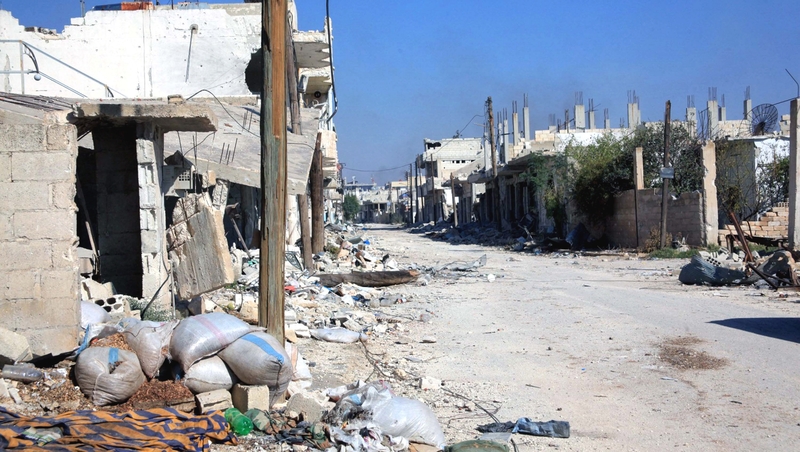
Syrian government air strikes on two rebel-held areas of the central province of Homs killed at least 25 civilians, 11 of them children, a monitoring group said today.
Sixteen members of a single family were among 18 people killed in raids late Saturday on the town of Talbisseh, the Syrian Observatory for Human Rights said.
They included 10 children and three women, said the UK-based monitoring group, which has a wide network of sources inside Syria.
In the Waer district on the outskirts of Homs - the only area of Syria's third city in rebel hands - the evening air strikes killed seven people, including a child, the Observatory added.
The Syrian Arab News Agency says the Syrian Army has killed a large number of rebels in recent days as they regained control of towns in the northern countryside around Hama.
Meanwhile, a relative sense of calm has prevailed in Kobane on the Turkish border.
Turkish military vehicles and personnel are monitoring the scene in Kobane, where Islamic State militants are battling with Kurdish fighters for control of the town.
US warplanes destroyed an Islamic State artillery piece near Kobane, officials said yesterday.
The town near Turkey's border appears in less danger of falling, but the threat remains, US officials said on Thursday.
On Friday the Democratic Union Party (PYD), a Syrian Kurdish group which controls Kobane, denied reports from Turkish President Tayyip Erdogan that it had agreed to allow the passage of 1,300 Free Syrian Army fighters to help secure the town.
Saleh Moslem, the co-chair of the PYD, said the FSA would be more helpful if it opened a new front against Islamic State militants elsewhere in Syria.
President Erdogan has long championed the relatively secular FSA in the insurgency against Syrian President Bashar al-Assad, and has repeatedly advocated intervention of the FSA in Kobane.
The Turkish president has come under fire for refusing to send Turkey's army across the border into Kobane to help resist the militants.
Western allies have been critical of what they see as a reticent response, and Turkish Kurds believe he is unwilling to strengthen the Kurds who have sought autonomy in Turkey, Iraq and Syria.
Mr Erdogan has agreed to allow Iraqi Kurdish forces to go through Turkey on their way to help fellow Kurds fighting in Kobane.
Kurdish militants killed three Turkish soldiers in Turkey's southeast yesterday, the Turkish Armed Forces said, in a further blow to peace talks between Ankara and the insurgents.
The fate of Kobane has become a credibility test of the international coalition's response to the threat from the militants.
