

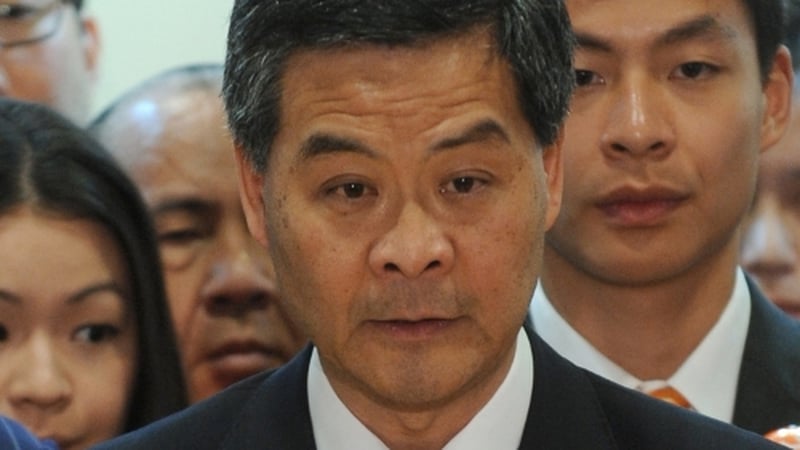
Self-made millionaire property consultant Leung Chun-ying has won Hong Kong's leadership election, after the most divisive vote since the city reverted to Chinese rule in 1997.
Mr Leung was chosen by a pro-Beijing committee as thousands of protesters rallied outside the harbourside convention centre where the vote took place, demanding full democracy in the semi-autonomous former British colony.
Mr Leung, 57, will replace outgoing Chief Executive Donald Tsang in July after winning 689 of the votes from the 1,200-strong election committee, according to an official count.
He promised to "reunite" Hong Kong and protect its "rights and freedoms" following an election which split the city's establishment camp and forced Beijing to heed popular opinion as never before.
"Now that the contest is over it is time to reunite," Leung said in his victory speech.
"With one heart and one vision we can turn Hong Kong into a more prosperous, more righteous and more progressive society," he said, acknowledging "deep-rooted problems" such as high property prices and a yawning wealth gap.
He also pledged to "pave the way for enhanced democracy with an open and fair election system" in 2017, when Beijing has promised all citizens will be entitled to vote for a chief executive from a vetted group of candidates.
China congratulated Mr Leung and said the election respected Hong Kong's constitution under mainland rule, Xinhua news agency quoted a Chinese official in Hong Kong as saying.
The US embassy issued a statement congratulating Mr Leung and looking forward to "continued progress toward the goal of full universal suffrage". Taiwan also offered its congratulations.
Mr Leung's main rival was establishment insider Henry Tang, 59, who was initially considered the strong Beijing-backed favourite. But his campaign struggled to recover from a series of personal scandals and verbal gaffes.
Pro-democracy candidate Albert Ho trailed with 76 votes, and he condemned the result as a "disgusting" display of "blatant interference" from China.
The 2012 election has been complicated by the behind-the-scenes machinations of mainland China's own once-in-a-decade leadership struggle, with various factions seeking to flex their muscles ahead of the transition later this year.
The Hong Kong protests, which could be heard inside the tally room, were noisy but generally peaceful. Some demonstrators tried to force their way into the convention centre but were pushed back by police.
Humble origins
Mr Leung's humble origins as a policeman's son stand in stark contrast to Mr Tang's background as heir to a textile fortune, but both men are considered pro-Beijing, establishment figures.
Mr Leung carved out a fortune from real estate before entering politics as a relative outsider.
Born in 1954, he is known as a self-made property consultant and, most recently, as the soft-spoken convener of the Executive Council, the city's top policy-making body.
Mr Leung was considered an outsider at the start of the race in contrast to the well-connected Tang. But Mr Tang's campaign faltered with the discovery of a huge illegal entertainment suite in his home and an admission of marital infidelity.
Outgoing leader Tsang and his predecessor, Tung Chee-hwa, the city's first post-handover leader, were by contrast elected virtually unopposed after receiving the clear backing of Beijing.
