


US President Barack Obama has unveiled a strategy for a leaner military focused on countering China's rising power and signalling a shift away from large ground wars against insurgents.
The plan calls for preparing for possible challenges from Iran and China, requiring air and naval assets, while downplaying any future massive counter-insurgency campaigns such as those conducted in Iraq and Afghanistan.
The "defence strategic review" sets out an approach for the US military in a looming era of austerity, as Mr Obama's administration prepares for $487bn in defense cuts over the next 10 years.
However the US president, anticipating attacks from his Republican rivals in an election year, said reductions would be limited and not come at the expense of America's military might.
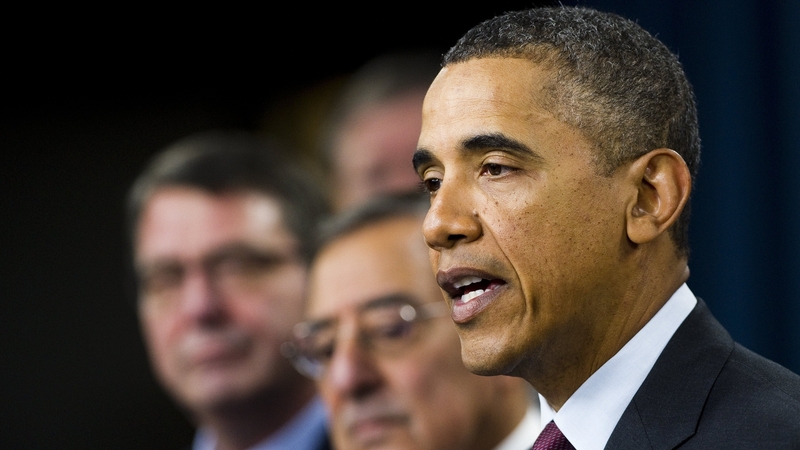
"So yes, our military will be leaner, but the world must know - the United States is going to maintain our military superiority with armed forces that are agile, flexible and ready for the full range of contingencies and threats," Mr Obama told reporters at a rare appearance at the Pentagon.
White House officials stressed that Mr Obama was deeply involved in the strategy review and sought to portray the president as taking a careful approach to defence spending having acted on the advice of leading commanders.
Saying the country was "turning the page on a decade of war," Mr Obama said the new strategy would increasingly focus on Asia, where commanders worry about China's growing military capabilities.
"We'll be strengthening our presence in the Asia Pacific, and budget reductions will not come at the expense of this critical region," he said.
Defence Secretary Leon Panetta, appearing with Mr Obama along with top officers, said the strategy envisages a "smaller and leaner" force that will expand the military's role in Asia while maintaining a strong presence in the Middle East.
According to the eight-page strategy document, the military will work with allies in the Middle East to ensure security in the Gulf and counter Iran's "destabilising policies."
However, counter-insurgency operations receive a lower priority under the plan, enabling the administration to scale back ground forces.
Mr Panetta said "with the end of US military commitments in Iraq, and the drawdown already under way in Afghanistan, the Army and Marine Corps will no longer need to be sized to support the large scale, long-term stability operations that dominated military priorities and force generation over the past decade."
The chairman of the House Armed Services Committee, Buck McKeon, hit out at the strategy and accused Obama of gutting defence.
"The President has packaged our retreat from the world in the guise of a new strategy to mask his divestment of our military and national defence," McKeon, a Republican, said in a statement.
The review reinforces what defence officials have already signalled -- that funds will flow to aircraft, ships, missile defence and high-tech weaponry while the US Army and Marine Corps will be downsized.
Washington's focus on Asia is fuelled by concerns over China's growing navy and arsenal of anti-ship missiles that could jeopardise US military power in the Pacific.
In keeping with plans for a smaller force, the strategy discards the doctrine that the military must be prepared to fight two wars at the same time, an idea long debated inside the Pentagon.
Instead, the US would be ready to fight one war while waging a holding action elsewhere to stave off a second threat.
The strategy review suggests reducing the atomic arsenal without saying how, amid calls from some lawmakers to reduce the number of nuclear-armed submarines.
The review also hints at scaling back the military's footprint in Europe but offered no details, saying "our posture in Europe must also evolve."
Britain's defence minister cautioned the US pivot to Asia should not neglect Russia, which he called an unpredictable force on the global stage.
"If the US is going to see its focus drawn increasingly to the Asia Pacific region, how does it secure the backyard?" said British Defence Secretary Philip Hammond during a visit to the US capital.
The new strategy comes ahead of the proposed defence budget for 2013 due to be released next month, which is expected to call for delays in some weapons programs, including the troubled F-35 fighter.
Despite talk of belt-tightening, the defence budget for 2012 came to $530bn, not counting the cost of the war in Afghanistan.
Obama said future military spending will still remain high and "larger than roughly the next 10 countries combined."
