


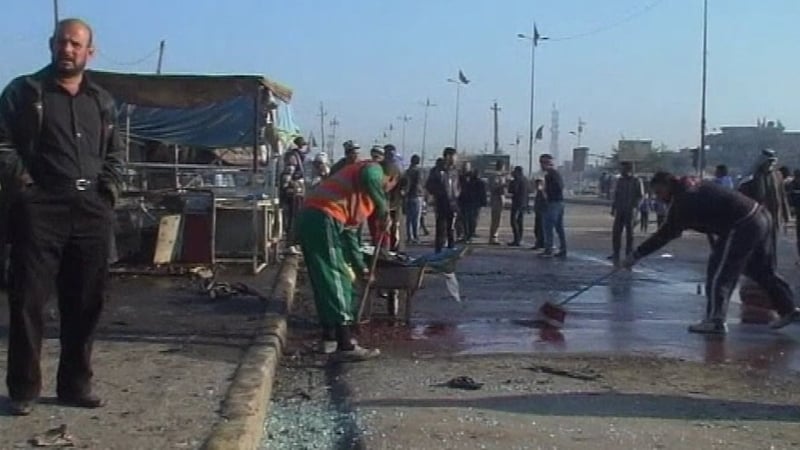
A wave of attacks against Shia pilgrims in Iraq has killed at least 68 people as the country grappled with a weeks-long political row that has stoked sectarian tensions.
The violence, which wounded more than 100 people, comes two weeks after a crisis erupted when the Shia-led authorities charged Sunni Vice President Tareq al-Hashemi with running a hit squad soon after US troops pulled out.
Washington condemned attacks it said were aimed at turning "back the clock" in Iraq while the European Union’s top diplomat said she deplored the”death and destruction caused by these acts of terrorism”.
Today’s attacks, which targeted only Shiites, were quickly condemned by Iraq's parliament speaker Osama al-Nujaifi, a Sunni, as well as by Iraq's Shia-majority neighbour Iran and UN special envoy Martin Kobler.
Nujaifi and Prime Minister Nuri al-Maliki held talks in Baghdad in the aftermath of the attacks, amid calls for a meeting of political leaders to resolve the festering stand-off.
The worst incident saw at least 45 people killed by a suicide attacker on the outskirts of the southern city of Nasiriyah as pilgrims were walking to the shrine city of Karbala for Arbaeen commemorations.
Arbaeen marks 40 days after the Ashura anniversary commemorating the killing of Imam Hussein, one of Shiite Islam's most revered figures, by the armies of the Caliph Yazid in 680 AD.
Five bombings also struck two Shiite neighbourhoods of northern Baghdad, killing 23 people and wounding dozens.
In Kadhimiyah, two car bombs exploded at around 9am (6am Irish time) at adjoining intersections, said interior and defence ministry officials.
The blasts killed 14 people and wounded 37 others, the defence official said, while the interior ministry source put the toll at 15 dead and 31 wounded.
In Sadr City, a booby-trapped motorcycle exploded at around 7am near a group of day labourers waiting to pick up work, killing seven and wounding 20, the interior ministry official said.
A short time later, twin roadside bombs detonated near the district's main hospital as victims were being ferried in, killing two more people and wounding 15, the official said.
The defence ministry official confirmed the toll.
Security forces cordoned off the scenes of the blasts, and largely refused to allow journalists to enter, sparking the ire of residents.
The death toll was the highest in Iraq since a spate of attacks on 15 August, most of which were claimed by Al-Qaeda, left 74 people dead.
The violence was the second major strike against Iraqis since a political crisis erupted last month.
On 22 December, 67 people were killed across the country.
Maliki has backed off from threats to fire ministers from the Sunni-backed Iraqiya bloc who have boycotted the cabinet, the latest move in an apparent toning down of the crisis.
The stand-off was sparked by a decision to issue an arrest warrant for Hashemi on terror charges.
Hashemi, who is holed up in the northern autonomous Kurdish region, denies the charges, and his Iraqiya party has boycotted the cabinet and stayed away when parliament reopened on Tuesday.
Sunni Deputy Prime Minister Saleh al-Mutlak, also a member of Iraqiya, has decried Maliki as a dictator "worse than Saddam Hussein," and the premier has called for him to be sacked.
UN envoy Kobler, in a statement yesterday, "expressed concern about the current political stalemate in the country," and US Vice President Joe Biden has urged dialogue among top Iraqi leaders.
On 18 December, US forces completed their withdrawal from Iraq, where there were once nearly 170,000 American troops on 505 bases.
