


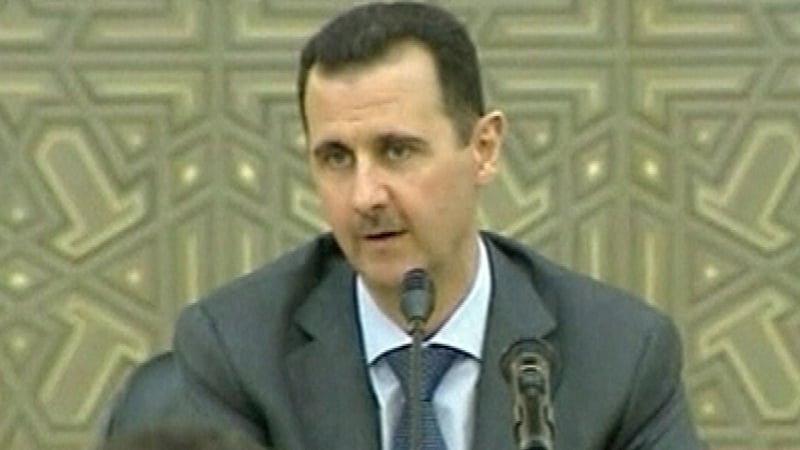
Syrian President Bashar al-Assad has dismissed calls on him from the international community to step down.
In an interview on Syrian state television, Mr Assad said the unrest sweeping the country had become more militant in recent weeks but he was confident it could be controlled.
He also said that any military action against his country would backfire on those who carried it out.
‘While withholding comment, we tell them that their words are worthless,’ Mr Assad said in the interview.
‘Such remarks should not be made about a president who was chosen by the Syrian people and who was not put in office by the West, a president who was not made in the United States.
'We have started to register some success on the security front and can say that the situation is now more reassuring,' he said.
'A political solution can not be put in place if security is not preserved.'
He said local elections would be held in December, to be followed by parliamentary polls in February after a new law on political parties comes into effect this week.
He also ruled out bowing to Western demands.
‘When they speak of reforms, Western colonialist countries mean that we must give them everything they want, that we abandon resistance, that we abandon our rights ... They shouldn't even dream of it ... We will not bow.’
Mr Assad's television appearance was his first since 20 June, and only his fourth since the start of pro-democracy demonstrations in mid-March, and came after several world leaders urged him to quit.
US President Barack Obama called on Thursday for Assad to stand down, a demand quickly echoed by the leaders of Britain, France and Germany and Spain.
A UN mission began its first full day in Damascus on Sunday, arriving yesterday evening to assess humanitarian needs in the wake of the crackdown which have left more than 2,000 people dead.
The team, led by the head of the Geneva bureau of the UN Office for the Co-ordination of Humanitarian Affairs, Rashid Khalikov, began its mission and will stay until 25 August.
The visit comes after 34 anti-regime protesters were killed on Friday by security forces as anti-regime rallies gripped the country after weekly Muslim prayers, according to the Britain-based Syrian Observatory for Human Rights.
It said about half of the deaths were in Homs province, where tanks rumbled into the central city of the same name on Saturday.
The latest anti-government rallies on Friday and Saturday put to the test assurances given by Assad to UN Secretary-General Ban Ki-moon on Thursday that his security forces had ended operations against civilians.
The UN High Commissioner for Human Rights, Navi Pillay, said Friday that there was now ‘evidence’ of ‘crimes against humanity’ committed in Syria, calling on the Security Council to seize the international justice.
In Brussels, diplomats said on Sunday that EU governments have ‘as good as’ wrapped up a key deal to ban imports of Syria's crude oil.
New legislation drafted over the weekend includes ‘restrictive measures in the area of oil, notably an embargo on the import of Syrian crude oil,’ according to an agreement reached by European Union ambassadors.
‘It's not a done deal yet, but it's as good as,’ a well-placed EU source told AFP. ‘The 27 states tasked the EU with preparing the ban, and on Tuesday we will put the formal legislation on the table,’ he said.
