

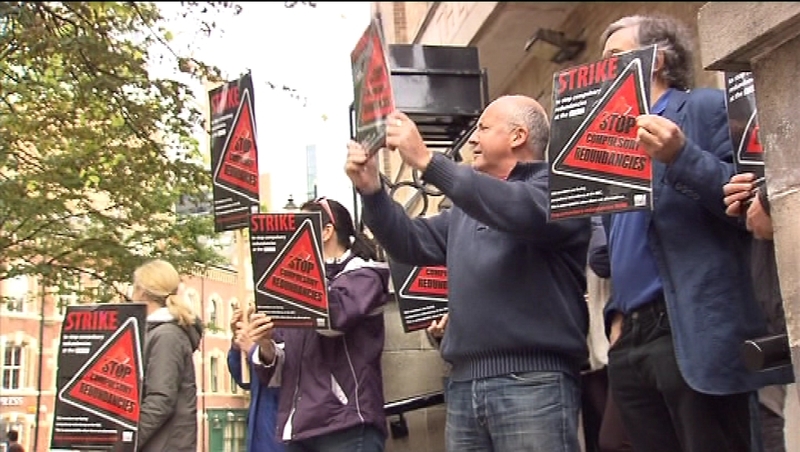
Radio and television programmes on the BBC have been disrupted today by a one-day strike involving journalists at the organisation.
BBC radio's flagship Today programme was disrupted as the strike hit the corporation's output.
The Radio 4 programme was broadcast an hour later, at 7am, because of industrial action.
Members of the National Union of Journalists are picketing the BBC studios, in a dispute over compulsory redundancies.
Picket lines have been mounted since midnight outside studios and offices across the UK.
British NUJ general secretary Michelle Stanistreet accused the BBC of 'provoking' a strike over a handful of job losses, but the corporation said there were 100 posts for which compulsory redundancy was 'regrettably unavoidable'.
Union members voted in favour of strikes in protest at compulsory redundancies, but Ms Stanistreet said the union offered a number of solutions to the dispute, adding that an offer from the conciliation service Acas for peace talks had not been taken up by management.
'There are so many people who want to leave the BBC that this could be resolved through negotiations. The NUJ has a long-standing policy of no compulsory redundancies, and it is clear that our members at the BBC are fully prepared to stand up for their colleagues under threat.
'Jobs are being saved and created at management level, but journalists are losing theirs. It is hard to avoid the conclusion that BBC management wants thousands of its journalists to go on strike rather than settle the dispute.
'If that is the case, it confirms our members' worst fears about the management strategy of introducing compulsory redundancy at the BBC.'
A BBC spokesman said: 'We are disappointed that the NUJ is intending to strike and apologise to our audience for any disruption to services this may cause.
'Industrial action will not alter the fact that the BBC is faced with a number of potential compulsory redundancies, following significant cuts to the central Government grants that support the World Service and BBC Monitoring.
'We will continue with our efforts to reduce the need for compulsory redundancies. However, the number of posts that we are having to close means that unfortunately it is likely to be impossible for us to avoid some compulsory redundancies.
'We have had to reduce the number of posts in World Service and BBC Monitoring by 387, following significant cuts to the central Government grants that support these services. In a significant majority of cases we have been able to reach this through voluntary redundancy or redeployment.
'However, there are in excess of 100 BBC posts for which compulsory redundancy is regrettably unavoidable, and this is our focus, regardless of whether staff are members of unions.'
