


The International Criminal Court has issued arrest warrants for Libya's Muammar Gaddafi, his son Saif al-Islam and the country's spy chief, Abdullah al-Senussi, on charges of crimes against humanity.
ICC prosecutor Luis Moreno-Ocampo had asked the court to issue arrest warrants for the 'pre-determined' killing of protesters in Libya following after the UN Security Council referred the issue to the court.
Gaddafi has 'absolute, ultimate and unquestioned control' over Libya's state apparatus and its security forces, ICC presiding judge Sanji Mmasenono Monageng said this afternoon.
She added that both Gaddafi and Saif al-Islam 'conceived and orchestrated a plan to deter and quell by all means the civilian demonstrations' against the regime and that al-Senussi used his position of command to have attacks carried out.
Libyan rebels welcomed the ICC's decision with a spokesperson saying they felt vindicated by the response.
Some anti-Gaddafi forces in Benghazi and Misrata took to the streets to celebrate, with rebels there seen shooting into the air in reaction to the news.
Gaddafi, who has been in power since a military coup in 1969, is under pressure to relinquish his leadership from rebels who rose up against his rule and from a NATO bombing campaign.
But more than three months into the NATO campaign, fissures are showing within the Western alliance and it is feared that the ICC warrant could also trigger greater violence in Libya as Gaddafi tries to cling to power.
In its ruling, the ICC said there was 'reasonable grounds' to believe that Gaddafi, his son and al-Senussi committed crimes within the jurisdiction of the court and that a warrant for their arrest should be issued.
This is the second warrant of arrest issued by the ICC against a sitting head of state - following two on Sudanese President Omar al-Bashir in 2009 and 2010 for crimes against humanity, war crimes and genocide in Darfur.
NATO operation
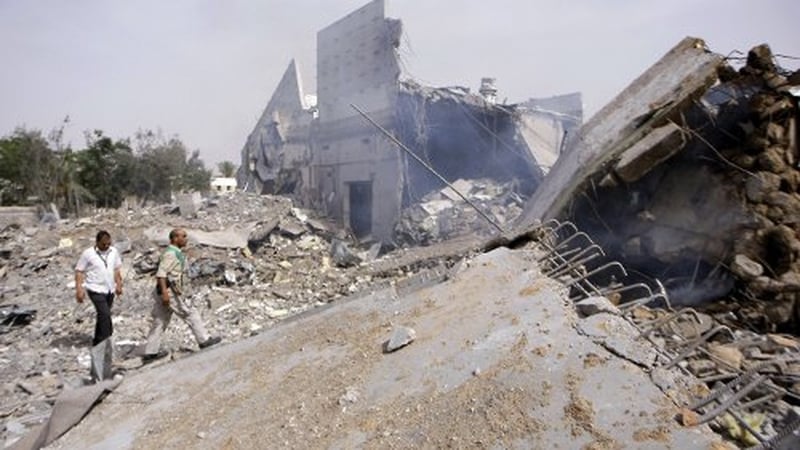
Three months after French jets flew their first missions over eastern Libya, NATO is still pounding targets across the country in what has become a war fought on multiple fronts, but with few clear victories for either side.
NATO is hitting around 50 targets a day, mostly in or around Tripoli and Misrata in the west, Brega in the east, and the Nafusa Mountains to the south of the capital.
But the alliance's early success in pushing Gaddafi's forces outside striking distance of Benghazi and Misrata have not decisively tipped the balance in favour of the rebels.
A stalemate has taken hold, with rebel fighters told to hold their positions around Misrata and Ajdabiya, near Brega, despite the occasional rocket or mortar attack causing casualties.
'It was all quiet today', said Musa Maghrebi, a rebel based at Ajdabiya, late yesterday. 'The forces are staying in position.'
Only in the Nafusa Mountains does the rebel army of ill-equipped irregulars and defectors appear to be making any sustained progress toward Tripoli.
Despite NATO's limited success in neutralising Gaddafi's forces, most Libyans in the east remain strongly in favour of the alliance's mission.
