


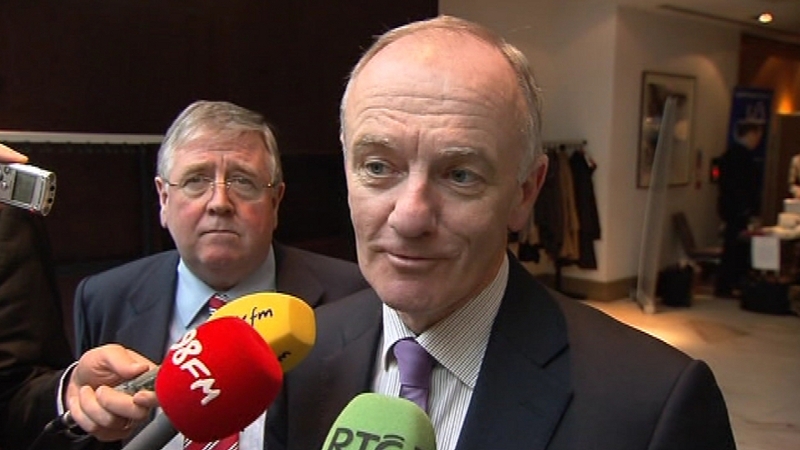
The head of the implementation body for the Croke Park Agreement has said they will insist on independent verification of savings which Government departments claim to have achieved.
Addressing the annual conference of the Association of Higher Civil and Public Servants, PJ Fitzpatrick said such verification would be critical to public confidence in the agreement.
He said the first review by the implementation body on progress to date in implementing the agreement on public sector reform should be complete and delivered to Government by the end of this month.
However, he said it would be a matter for Government to decide when to make it public.
He said that it would be scrutinised as never before by the Government, the IMF, the EU, the media and the general public.
Mr Fitzpatrick said he did not know whether staff reduction targets could be met solely through natural wastage, or whether further redundancy or retirement schemes would have to be offered.
However, he said such decisions would be a matter for Government.
Elsewhere, the AHCPS has said it will resist moves to open up recruitment for top jobs to candidates from outside the Civil Service, if civil servants are prevented from applying to these positions.
AHCPS General Secretary Dave Thomas said that to do so would be to actively discriminate against what he called ‘ambitious and hardworking public servants who do vital work on behalf of the State.’
Mr Thomas defended the Croke Park Agreement, saying that implementation in the Civil Service was ahead of target in reducing staff.
By the end of the first quarter of 2011, the numbers in the Civil Service had been reduced to 36,079 - already ahead of the 36,200 target for the end of the year.
He said that overall numbers had now fallen by 16,000 in the last two years, creating a saving of €900m.
He said the association was prepared to work with the new Government on achieving further efficiencies and savings, but warned he did not believe there was scope for further pay reductions given the reductions in salary pensions and entitlements endured by members in recent years.
Planned reform of JLC system
The Minister for Enterprise, Jobs and Innovation has said he plans to introduce far-reaching reforms of the Joint Labour Committee system of setting sectoral wages.
Richard Bruton has said the current system is no longer fit for purpose.
He said he anticipated the changes would be introduced before the end of the year.
The Joint Labour Committee system has been strongly criticised by employers who say they set unaffordable, but legally-binding, wage rates and employment conditions.
However, unions argue that the system provides protections for vulnerable workers in low paid sectors, including contract cleaning, catering and hairdressing.
An independent review of the system was recently completed by Labour Court chairman Kevin Duffy and UCD Economist Dr Frank Walsh.
Speaking in Athlone, Mr Bruton said that the system required a radical overhaul to make it fairer and more responsive to changing economic circumstances and labour market conditions.
He intends to bring the Duffy/Walsh report to Government this week and will then set up an action plan to make the system more responsive and fit for purpose in the context of a modern economy.
