


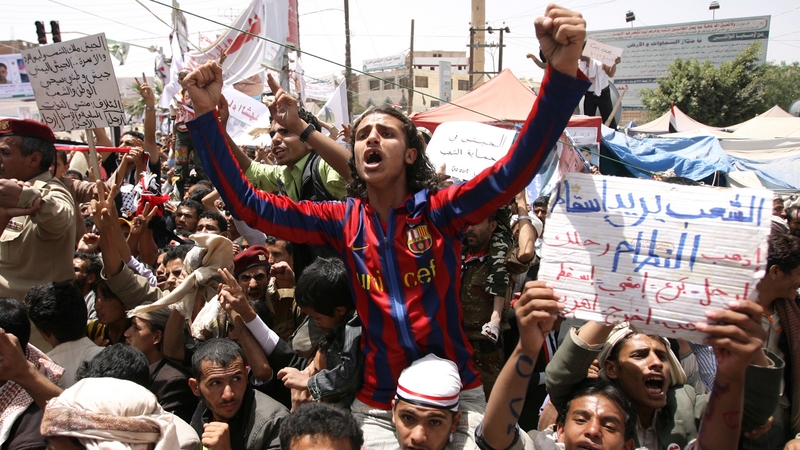
Police and armed men in civilian clothes opened fire on anti-government demonstrators in the Yemeni cities of Taiz and Hudaida as a drive to oust President Ali Abdullah Saleh gathered pace.
The attempt to suppress mounting protests inspired by uprisings in Egypt and Tunisia came amid signs that the US is seeking an end to Saleh's 32-year rule, long seen as a rampart against Yemen-based al Qaeda in the Arabian Peninsula.
In Taiz, south of the capital Sanaa, police shot at protesters trying to storm the provincial government building, killing at least 15 and wounding 30, hospital doctors said.
The television showed a row of men, apparent tear gas victims, lying motionless and being tended by medics on the carpeted floor of a makeshift hospital in Taiz.
In the Red Sea port of Hudaida, police and armed men in civilian clothes attacked a march towards a presidential palace.
Three people were hit by bullets, around 30 were stabbed with knifes, and 270 were hurt from inhaling tear gas, doctors said.
Local doctors have said at least six demonstrators were shot dead and several wounded during evening rallies, and that the toll was likely to rise.
Yemen's opposition coalition appealed in a statement to the UN, human rights groups and other international bodies 'to intervene quickly to stop President Saleh and his entourage from shedding more blood.'
As opposition forces stepped up their actions, Saleh again appeared defiant.
'Just as you gave us your confidence, we will respond to that. We will be steadfast like the mountains,' he told hundreds of tribesman who chanted their rejection of concessions. 'We will stay loyal to you, just as you have been loyal to constitutional legitimacy.'
Saleh has said he will not run for re-election in 2013 and could step down following new presidential and parliamentary elections within a year. Yesterday, he called on the opposition to end protests to help ease talks.
An opposition proposal would see the army and security forces restructured by a vice-president acting as temporary president ahead of political reforms and elections.
The ruling party says Saleh should remain in office to oversee changes.
Gulf Arab states have invited Yemeni government and opposition representatives to talks in Saudi Arabia, Kuwaiti Foreign Minister Sheikh Mohammad al-Salem al-Sabah said, in a bid to end the crisis, but a date is yet to be set.
Gulf Arab countries have taken a wait-and-see approach, resisting efforts by Sanaa to entice them into mediation.
UAE Foreign Minister Sheikh Abdullah bin Zayed al-Nahayan has said that 'there are some ideas that will be addressed to the Yemeni sides. I don't want to use the word mediation because now we are in a stage of feeling the pulse.'
There were signs of mounting US pressure on Saleh to go.
The New York Times said Washington had 'quietly shifted positions' and 'concluded that he is unlikely to bring about the required reforms and must be eased out of office.'
