


Leaders of the United States, France, Britain and Germany have held a conference call to discuss the situation in Libya and plans for a conference in London tomorrow.
Presidents Barack Obama and Nicolas Sarkozy, Prime Minister David Cameron and Chancellor Angela Merkel considered a Franco-British proposal to help secure a political transition in Libya.
Mr Cameron called on his fellow leaders to ‘broaden the coalition’ of nations committed to enforcing United Nations resolutions.
Foreign ministers from coalition countries taking part in the United Nations-mandated operation in Libya will meet in London to discuss political strategies to help bring an end to Colonel Gaddafi's rule.
Earlier, France and Britain urged supporters of Gaddafi to abandon him before its too late.
Britain's Foreign Secretary William Hague said anybody against him should join a process for political transition.
Rebels target Gaddafi's home town
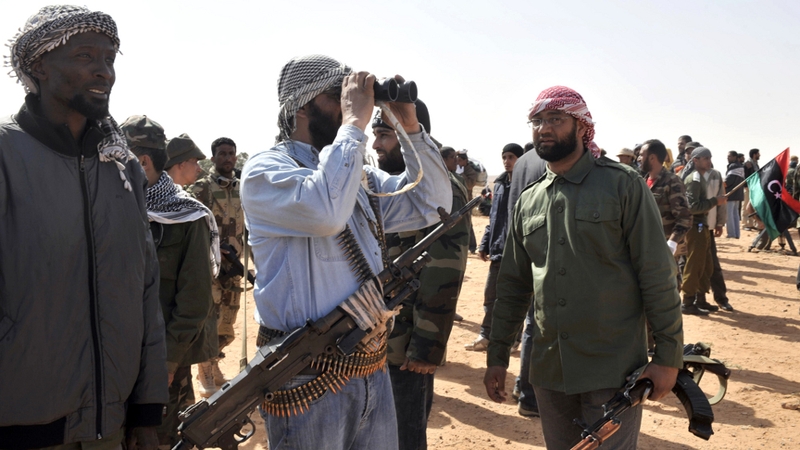
Libyan rebels are advancing west along the main coastal road towards the birthplace of leader Muammar Gaddafi.
Russia has criticised the Western-led air strikes, saying these amounted to taking sides in a civil war and breached the terms of a United Nations Security Council resolution.
Qatar has become the first Arab country to recognise the rebels - now in the sixth week of their uprising against Gaddafi's 41-year rule - as the sole legitimate representative of the Libyan people.
Al Jazeera said the rebels have seized the town of Nawfaliyah from forces loyal to Gaddafi, extending their advance westwards towards his home town of Sirte.
Emboldened by the Western-led air strikes against Gaddafi's forces, the rebels have reversed earlier losses and regained control of all the main oil terminals in the east of the country.
'We want to go to Sirte today. I don't know if it will happen,' said rebel fighter Marjai Agouri as he waited with 100 others outside Bin Jawad.
They have three multiple rocket launchers, six anti-aircraft guns at their disposal, as well as around a dozen pick-up trucks with machineguns mounted on them.
A Reuters correspondent who is about 15km west of Bin Jawad on the road to Nawfaliyah heard a sustained bombardment on the road ahead.
Western-led air strikes began on 19 March, two days after the UN Security Council authorised 'all necessary measures' to protect civilians from Gaddafi's forces.
But since the outset, the mission has faced questions from critics about its scope and aims, including the extent to which it will actively back the rebel side and whether it might target Gaddafi himself.
Russian criticism of operation
Russia, which abstained in the UN vote, said Western attacks on Gaddafi's forces amounted to taking sides with the rebels.
'We consider that intervention by the coalition in what is essentially an internal civil war is not sanctioned by the UN Security Council resolution,' said Foreign Minister Sergei Lavrov.
Contradicting an earlier rebel claim to have captured Sirte, Reuters correspondent Michael Georgy reported from the city that the situation was normal.
As the rebels pressed forward in the east, they reported attacks by Gaddafi's forces in the west.
One rebel spokesman told Al Jazeera that loyalist forces bombarded the rebel-held city of Misrata this morning and snipers are on rooftops.
Another told Al Arabiya television that eight people have been killed and more than 24 injured in clashes.
A rebel spokesman in the western town of Zintan said forces loyal to Gaddafi bombarded the town with rockets early this morning.
Libya's state news agency Jana said Western forces bombed the southern city of Sabha at dawn, leading to several casualties.
NATO enforces no-fly zone
NATO has taken over enforcing a no-fly zone over Libya, the general in charge of operations told reporters at the Allied Joint Force Command in Naples in southern Italy.
'Yesterday NATO aircraft flew the first no-fly zone enforcement over Libya,' said General Charles Bouchard.
NATO agreed to take full command of military operations in Libya after a week of heated negotiations.
The US, which led the initial phase, had sought to scale back its role in another Muslim country after the wars in Iraq and Afghanistan.
US Defence Secretary Robert Gates said Western air strikes had 'eliminated' Gaddafi's ability to move his heavy weapons.
Mr Gates also raised the possibility that Gaddafi's government could splinter and said the international conference in London tomorrow would discuss political strategies to help bring an end to Gaddafi's rule.
Libya accused NATO of 'terrorising' and killing its people as part of a global plot to humiliate and weaken the North African country.
