


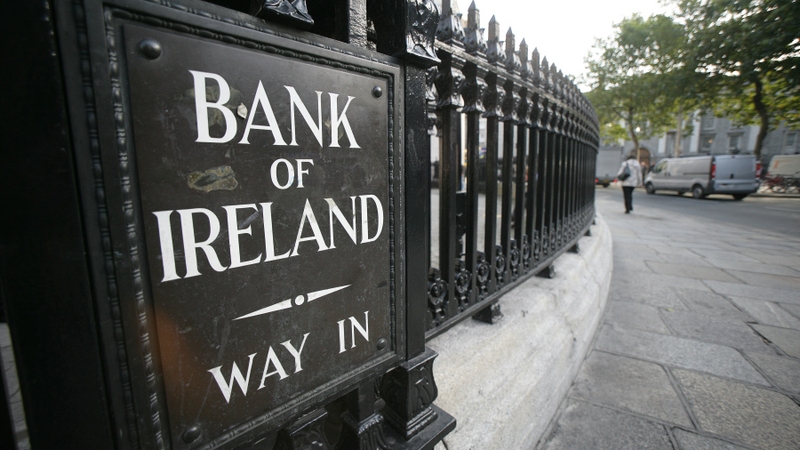
New charges being introduced by Bank of Ireland have been criticised as unfair and ill-considered.
From Monday most of the bank’s current account holders will face new requirements to qualify for free banking.
According to FLAC, the Free Legal Advice Centres, the charges will hit low-income customers who in many cases will be unable to avoid them.
Bank of Ireland's new charges will affect three-quarters of its 1.2 million current account holders.
The only ones not affected will be customers with Golden Years or Student accounts.
From Monday to qualify for free banking, customers will have to lodge €3,000 per quarter into their current account and make at least nine debit payments per quarter using Banking 365 or keep a minimum of €3,000 in their account.
Otherwise they will face charges - either a flat fee of 90 transactions per quarter for €11.40, or a pay as you go charge of 28c per transaction - which works out more expensive - 90 transactions costing €25.20.
FLAC, the Free Legal Advice Centres has severely criticised the new charges - someone on social welfare for example who has a quarterly income of under €2,500 would not be able to lodge enough and would have to pay the charges - which it says are unfair and will lead to vulnerable people being excluded from high street banking.
AIB says it has no current plans to change charges - but is keeping them under review.
BoI says deposits have stabilised
Bank of Ireland says its deposits have stabilised in recent months after 'significant outflows' of money in the three months leading up to the announcement of Ireland's EU/IMF bail-out package.
In a trading update issued this afternoon, the bank also said loan losses - excluding those transferred to NAMA - were lower compared with 2009. During the year, the bank also transferred loans with an original value of €9.4bn to NAMA, receiving €5.2bn in return.
It still has loans worth around €5bn yet to be transferred to NAMA.
The bank said it expected its profits for last year - excluding losses - to be 25% to 30% lower than €1.4 billion recorded in the previous year.
Bank of Ireland said there were 'significant' outflows of deposits from the bank in the three months leading up to the announcement of Ireland's EU/IMF bail-out package, but retail customer deposits had remained stable. It added that overall, deposits had stabilised since late November. The bank said loans to customers continued to fall last year.
Bank of Ireland also said it would pay €214.5m to the National Pensions Reserve Fund next week on preference shares held by the State. Such payments had been prohibited for a year by the European Commission. Last year, the dividend was paid to the State in the form of ordinary shares.
The bank also said it lost around €100m on subordinated bonds in an unnamed Irish financial institution, which exchanged the bonds for cash. The institution involved is understood to be AIB.
Since the end of November, Bank of Ireland has raised €750m towards meeting targets set by the Central Bank. The Central Bank is due to carry out updated assessments of the financial position of the banks by the end of March.
