

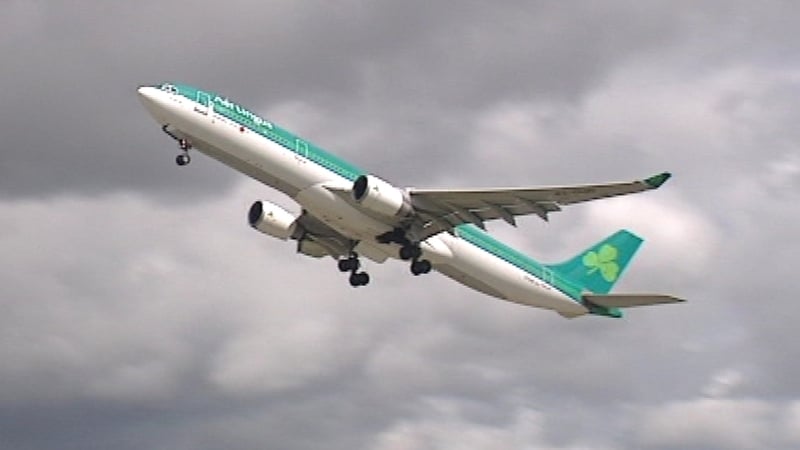
Cabin crew at Aer Lingus have called off a proposed work-to-rule to consider a Labour Relations Commission recommendation on changes to work practices.
The trade union IMPACT said it had suspended the industrial action to consider an arbitration finding issued tonight by LRC Chief Executive Kieran Mulvey.
Cabin crew were due to take the action in protest at the introduction of new rosters with longer working hours and fewer breaks.
Management at Aer Lingus have maintained that cabin crew agreed to the measure under a €97m cost-saving programme.
In a statement, the union said: 'The detailed findings, which run to 39 pages and reflect the complex technical issues under consideration, deserves and demands close reading and analysis.
'Time will also be required for cabin crew staff to read, digest and discuss the document.
'It would be unreasonable to press ahead with industrial action while this happens and IMPACT is, therefore, suspending its planned work-to-rule to allow detailed consideration of the arbitration finding.'
A spokesperson for the airline said it would be considering Mr Mulvey's arbitration document in detail.
Aer Lingus earlier reported a loss of €20.8m for the first six months of the year.
This compares with losses of €81.7m the same time last year, which is a 74% improvement.
On RTÉ Radio's Morning Ireland, Aer Lingus Chief Executive Christoph Mueller said he hoped the airline would return to profit next year.
The airline managed to make a profit of €18.8m in the second quarter of the year, due to lower operating costs, savings in fuel costs and savings in staff costs due to the initial implementation of its 'Greenfield' programme.
The airline said that, despite challenges, it remains confident of at least breaking even in 2010.
Aer Lingus has not had a profitable year since 2007.
It said it carried 11% fewer passengers in the six-month period, but with the benefit of cost cuts becoming apparent, each journey was more profitable than they were a year ago.
Average yield per passenger increased by 8% while revenue per passenger also increased by 8%.
Capacity was reduced by 15.6% in the six-month period.
