


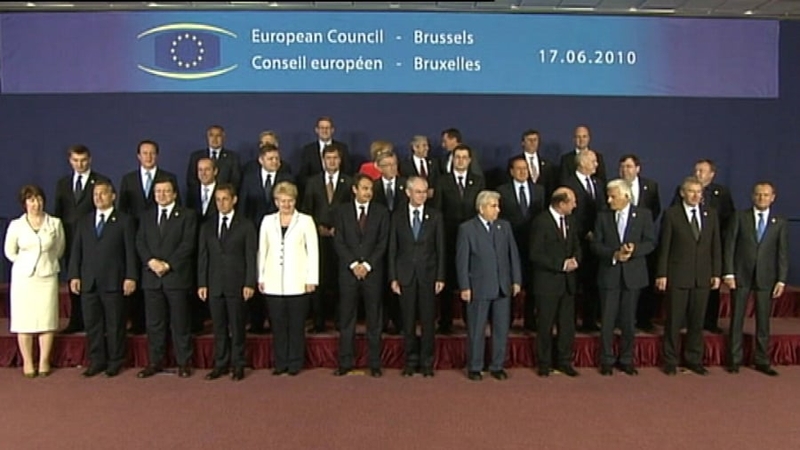
It is a truism of European politics that the EU motor works best when the German and French cylinders are firing in harmony.
But since the Greek debt crisis took off, the engine has been sputtering due to growing discord between Paris and Berlin.
These divisions will shape the way in which Europe will climb out of the crisis and develop the architecture to prevent a future recurrence.
At the heart of the divisions are two opposing views on how the European economy should be run.
German Chancellor Angela Merkel is guided by prudence and fiscal restraint.
Her image is reflected in the success of the German economy, which has become one of the most competitive export-driven models in the world.
It does this by keeping wages, spending and inflation in check.

That means Germany’s current account surplus is huge thanks to its exporting prowess, but other eurozone countries suffer because Germans themselves are not spending, therefore they are not buying the goods other EU countries produce.
The French want Germany to boost consumer spending at home to give everyone else a fighting chance, but German officials have bridled at such suggestions.
The other point of difference has been the question of how eurozone countries should be forced to follow the rules so that a Greek-style crisis cannot reoccur.
President Nicolas Sarkozy favours 'economic government', a much tighter and more invasive co-ordination of how capitals manage their budgets.
He foresaw a secretariat of eurozone members directing new austerity rules. 'That would be a way for France to push the European Central Bank around and to line up other countries against Germany,' observed one senior EU diplomat.
By last week, Paris and Berlin were briefing against each others' ideas with unprecedented frostiness.
At a kiss-and-make-up meeting between Ms Merkel and Mr Sarkozy in Berlin on Monday night, President Sarkozy agreed to drop his secretariat idea.
Instead the attention has now switched to other ways of keeping eurozone countries in line.
Most notable are the suspension of voting rights, and the withdrawal of EU subsidies from offenders.
The latter idea is already causing some angst among eastern European countries, which have a disproportionately higher reliance on social and cohesion funds.
But suspending voting rights at EU ministerial meetings is even more fraught. Such a move would require a change to the existing (Lisbon) treaty.
Angela Merkel has been the most vociferous on this idea but other capitals are shuddering in doubt.
'Opening up the treaty would be a Pandora’s box,' said an EU diplomat. As European Commission President Jose Manuel Barroso has already observed, if Germany wanted a treaty change to suspend voting rights, the UK, under David Cameron, would march in and demand other changes.

The Irish Government knows too, to its cost, the difficulty of pushing through EU treaties.
For the moment the suspension of voting rights appears a non-runner, although Berlin has not dropped the idea just yet.
Angela Merkel is still pushing the notion that any toughening of economic co-ordination will apply to all 27 member states, not just the 16 eurozone members.
This is because she could marshal other like-minded governments outside the single currency (UK, Sweden, Poland) who are equally antagonistic to having to bail-out profligate Club Med countries.
Also, if all 27 economies are following the same principles of sensible spending and competitiveness, then theoretically everyone benefits.
At this week's one-day summit in Brussels, member states are also likely to agree, in principle at least, the idea of governments presenting their budget plans to the European Commission (and other member states) before they are presented to national parliaments.
This was the idea, presented by the European Commission on 12 May, which got Fine Gael so flustered, but it now appears to be gaining acceptance.
Governments would, in the first half of the year, submit their broad budgetary plans to Brussels for the Commission to check that their spending plans are sustainable within the Maastricht guidelines of deficits remaining at or close to 3% of GDP.
Member states already do this, but in reverse order (budgets are presented to the Commission for approval, but only after they have been presented to parliaments).
In Ireland’s case, officials point out that Brian Lenihan has already committed to ensuring that the next budgets comply with the general austerity measures outlined and approved by Brussels.
These measures will not be fully agreed at the summit; the technical detail will be worked out by finance ministers over the coming months, but the scheme should be in place by 2011.
Elsewhere, the summit will test the water for a bank levy which is the subject of much discussion between Europe and America.
Some countries want a levy to go into a fund to cushion the banking sector against any future shocks, others want the money to go into general tax revenues.
The government believes that Irish banks are already seriously starved of capital, since they are being propped up by taxpayers, so another levy would be a step too far.
Tony Connelly, Europe Correspondent
