


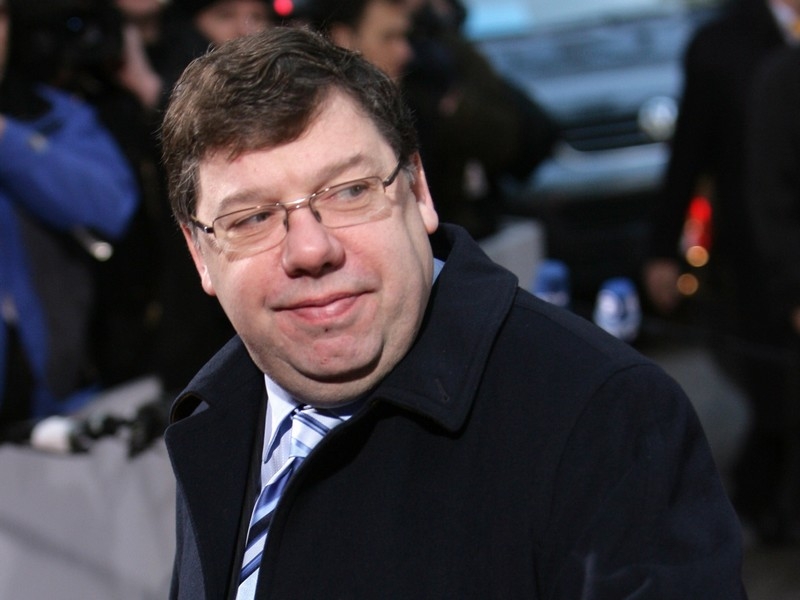
Taoiseach Brian Cowen has said he will hold a second referendum on the Lisbon Treaty after receiving assurances at an EU summit in Brussels that it would not threaten Irish domestic policy.
Mr Cowen said: 'On the basis of today's agreement ... I am prepared to go back to the Irish people next year.'
The Taoiseach added that the Government would only decide on a date for a second referendum when certain conditions were finalised to their satisfaction.
EU leaders earlier agreed on assurances to pave the way for a second referendum.
The plans, to be made public later today, would see the EU agree to allow Ireland to retain a commissioner post in exchange for putting the treaty to the people again.
 RTÉ Europe Editor Sean Whelan speaks to European Commission President José Manuel Barroso
Watch the full interview
According to a draft statement, the leaders will say that the EU 'agrees that provided the Lisbon Treaty enters into force, a decision will be taken ... to the effect that the commission should continue to include one national of each member state.'
They will also note other concerns of the Irish people, including worries about interference in neutrality, abortion laws and taxation.
'In light of the above commitments ... the Irish government is committed to seeking ratification of the Lisbon Treaty by the end of the term of the current commission,' their draft statement said.
The commission's mandate comes up at the end of October 2009, which the leaders hope will allow the treaty to enter into force late next year.
The text of the agreement will be worked on during the Czech presidency, and with the troika of the French, Czech and Swedish governments.
Mr Cowen said other European members had given a satisfactory response to concerns expressed by the Irish public.
He said the retention of a Commissioner was a hard fight and a hugely significant concession.
The Taoiseach also said there would be lots of detailed work in the months ahead and that he would be consulting with opposition leaders on his return.
He said the issue is of huge important to Ireland and was above party politics and admitted that if the treaty is to be ratified the campaign will have to be different to last time.
Poland's president has promised to allow the ratification of the Lisbon Treaty in his country if a Yes vote is passed in Ireland.
President Lech Kaczynski said: 'If Ireland says Yes, the treaty will be signed.'
Poland and the Czech Republic are the only other two countries who have not ratified the treaty yet.
Workers' rights
Minister for Foreign Affairs Micheál Martin earlier repeated his view that if the Government was satisfied with the legal guarantees it received, it would be prepared to put the treaty back to the electorate.
When asked why the subject of workers' rights had not been raised by the Government before as a reason for the No vote, Mr Martin insisted that this had come under the general heading of social and ethical issues.
However, he added that the EU troika, which comprises the previous, current and future presidencies, were interested in 'pulling social partnership together' at an EU level in relation to the Laval judgement.
That judgment at the European Court of Justice enshrined the right of a company to employ workers from another member state at a lower rate of pay than the host state.
The EU trade unions largely regarded the Laval ruling as an erosion of workers' rights.
Mr Martin said that competitiveness and employees' rights did surface in the research the Government had carried out and they were issues in which the French and the Swedes were interested in.
Jack O'Connor, General President of SIPTU, said that he welcomed the belated recognition that action to protect people's rights at work is central to any prospect of endorsement of the Lisbon Treaty in Ireland.
He said that it is clear from the results of the Government's own survey that concern regarding people's rights at work was identified as the top priority above other issues.
Meanwhile, the founder of the anti-Lisbon treaty group Libertas, Declan Ganley, has said he is considering running in the European elections next year.
He was speaking on RTÉ Morning Ireland in the wake of the announcement yesterday that Libertas will run candidates in every EU member state.
