


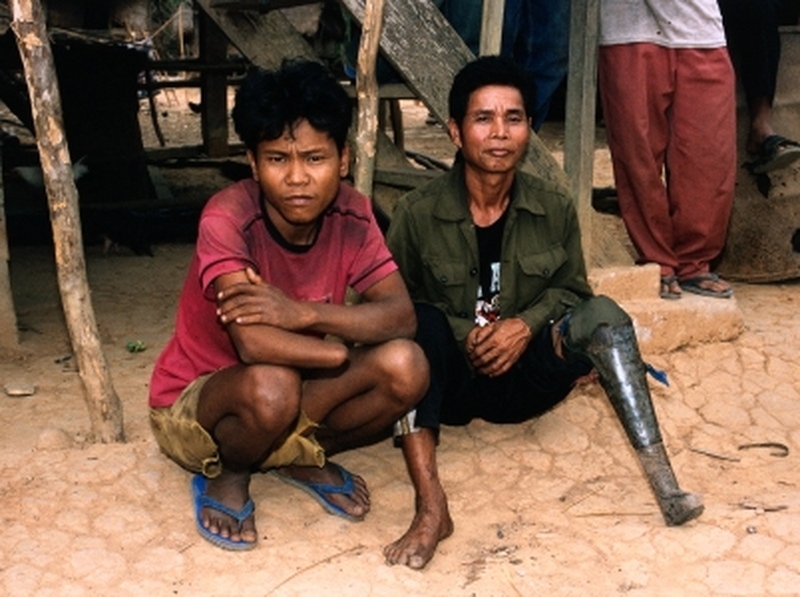
Like landmines, cluster munitions can kill and maim for years after their initial use, but unlike mines they are still neither banned nor regulated by an international treaty.
The conference in Dublin saw renewed momentum for a global ban, as more than 100 nations - but not the world's top users and stockpilers - gathered to finalise an anti-cluster munitions treaty.
The so-called Oslo process began three years ago and is modelled on the campaign against land mines, which won the Nobel Peace Prize in 1997 and led to a full ban in 1999 Ottawa Treaty.
Watch RTÉ Europe Editor Sean Whelan's report on the effect of cluster bombs in Serbia.
Watch RTÉ Foreign Editor Margaret Ward's report on the consequences of cluster munitions in Laos
 What they are
A category of ordnance - usually delivered via a bomb, shell or missile - which spreads small 'bomblets' over a wide area. In their various forms they can be used to kill enemy troops, destroy dispersed weapons systems and pit runways with craters.
The first major use of cluster bombs was during World War II, when they were widely used by both sides.
In recent years, the weapons have notably been used by Israel, during its brief war with the Lebanese group Hezbollah in 2006, and by the US in Iraq and Afghanistan.
 Why they are controversial
Like most bombs and shells, cluster munitions make no distinction between civilians and soldiers within their range, which can be over several hundred metres.
However groups opposed to cluster bombs say that between five and 40% of the bomblets fail to explode on impact, and can remain hidden for years after a conflict has ended.
In such cases, they have the same effect as mines, making farmland unusable and causing long-term danger for civilians.
Furthermore, many bomblets are brightly coloured, attracting children and exploding when they are picked up.
Civilians are still being killed by both landmines and cluster munitions used during the Vietnam War, which ended in 1975, as well as in those from more recent conflicts in the Middle East, Africa, the former Yugoslavia, central Asia and other regions.
 Casualties
According to the UNDP, more than 13,000 people are known to have been killed by cluster bombs around the world since 1965. The majority of those killed were in Laos, Vietnam, Afghanistan, Iraq and Lebanon.
However, the true figure is believed to be much higher. A large majority of victims were civilians, and around a quarter of those were children.
During the same period the weapons have been used in warfare by 18 countries or armed groups. 77 nations continue to hold them in their arsenals.
 Proposed ban
The draft convention obliges that signatories never:
1: Use cluster munitions;
2: Develop, produce, otherwise acquire, stockpile, retain or transfer to anyone, directly or indirectly, cluster munitions;
3: Assist, encourage or induce anyone to engage in any activity prohibited to a state party under this convention.
Signatories would have six years to destroy their stockpiles.
