


Tony Connelly, Europe Correspondent, looks at how a rubbish problem in Naples has become a key issue in this weekend's Italian elections.
What is it about Italy that can drag the visitor through so many extremes of seduction and exasperation in such a short period of time? Or, as the Italian writer Beppe Severgnini put it: have you fuming and then purring in the space of 100m, or ten minutes?
It is a question that is taking on more of a political edge as Italy faces into its umpteenth general election since the war.
Italy is a country blessed with incredible visual and gastronomic wealth, where a myriad luxury brands and arguably the richest art and archaeological culture in the world conspire with the best in food and wine to create the inimitable 'dolce vita'.
Yet it is almost ungovernable, its economic indicators are now among the worst in Europe, and its national flag carrier, Alitalia is on the verge of bankruptcy.
One day in Naples confirms that what might have been a brow-furrowing conundrum is a worrying reality.
Driving east and then north west out of the city past the slumbering hulk of Vesuvius we arrive at Paolo Marrandino's buffalo farm in Castel Volturno.
 He keeps 1,200 water buffalo, huge docile beasts that gorge on the local, organic 'oietta' grass. His father Pasquale founded the farm with a handful of buffalo in 1947 and the extended Marrandino family have built it up since then to become one of the most successful in the area.
The buffalo, originally from India and brought to Italy in the seventeenth century, flourish in the wet plains of the Campagna region. Due to their thick, dark brown (almost black) hide, the buffalo can easily overheat in high summer temperatures, but the rivers and canals in the fertile plains here have made them feel right at home.
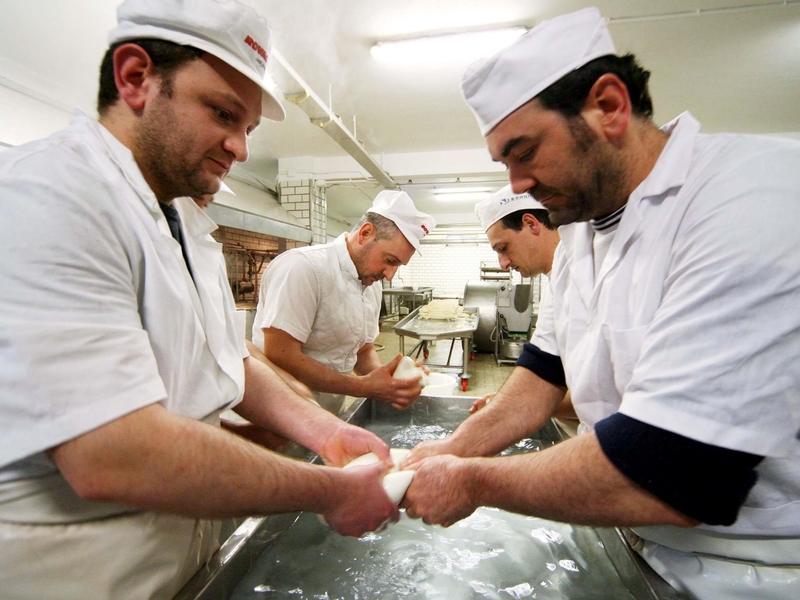
And in such conditions they are fabulously productive. Paolo's herd on his 150 hectare farm provide him with 2.5 million litres of milk a year. In 1970 the family started turning the milk into mozzarella cheese, and today he is selling the soft globules across the globe.
Buffalo mozzarella is softer and richer yet more delicate than that made from cows, the stuff which normally ends up on pizzas. Buffalo mozzarella, on the other hand, is normally eaten with tomato and basil or with some local parma ham. With sales peaking in 2003 and still rising 6% or 7% a year, there seemed a bright future for producers like Paolo.
But a few weeks ago disaster struck. Unusually high levels of cancer-causing dioxins were found in some of the 33,000 tonnes of buffalo mozzarella Italy produces every year. The Italian health ministry recalled products from 25 farms in Campagna; Japan, Korea, then France placed a ban on imports. The EU threatened to follow suit.
The reaction was blow to the €300m industry, one of those activities which mark Italy out as a producer of fine foods which are increasingly in demand by discerning global consumers.
'We lost €300,000 overnight,' says Paolo.
But the worst thing is that the scandal was probably man made. For the past year Naples has been in the grip of a garbage crisis.
A complex blend of Mafia activity, official complicity and the total absence of the kind of strategic waste management solutions the rest of Europe has been promoting for years meant that for months garbage was piling high on the streets of Naples.
The burning of refuse and the illegal dumping of household and toxic waste in the countryside around the city are blamed for raising dioxin levels in local mozzarella production.
'It's been created out of nothing by politicians on the left and the right, because by bringing about this problem they were either trying to get more votes or trying to damage the opposite party, so they created an irreversible problem and damaged the whole region for nothing', says Paolo.
Whoever is to blame – and everyone is blaming everyone else – the garbage-and-mozzarella scandal has hit sensitive nerves hard. The country's self image relies on good food and beautiful scenery, the gifts which abound in Naples and the Campagna region.
But years of mismanagement and criminal activity have ruined that image. It is not exactly overnight – the problem has been building for a long time.
The Camorra, the Campagna Mafia, is the hidden target of blame. For years they were forcing waste disposal companies to pay protection money. Then they decided to buy the companies themselves.
 While part of their business seemed legitimate, local businesses were also paying huge amounts of cash to have waste dumped illegally. Then the Camorra began making deals to bring toxic waste down from the industrial north of Italy and dump it in illegal landfills blasted out of mountainsides.
At the same time the Camorra could use local muscle and influence to frustrate any recycling or incineration initiatives, so that landfill remained the only solution.
Last year when the local landfill began to spill over, there was nowhere for the waste to go. There were no alternative solutions.
In Pianora, a working class suburb high in the hills to the north of Naples, the local government was forced to re-open a landfill which had been closed 14 years before. At that time it had been already been declared by the EU as deeply polluted.
'Now we can’t even drink the water,' said one local student outside a miniature supermarket. Opposite us piles of garbage are abutting the narrow pavement. 'Even the local politicians were making money from the waste we were bringing down from the north, so why should they try and stop it happening?'
Her anger shows the cynicism which has gripped voters in advance of Sunday’s election. One man said only the far right Alleanza Nazionale had stood with the locals.
Nearby a private waste removal company is using a Fiat bulldozer to lift piles of rubbish into a bin lorry. One worker languidly kills a mid-sized rat and tosses it onto the rubbish as it goes into the truck.
'Tomorrow morning, I guarantee you, there will be fridges and mattresses back here again,' said one worker, laughing bitterly.
The pile of rubbish did not seem that big, but a week before it had stretched for 200m along the pavement.
In downtown Naples, the tourist areas have been cleaned up. It is not surprising that tourist bookings are down 30% on last year and down 40% since 2004. An outburst of bloodletting between rival Camorra drugs gangs, the garbage crisis and now the fall in the dollar have all taken their toll.
At the five star, €300 a night Grand Hotel Vesuvio, one of the world’s leading hotel’s they’ve just closed the Caruso Restaurant, one of Italy’s most famous eateries, named after the legendary Italian tenor who lived and died in there.
'I can remember Bill Clinton, Francois Mitterand, Claudia Schiffer, Sophia Loren, Alfred Hitchcock, all staying here,' recalls Sergio Maione, the managing director.
'The garbage crisis was the last straw. It made Italy look like the Third World, it was shameful.'
When the Caruso restaurant took in just 16 bookings one weekend, the hotel was forced to close it.
The crisis has been given a thorough airing in the election campaign. The right, under the old showman Silvio Berlusconi, is happily blaming the left since it has been in charge of Campagna for the past 15 years.
The left, under Walter Veltroni, the former mayor of Rome, says everyone should take part of the blame.
 Mr Berlusconi is consistently ahead in the polls, but while he will probably win the lower chamber, complex voting rules in the regions mean that the left could control the Senate.
Electoral reform in Italy is now long overdue.
'For years there’s been no political centre of gravity in Italy,' says Massimo Franco, political editor of Corriere della Sera. 'That means politics is polarised and small parties get undue influence, and stability is hard to come by. Anyone who rises to the surface has been politically co-opted by one side or the other, so there is no risk-taking. It’s Italy’s Original Sin.'
Few people will be surprised if Mr Berlusconi under his People of Freedoms party wins and then his government falls again soon after. Or there could be some kind of hidden co-habitation or truce between the right and the left if the left does win the Senate.
There has even been talk of a grand coalition between right and left as there currently exists in Germany.
The objective in such a scenario would be simple: to bring in the kind of electoral reform which might provide some political stability in Italy. A referendum next year might help, but it is not clear if that will happen.
Opinion polls show that Italians are happy with their home and family life. But red lights are flashing furiously that the 'dolce vita' is heading for a massive hangover.
Alitalia, the waste crisis, the unchecked dominance of organised crime, and desperately low growth rates all point in that direction. Italy needs to break the power of lobbies and the polarised electoral system to turn things around. All that beauty could only be skin deep, if the body politic is rotting underneath.
