


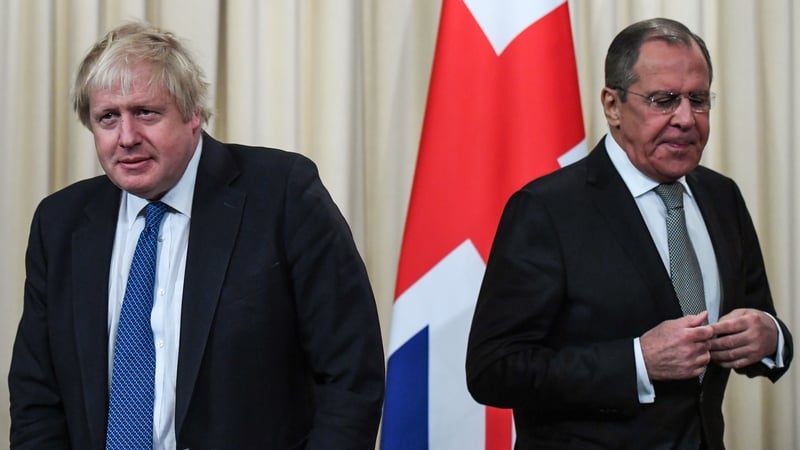
British Foreign Secretary Boris Johnson and his Russian counterpart clashed over Crimea and Moscow's alleged cyber attacks on the West, as the two men met in Moscow.
Sergei Lavrov denied claims that Moscow had interfered in democratic elections online and accused Mr Johnson of being a "hostage" of untrue Western narratives on the issue.
But Mr Johnson insisted there was "abundant evidence" of Russian interference in polls in the US, Germany, Denmark and France.
And when the Russian foreign minister told a press conference in Moscow that Mr Johnson himself had confirmed Russia had not interfered in the UK's election and Brexit referendum, Mr Johnson interrupted to add: "Not successfully."
The clash came after Mr Johnson issued a warning to the Kremlin that Britain was "prepared and able" to respond in kind to cyber attacks.
Speaking after more than an hour of talks on the first visit to Russia by a British foreign secretary for five years, both men acknowledged that relations between the two countries were at their worst for many years.
But they insisted that Russia and the UK had a duty to work together as fellow permanent members of the UN Security Council on issues affecting global security like Syria, Iran and North Korea.
And both said they had established a level of personal trust, Mr Lavrov saying he got on well enough with Mr Johnson to pronounce his first name in the Russian way as "Barees".
Mr Johnson said he adopted the approach Ronald Reagan had taken with Mikhail Gorbachev: "Trust, but verify."
And he joked that his trust was so great that he had handed his coat with "everything in my pockets, secret or otherwise" to Mr Lavrov when he arrived at the Ministry of Foreign Affairs building.
Mr Lavrov joked back: "I can say that there was nothing in the pockets of Boris's coat", to which Mr Johnson responded in surprise: "So you have searched it already?"
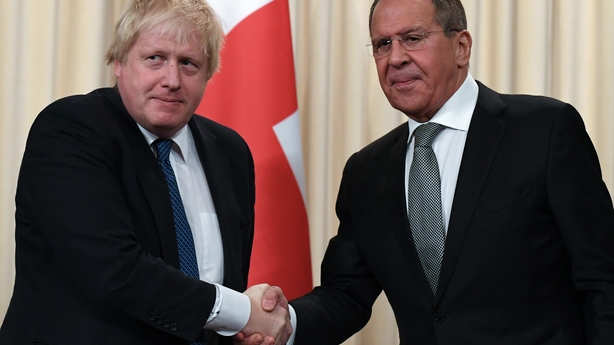
When Mr Johnson rejected Mr Lavrov's denial that Russia had attempted to interfere in British polls, the Russian foreign minister retorted: "He is afraid if he doesn't contradict me his reputation is going to be ruined."
Mr Johnson said: "Russian attempts to interfere in our referendums and elections, whatever they might be, have not been successful."
He said they had they been successful "that would have been an entirely different matter".
Mr Lavrov responded that "the absence of action can never result in anything" and asked to see "concrete facts" about their alleged unsuccessful attempts.
"I think you have made all this up in your Western community and unfortunately right now you are hostage to this subject, it is very difficult for you to climb down from the fence you have climbed."
The evidence produced so far of Russian attempts at interference amounted to no more than the spending of "a few kopecks" on social media adverts, he said.
He criticised Britain for cutting off ties with the FSB security agency over the murder of Alexander Litvinenko in London, complaining that UK authorities had refused to hand over information in the case.
He said that the takeover of Crimea had been approved by a referendum of its citizens unlike the break-up of the former Yugoslavia
And he said that UK government criticism of politicians who speak to Russian media outlets like the RT TV channel did not reflect well on the UK.
"We are concerned that the cradle of democracy, the United Kingdom, sees the vilifying of people for speaking to Russian media," he said. "It doesn't add to the good reputation of the Government unfortunately."
Earlier, Mr Johnson was rebuked by his host for speaking in public about their differences. On the eve of their talks, Mr Johnson sent a blunt message to the Kremlin to stop its use of cyber space to disrupt Western countries.
He told reporters: "The UK is certainly prepared and able to respond, should we so desire."
Facing Mr Johnson across a conference table at the Ministry of Foreign Affairs Guest House in Moscow, Mr Lavrov said: "It is no secret that right now our relations are at a low point."
Noting that Mr Johnson has openly talked about the reasons for the frosty relationship, he added: "You prefer to talk about these reasons publicly, whereas we would prefer to talk about our mutual concerns not before a mike and at a tribune, but directly."
Mr Johnson invoked the Second World War as an example of how Britain and Russia can co-operate despite profound policy differences.
