


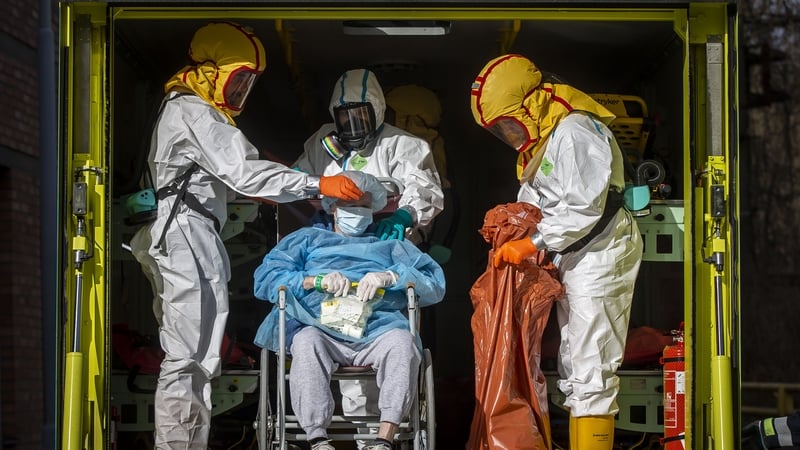
Covid-19 reinfections are growing fast in the Czech Republic, which currently has the world's highest per capita death rate from the disease, a state health institute said.
The number of reinfections jumped to 1,400 by 28 February from 158 registered at the end of January and 56 at the end of 2020, data from the National Institute of Public Health have shown.
"The reinfection rate is growing because of the significant number of Covid-19 cases during the autumn wave," the institute said in a statement.
The EU member of 10.7 million people has so far registered over 25,000 deaths from almost 1.5 million Covid-19 cases.
The figures make it the world's leader in deaths per capita and second worst in cases per capita, according to an AFP tally based on data per 100,000 inhabitants over the past 14 days.
The country managed to contain the first wave of the disease last spring, but it has been struggling to contain the spread since last summer.
The institute said the interval between the first and second occurrences of the disease was 68-359 days with a median of 142 days, while the median age of those getting Covid again was 42.
Given the data, the institute said it would still recommend people who already had Covid-19 to get a vaccine, though "with a certain interval".
A recent Danish study published in The Lancet magazine showed initial Covid-19 infection was likely to bestow 80% protection from reinfection among under-65s, while elderly people were more prone to reinfection.
Germany orders tough Easter shutdown as ICUs come under pressure
Germany is to impose a strict lockdown for five days over Easter as Covid-19 infections spiral "exponentially".
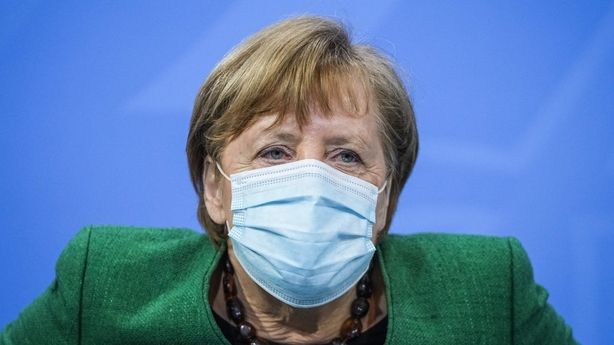
Chancellor Angela Merkel ordered the nationwide measures after marathon talks with regional leaders, warning a potent strain of coronavirus in the country.
"The situation is serious," Ms Merkel said.
"Case numbers are rising exponentially and intensive care beds are filling up again."
A variant first identified in the UK has become the dominant strain circulating in Germany, she said, adding that "we are in a new pandemic".
"Essentially, we have a new virus ... it is much deadlier, much more infectious and infectious for much longer."
Cultural, leisure and sporting facilities will stay closed through to 18 April, and a lockdown will come into force between 1 and 5 April.
Almost all shops will be closed across the five days, and religious services will be moved online.
Globally, the coronavirus crisis that first emerged in China in December 2019 has killed more than 2.7 million people and infected over 123 million, according to official data collated by AFP.
Vaccination drives are seen as crucial to overcoming the pandemic and navigating countries out of brutal restrictions that continue to paralyse economies around the world.
More than 430 million jabs have now been administered globally, mostly in wealthier nations.
The World Health Organization (WHO) director general Tedros Adhanom Ghebreyesus has criticised the "grotesque" vaccine gap, calling it a "moral outrage".
"Countries that are now vaccinating younger, healthy people at low risk of disease are doing so at the cost of the lives of health workers, older people and other at-risk groups in other countries," he said.
Britain today marks the anniversary of its first coronavirus lockdown with a 'National Day of Reflection', which will see parliament hold a minute's silence in tribute to the more than 126,000 people who have died.
The country ranks fifth in the world for both virus cases and deaths.
Prime Minister Boris Johnson said the last year has "taken a huge toll" and called the anniversary "an opportunity to reflect on the past year - one of the most difficult in our country's history".
Macron: Vaccination campaign at heart of Covid-19 battle
French President Emmanuel Macron said the acceleration of the vaccination campaign was at the heart of the battle against Covid-19.
"Vaccination is a national priority," he told reporters during a visit to a vaccination centre in Valencienne, northern France, adding vaccination would also be rolled out during public holidays and weekends.
Earlier, Frederic Valletoux, president of the French hospital federation, said France's Covid-19 figures are going up at a "vertiginous rate" and if the situation does not improve, further lockdown measures may be needed.
"The epidemic is gathering pace, and the figures are exploding," Mr Valletoux, who is also mayor of Fontainebleau just south of Paris, told LCI TV.
Official data published yesterday showed that the tally of new Covid-19 cases in France had accelerated further despite the start of a third lockdown over the weekend, with the number of people in intensive care at a new four-month high.
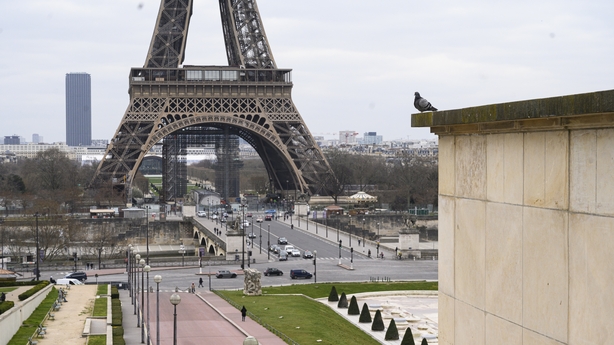
Mr Valletoux said if the situation did not improve, the French hospital system could face an "unprecedented violent shock" in about three weeks time.
France reported 15,792 new coronavirus cases yesterday, more than double the 6,471 reported last Monday and the highest number on a Monday since the peak of the second wave in early November.
France also registered 343 new deaths, pushing the official tally of Covid-19 fatalities to 92,621 - the eighth-highest Covid death toll in the world, just behind Russia.
Roche reports promising results from anti-Covid cocktail
Swiss pharma giant Roche has announced "positive" results from clinical trials of an anti-Covid cocktail developed with US biotech firm Regeneron.
The results of the Phase 3 trial, "shows investigational antibody cocktail casirivimab and imdevimab reduced hospitalisation or death by 70% in non-hospitalised patients with Covid-19," it said in a statement.
The cocktail also "significantly shortened the duration of symptoms by four days".
The Covax vaccine-sharing scheme will set aside 5% of the vaccine doses it procures for a "buffer" to be used in humanitarian settings or released in the case of severe outbreaks, the GAVI vaccine alliance said.
That amounts to up to 100 million vaccine doses by the end of 2021, it said.
Covax is the programme backed by the World Health Organization and GAVI vaccine alliance to provide vaccines for poor and middle-income countries.
So far, 31 million doses have been delivered to 57 economies, although the rates trail behind wealthier countries.
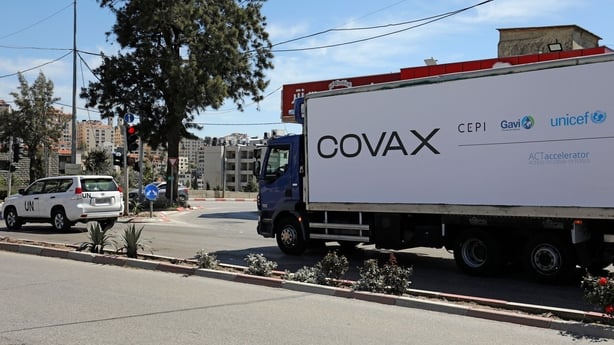
GAVI said that the reserve doses would be used in areas where there were "unavoidable gaps in coverage", such as conflict zones and areas controlled by armed groups inaccessible to governments.
"As we have started the rollout of millions of doses of Covid-19 vaccines to Covax economies, it is essential to also protect high-risk groups caught in crisis settings," said GAVI CEO Seth Berkley.
The contingency doses could also be used as part of an "emergency release" to quell severe outbreaks of Covid-19 where regular vaccine allocation timelines are insufficient, it said.
Those doses will only, however, be available once all Covax participants have received their early doses.
Putin to be vaccinated in private, says Kremlin
Russian President Vladimir Putin will be vaccinated in private this evening, the Kremlin said, as Russia looks to boost a vaccination campaign that is faltering despite having produced three home-grown jabs.
Mr Putin announced a day earlier that he would be vaccinated today, joining other world leaders who have received jabs including US President Joe Biden, Pope Francis and Britain's Queen Elizabeth.
But unlike many others who were vaccinated in public - Mr Biden was shown on TV being given the Pfizer-BioNTech vaccine, while Ukraine's Volodomyr Zelensky even took off his shirt for the jab - Mr Putin will do so behind closed doors.
Kremlin spokesman Dmitry Peskov said that the 68-year-old Russian leader, who has never been media shy during his two decades in power, does not want to get a jab in front of the cameras.
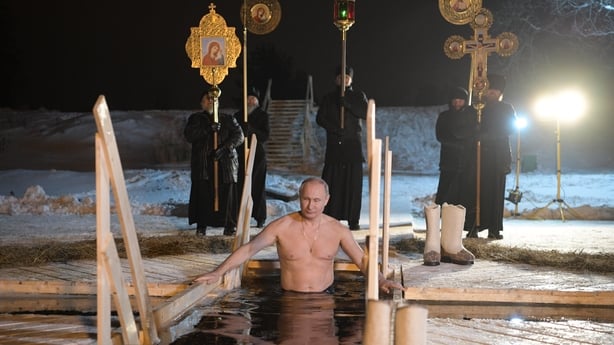
"We will not show this, you will have to take our word for it," Mr Peskov told reporters.
"As for being vaccinated in front of the cameras, he does not like it."
Mr Peskov said the Kremlin chief would receive one of three Russian vaccines, declining to specify which one "on purpose".
"All three Russian vaccines proved their effectiveness and reliability," Mr Peskov said.
Russia has developed three vaccines - Sputnik V, EpiVacCorona and CoviVac, though most of the attention has focused on Sputnik, named after the first satellite launched into space by the Soviet Union.
Russia's vaccination campaign has been slower than in many countries but Mr Peskov said Mr Putin did not have to get vaccinated in public to encourage more Russians to get jabs.
Only about four million of the country's 144 million people have so far received two doses of a vaccine, while another two million have had a first dose.
Vaccine scepticism runs high in Russia, with a recent opinion poll showing less than a third willing to have a jab, and close to two-thirds saying they believe the coronavirus is a man-made biological weapon.
The country has been among the hardest hit by Covid-19, with more than 4.4 million cases of the coronavirus and more than 95,000 deaths.
