


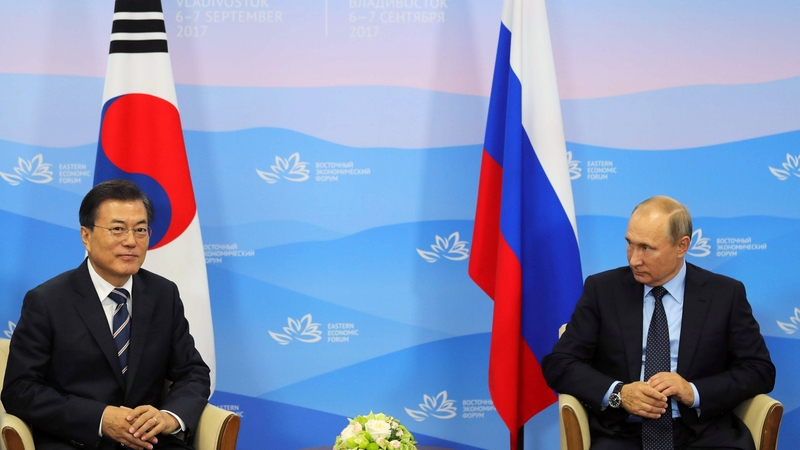
Resolving the North Korean nuclear crisis is impossible with sanctions and pressure alone, Russian President Vladimir Putin said this morning after meeting his South Korean counterpart
Mr Putin met South Korean leader Moon Jae-in on the sidelines of an economic summit in the eastern Russian city of Vladivostok amid mounting international concern that North Korea plans more weapons tests, possibly a long-range missile launch ahead of a weekend anniversary.
Mr Putin denounced North Korea's sixth and largest nuclear bomb test on Sunday, saying Russia did not recognise its nuclear status.
"Pyongyang’s missile and nuclear programme is a crude violation of UN Security Council resolutions, undermines the non-proliferation regime and creates a threat to the security of northeastern Asia," Mr Putin said at a joint news conference.
"At the same time, it is clear that it is impossible to resolve the problem of the Korean peninsula only by sanctions and pressure," he said.
No headway could be made without political and diplomatic tools, Mr Putin said, later telling the TASS news agency that Russian and North Korean delegations might meet at the Vladivostok forum.
Mr Moon, who came to power this year advocating a policy of pursuing engagement with North Korea, has come under increasing pressure to take a harder line.
He has asked the United Nations to consider tough new sanctions after North Korea's latest nuclear test.
Diplomats say the UN Security Council could consider banning North Korean textile exports, barring its airline or stopping supplies of oil to the government and military.
Other measures could include preventing North Koreans from working abroad and putting top officials on a blacklist aimed at imposing asset freezes and travel bans.
"I ask Russia to actively cooperate as this time it is inevitable that North Korea's oil supply should be cut at the least," Mr Moon told Mr Putin, according to a read-out from a South Korean official.
Mr Putin said North Korea would not give up its nuclear programme no matter how tough the sanctions.
"We too, are against North Korea developing its nuclear capabilities and condemn it, but it is worrying cutting the oil pipeline will harm the regular people, like in hospitals," Mr Putin said, according to the South Korean presidential official.
Russia's exports of crude oil to North Korea were tiny at about 40,000 tonnes a year, Mr Putin said.
By comparison, China provides it with about 520,000 tonnes of crude a year, according to industry sources.
Last year, China shipped just over 96,000 tonnes of gasoline and almost 45,000 tonnes of diesel to North Korea, where it is used across the economy, from fishermen and farmers to truckers and the military.
Sanctions have done little to stop North Korea boosting its nuclear and missile capacity as it faces off with US President Donald Trump, who has vowed to stop it from being able to hit the US mainland with a nuclear weapon.
China and Russia have advocated a "freeze for freeze" plan, where the United States and South Korea stop major military exercises in exchange for North Korea halting its weapons programmes, but neither side is willing to budge.
North Korea says it needs to develop its weapons to defend itself against what it sees as US aggression.
South Korea and the United States are technically still at war with North Korea after the 1950-53 Korean conflict ended with a truce, not a peace treaty.
China objects to both the military drills and the deployment in South Korea of an advanced US missile defence system that has a radar that can see deep into Chinese territory.
South Korea's Defence Ministry said the four remaining batteries of the Terminal High Altitude Area Defense (THAAD) system would be deployed on a golf course in the south of the country tomorrow.
Two THAAD batteries have already been installed.
Meanwhile Japanese Prime Minister Shinzo Abe has said that he wants North Korea to understand it has "no bright future" if it continues on its current path, and that the reclusive country needs to change its policies.
Mr Abe told reporters he wants to discuss the North Korea situation with Mr Putin and Mr Moon separately when they meet on the sidelines of an Eastern Economic Forum.
Mr Abe and Mr Putin are also expected to discuss economic cooperation and a peace treaty between the two nations.
The Japanese leader's comments come as Japan has again upgraded its estimated size of North Korea's latest nuclear test to a yield of around 160 kilotons - more than ten times the size of the Hiroshima bomb.
It marks Tokyo's second higher revision after previously giving estimates of 70 and 120 kilotons.
Defence Minister Itsunori Onodera said that his ministry's upward revision to 160 kilotons was based on a revised magnitude by the Comprehensive Nuclear-Test-Ban Treaty Organisation (CTBTO).
"This is far more powerful than their nuclear tests in the past," Mr Onodera said.
The US bomb that destroyed Hiroshima in 1945 carried a yield of 15 kilotons.
Japan's latest estimate far exceeded the yield of between 50 and 100 kilotons indicated by UN political affairs chief Jeffrey Feltman at the UN Security Council.
Mr Onodera has held telephone talks with US Defense Secretary Jim Mattis and both agreed to step up "visible pressure" on North Korea, the ministry in Tokyo said.
"North Korea's nuclear and missile development is at a new stage of grave and imminent threats," Mr Onodera told Secretary Mattis, the ministry said, adding that his US counterpart shared the view.
