


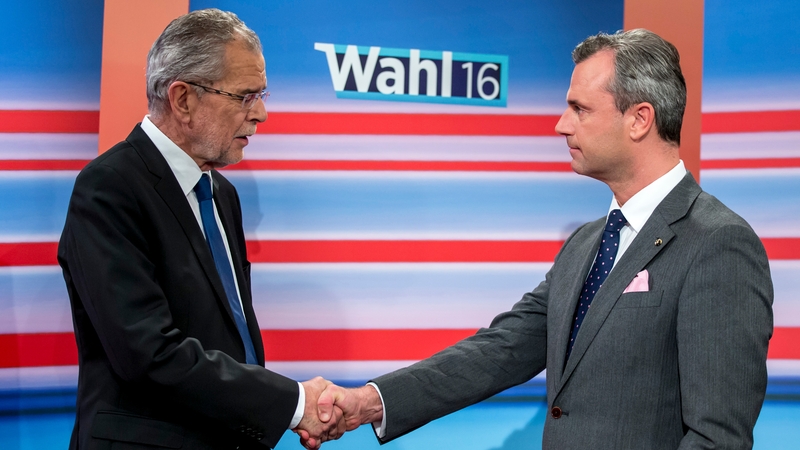
Austrian independent Alexander Van der Bellen hailed his presidential election victory over his eurosceptic far-right challenger as a vote for a "pro-European" Austria five months after the Brexit vote.
"From the start I have always fought and argued in favour of an Austrian that is pro-European," Mr Van der Bellen said on public television, saying that "old values like freedom, equality and solidarity" also contributed.
The candidate vying to become Europe's first freely elected far-right head of state since World War Two conceded defeat soon after polls closed this afternoon.
The result is a blow to populists who had hoped a wave of anti-establishment anger sweeping Western democracies would carry Norbert Hofer to power after Britain's Brexit referendum and Americans' election of Donald Trump as president.
Mr Hofer, of the anti-immigration and anti-Islam Freedom Party (FPO), conceded he had been soundly beaten by former Greens leader Alexander Van der Bellen.
"I am infinitely sad that it didn't work out," Mr Hofer said in a posting on his Facebook page less than an hour after polls closed and the first projections were broadcast.
Voters may have heeded Mr Van der Bellen's increasingly strident warnings that Mr Hofer wanted to follow Britain's lead and pull Austria out of the European Union.
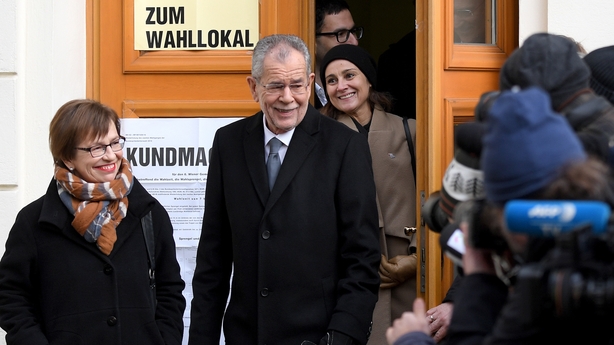
Mr Van der Bellen (below) had a clear lead over Mr Hofer, according to a projection by pollster SORA for broadcaster ORF that included a count of 69% of votes. The projection showed Mr Van der Bellen on 53.3% and Mr Hofer on 46.7%, with a margin of error of one percentage point.
"Should this projection really be true, at which point we can be pleased, it is a good day for Austria," Mr Van der Bellen's campaign manager Lothar Lockl told ORF minutes after polls closed.
When Mr Hofer narrowly lost the original run-off in May with 49.65% of the vote, European governments breathed a sigh of relief. However, far-right parties like France's National Front cheered the record performance.
A Hofer win would have raised the prospect of two near-simultaneous blows to Europe's political establishment.
Italy is holding a referendum today on constitutional reform that could decide the political future of Prime Minister Matteo Renzi, who has promised to resign if he loses.
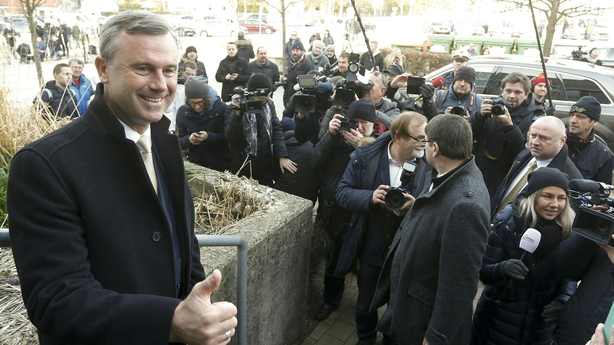
While the president's role is traditionally largely ceremonial, Mr Hofer (below) had made clear he wanted to be an interventionist head of state, threatening to dismiss a government if it raises taxes and calling for referendums on a range of issues, even though referendums are beyond the job's remit.
The president also plays an important part in forming coalitions. Mr Van der Bellen has said he would try to prevent an FPO-led government even if it won an election. The FPO is running first in polls with support of roughly a third of voters, with parliamentary elections due in 2018.
Mr Van der Bellen, 72, put Brexit at the heart of his campaign, arguing that Mr Hofer wanted Austria to hold its own "Oexit" referendum, putting jobs at risk in the small, trade-dependent country.
The result of the May 22 run-off was overturned mostly due to election officials cutting corners as they raced to complete the count. The re-run was then postponed because the glue on the envelopes for some postal ballots did not stick.
We need your consent to load this rte-player contentWe use rte-player to manage extra content that can set cookies on your device and collect data about your activity. Please review their details and accept them to load the content.Manage Preferences
