


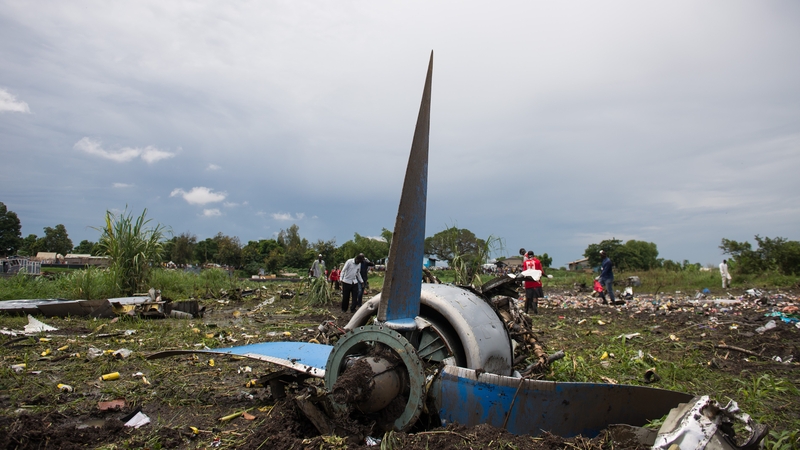
The decades-old Antonov plane that crashed in South Sudan, killing at least 36 people, "was is no state to fly", the Ukraine-based aircraft company said.
"The An-12B was is no state to fly because it failed to undergo timely technical servicing... that should have included work on extending its resources and exploitation timeframe," Antonov said in a statement.
The Antonov firm was spread out across the former Soviet Union plane when the ill-fated plane was built in 1971.
Ukraine was the An-12B's designer. The plane itself was built in Uzbekistan and later registered in the neighbouring Central Asian state of Tajikistan.
It is both a civil and a military transport aircraft that conducted its first test flight in 1957.
The plane crashed just seconds after taking off from South Sudan's capital Juba, smashing into a farming community on an island on the White Nile river.
A spokesman for Antonov in Kiev said the company was now in contact with the aviation authorities of Tajikistan, believing they were responsible for the plane's upkeep.
Two survivors were pulled out of the twisted metal hulk of the plane but one of those later died, with a young boy the only survivor, the Red Cross said, adding the number of dead may still rise.
The five-member Armenian crew were all killed, the Armenian embassy in Egypt said in a statement.
Cargo planes to remote parts of South Sudan often carry passengers as well as goods.
The main fuselage of the plane ploughed into thick woodland, with debris scattered around the riverbank in a wide area, according to an AFP reporter at the site.
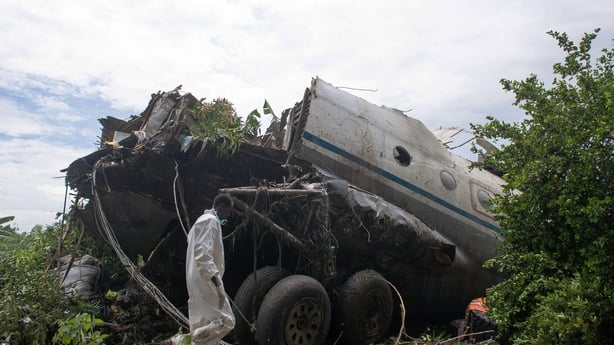

Radio Miraya, a United Nations-backed station, said the plane had been heading to the northern Upper Nile state, crashing some "just 800 metres from Juba International Airport runway."
Police at the site said they did not know how many had been on board the plane when it crashed - nor if people may have been hit when it smashed into the island - and so were unable to give an official death toll.
The island is home to several small farming communities.
Juba's airport is the busiest in the war-torn country, which is the size of Spain and Portugal combined but with few tarred roads.
The airport hosts regular commercial flights, as well as a constant string of military aircraft and cargo planes delivering aid to remote regions cut off by road.
