


US President Barack Obama and Russian President Vladimir Putin shook hands today at United Nations headquarters and went into their first substantial bilateral talks in two years.
They will discuss the increased Russian military presence in Syria and the situation in Ukraine.
The US earlier said it was willing to cooperate with Russia, as well as Iran, to try to end the Syrian civil war, but the two big powers clashed over whether to work with Syrian President Bashar al-Assad.
Speaking at the annual United Nations General Assembly, Mr Obama described Mr Assad as a tyrant and as the chief culprit behind the four-year civil war.
At least 200,000 people have died in the Syrian war and millions have been driven from their homes.
Mr Putin, in contrast, told the gathering of world leaders that there was no alternative to cooperating with Mr Assad's military in an effort to defeat the so-called Islamic State militant group, which has seized parts of Syria and neighboring Iraq.
Mr Putin called for the creation of a broader international anti-terrorist coalition with majority-Muslim countries as members, an appeal that may compete with the group that the US has assembled to fight IS.
"The United States is prepared to work with any nation, including Russia and Iran, to resolve the conflict," Mr Obama, who spoke before Mr Putin, told the General Assembly.
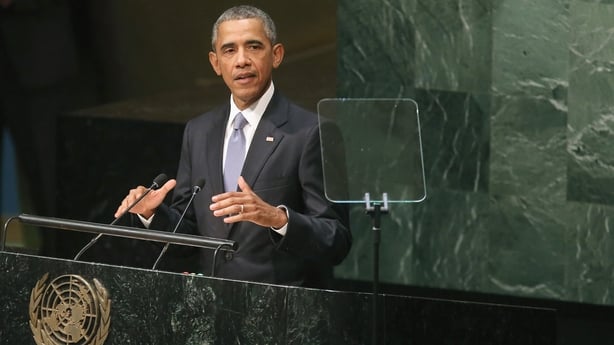
"But we must recognise that there cannot be, after so much bloodshed, so much carnage, a return to the prewar status quo."
The disagreement over Mr Assad raised questions about how Mr Obama and Mr Putin might find common ground during their meeting on the sidelines of the General Assembly.
The two leaders began meeting shortly after 10pm Irish time.
Mr Putin walked in first with Mr Obama close behind.
Stopping in front of US and Russian flags set up for a photo opportunity, Mr Obama put out his hand and Mr Putin took it for a handshake.
They did not speak to each other or answer questions from journalists.
Mr Obama did not explicitly call for Mr Assad's ouster and he suggested there could be a "managed transition" away from his rule, the latest sign that despite US animus toward the Syrian leader it was willing to see him stay for some period of time.
He dismissed the argument that authoritarianism was the only way to combat groups such as IS, saying: "In accordance with this logic, we should support tyrants like Bashar al-Assad, who drops barrel bombs to massacre innocent children, because the alternative is surely worse."
Mr Putin differed, suggesting there was no option but to work with Mr Assad against IS fighters.
"We think it is an enormous mistake to refuse to cooperate with the Syrian government and its armed forces who are valiantly fighting terrorism face to face," Mr Putin said during his speech before the UN General Assembly.
"We should finally acknowledge that no one but President Assad's armed forces and (Kurdish) militia are truly fighting the Islamic State and other terrorist organisations in Syria," he said.
French President Francois Hollande and Turkish Prime Minister Ahmet Davutoglu both rejected the possibility of allowing Mr Assad to stay.
In voicing a willingness to deal with Iran and Russia, both backers of Mr Assad, Mr Obama was openly acknowledging their influence in Syria and swallowing a somewhat bitter pill for the United States.
Tehran has armed the Syrian government and, through its backing of Lebanese Hezbollah fighters, has helped Mr Assad combat rebels seeking to end his family's four-decade rule.
Russia has started a military buildup in Syria, where it has a naval base that serves as its foothold in the Middle East.
US officials say they believe Mr Putin's buildup of Russian forces, including tanks and warplanes, in Syria mainly reflects Moscow's fear that Mr Assad's grip might be weakening and a desire to shore him up to retain Russian influence in the region.
They also see it as a way for Mr Putin to try to project Russian influence more widely, a goal he appeared to achieve yesterday with Iraq's announcement that Russia, Iran, Syria and the Iraqi government were sharing intelligence on Syria.
Iranian President Hassan Rouhani, in his speech to the General Assembly, blamed terrorism on what he characterised as US occupations of Iraq and Afghanistan and Washington's support for Israel "against the oppressed nation of Palestine."
Mr Rouhani said Iran was ready to help bring democracy to Syria and Yemen, another war zone in the region, where Iran backs Houthi rebels.
Mr Obama also renewed his criticism of Russia over its March 2014 annexation of Crimea from Ukraine and support for separatist rebels in eastern Ukraine.
"We cannot stand by when the sovereignty and territorial integrity of a nation is flagrantly violated," he said.
"If it happens without consequences in Ukraine, it can happen to any nation here today. That's the basis of the sanctions that the United States and our partners impose on Russia, it's not a desire to return to a cold war."
Mr Putin, however, told the 193-nation General Assembly that the crisis in Ukraine was the result of "a military coup ... orchestrated from outside".
He was alluding to Russian allegations, denied by the United States, that Washington was behind the 2014 ouster of Ukraine's former pro-Russian president.
Mr Putin also complained that unilateral sanctions, such as the US and European Union measures against Russia over Ukraine, were not only illegal but "a means of eliminating competitors".
Castro addresses UN General Assembly for first time
Cuban President Raul Castro told the UN General Assembly that normal relations with the US would only be possible if Washington ended its trade embargo on his country, returned the military base at Guantanamo and ended anti-communist broadcasts beamed into the island.
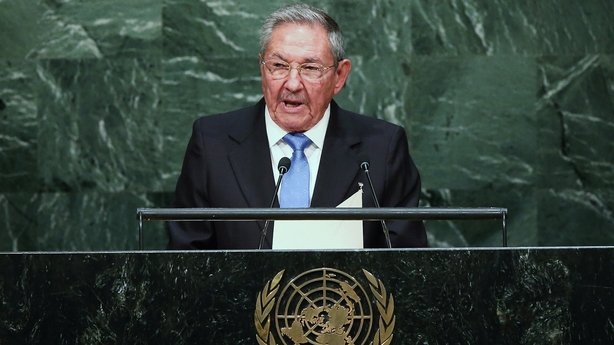
With diplomatic ties now restored, overall normal relations "will only be achieved with the end of the economic, commercial and financial blockade against Cuba; the return to our country of the territory illegally occupied by the Guantanamo Naval Base; the cessation of radio and TV broadcasts, and of subversion and destabilisation programs against the island; and when our people are compensated for the human and economic damages they still endure," Mr Castro said in his first address ever to the United Nations.
He received sustained applause.
30,000 more troops pledged for peacekeeping missions
More than 50 countries have offered to contribute about 30,000 new troops and police to the UN's struggling peacekeeping missions, Mr Obama announced.
The pledges represent a major boost to UN blue helmet operations as peacekeeping demands grow worldwide and conflicts become deadlier.
"We know that peace operations are not the solution to every problem," Mr Obama told a peacekeeping summit organized by the United States on the sidelines of the UN General Assembly.
"But they do remain one of the world's most important tools to address armed conflict," he said.
The new contributions include helicopters, engineering units, field hospitals and bomb-detonating expertise that is desperately needed to bolster UN peace missions.
More than 125,000 troops and police from 120 countries serve in the UN's 16 peacekeeping missions worldwide.
Mr Obama stressed that strengthening peacekeeping would serve "our common security" and pledged to double the number of US officer staff serving under the blue flag.
