


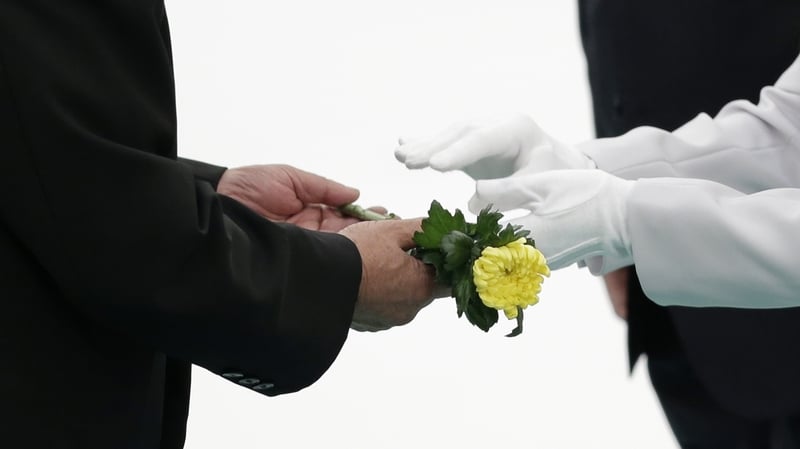
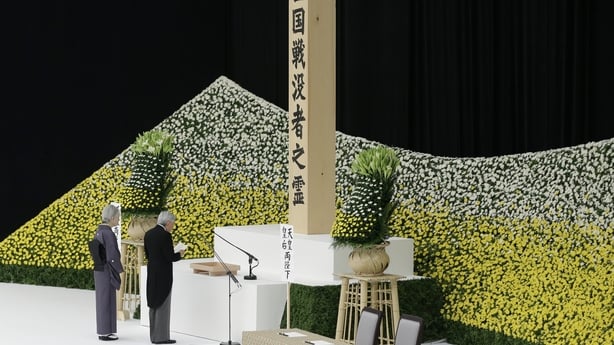
Japanese Emperor Akihito has marked the 70th anniversary of the end of World War Two with an expression of "deep remorse" over the conflict, a departure from his annual script that could be seen as a subtle rebuke of conservative Prime Minister Shinzo Abe.
Mr Abe yesterday expressed "utmost grief" for the suffering Japan inflicted in the war, but said future generations should not have to keep apologising for the mistakes of the past.
He offered no fresh apology of his own.
"Together with deep remorse over the war, I pray that this tragedy will not be repeated in the future and together with the people, express my deep condolences for the war dead and those who were affected, and pray for the peace and further prosperity of our country," Emperor Akihito, 81, said at a memorial service on the anniversary of the day his father, Hirohito, announced Japan's defeat.
Emperor Akihito has often urged Japan not to forget the suffering of the war and tried to promote reconciliation with Asian countries.
His comments have attracted increased attention at a time when Mr Abe appears to be pushing for a less apologetic tone towards Japan's past.
Emperor Akihito had expressed remorse previously but not at the annual service. The emperor is banned by the constitution from any political role, so his remarks need to be carefully nuanced.
Philippines says WWII foe Japan now trusted friend
Meanwhile, the Philippines has said it had rebuilt a "strong friendship" with former foe Japan, as its neighbours criticised Mr Abe for failing to properly apologise for Tokyo's aggression during World War II.
Since the war, Japan had "acted with compassion" which led to a relationship "characterised by trust and unfailing support in so many fields", Foreign Affairs Secretary Albert del Rosario said in a statement.
"This 70-year history demonstrates to the world that through their relentless efforts, peoples of two countries can attain a remarkable achievement in overcoming issues of the past and establishing strong friendship," he said.
Japan is now the Philippines biggest source of development assistance and the two countries have also been strengthening defence cooperation in the face of separate territorial disputes with China.
Mr Del Rosario's comments were in stark contrast to reactions from China other Asian victims of Japan's wartime aggression.
Beijing called Mr Abe's statement a non-apology while North Korea derided it as an "unpardonable mockery of the Korean people".
South Korean President Park Geun-Hye said the speech "left much to be desired" and stressed the need for Japan to resolve the issue of Asian women forced to work in Japanese wartime brothels.
A Philippine group representing dozens of former sex slaves denounced Mr Abe's pronouncement that future Japanese generations should not be compelled to apologise for past aggression.
"He wants a gag of silence. That is unacceptable. You can't commit a crime and set conditions... Our grandmothers didn't set conditions when they were victimised," Rechilda Extremadura, executive director of Lila Pilipina, told AFP.
Only 70 of the estimated 1,000 Filipina "comfort women" are still alive, many of them ill and in their twilight years, she said.
The women are demanding an "unequivocal apology", an acknowledgement of the war brothels policy and compensation from the Japanese government, she said.
"I am very angry because Japan does not want to close this chapter. Will they wait for another 80 years? 100 years?" she said.
Australian Prime Minister pays tribute to Australians who served in WWII
Australian Prime Minister Tony Abbott has paid tribute to the Australians who served in World War Two saying: "Today in awe and in gratitude we honour a generation of Australians who helped turn the tide of history.
"You fought in the air and on the sea, in the jungle and in the desert. You fought to defend our country against fascism, nazism and militarism. You fought against evils that sought to destroy human decency and you fought to build a lasting peace."
"On this 70th anniversary of the war’s end we acknowledge all those who died in the service of our country, all who made unknown and untold sacrifices and we remember the enduring grief of those left behind.
"We thank you for the free and democratic Australia that is your true legacy and we resolve always to strive to be worthy of your sacrifice. Lest we forget."
Queen Elizabeth leads VJ Day anniversary commemorations
Queen Elizabeth and other members of the British royal family have led commemorations in London marking the 70th anniversary of VJ Day.
A series of events commemorated the sacrifices of British WWII forces who fought and died defeating Japan.
Speaking to BBC Breakfast, British Prime Minister David Cameron said: "I think it's really important to mark this date and to honour the memory of those that died, the thousands that died, serving our country, preserving our freedoms.
"I think it's also particularly important perhaps, this anniversary, where so many of the participants are now such a great age. I'm going to be laying a wreath with a 97-year-old hero from those times. I think it's very poignant and right that we're doing this."
He said many veterans "suffered appalling injuries and torture" during the conflict "for our freedoms".
