


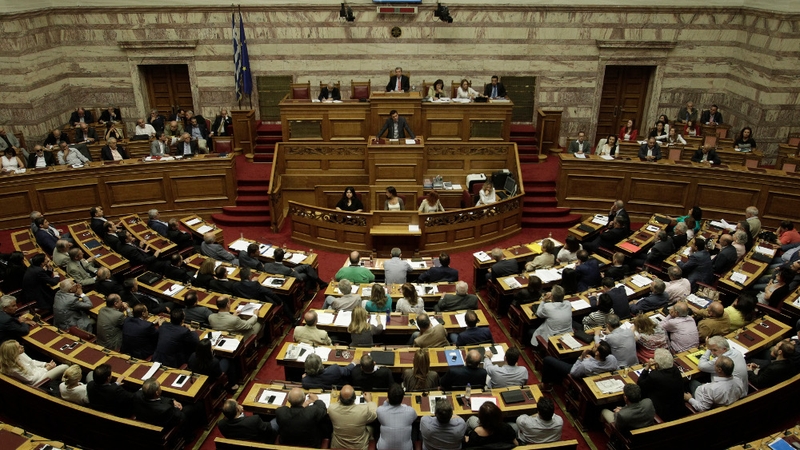
The Greek parliament has passed legislation on a second batch of reforms needed to help unlock a huge international bailout for the country's stricken economy.
A first set of reforms that focused largely on tax hikes and budget discipline triggered a rebellion in Greek Prime Minister Alexis Tsipras's Syriza party last week, but passed thanks to votes from pro-EU opposition parties.
The bill that politicians voted on early this morning covered rules for dealing with failed banks and speeding up the justice system.
They are two more conditions set by the eurozone and IMF to open negotiations on an €86bn rescue loan.
The legislation easily passed with the backing of 230 votes in the 300-seat chamber, once again due to opposition support.
But 36 Syriza deputies, or almost 25% of the party's 149 politicians, voted against the overall bill or abstained.
Significantly for Mr Tsipras, that was a smaller rebellion than the 39 deputies who defied him in last week's vote.
"We made tough choices, and I personally made difficult, responsible choices. Today we must all redefine the possibilities ahead of us given the new circumstances," Mr Tsipras said in an appeal to parliament to back the reforms.
"We chose a difficult compromise to avert the most extreme plans by the most extreme circles in Europe."
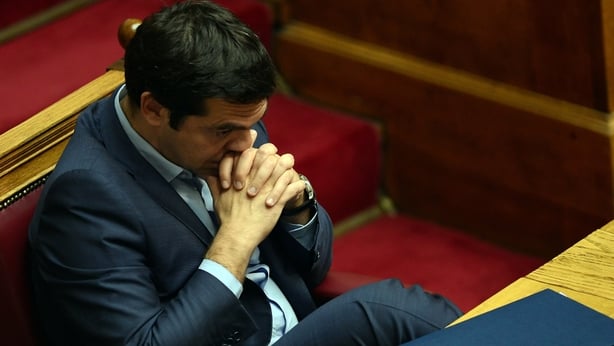
Mr Tsipras has publicly said he disagrees with measures demanded by Greece's eurozone peers and the IMF for talks to proceed on a third bailout to save the country from bankruptcy.
But after he made a U-turn by accepting a deal at the 11th hour to keep his country in the euro, he told party hardliners to face reality and back the package.
Last week's rebellion cut his support to just 123 votes and government officials have said elections are likely in September or October once the package is agreed.
"We might go to elections, when this is needed," government spokeswoman Olga Gerovasili told local radio.
She said it would not be helpful now as the country prepares to negotiate the new bailout deal.
European Economic and Monetary Affairs Commissioner Pierre Moscovici told reporters in Brussels he was confident the parliament would adopt the bill.
Creditor institutions were seeking to conclude talks with Greece on a third bailout in the second half of August, he said.
The government has said it hopes negotiations on the bailout deal can start this week and be wrapped up by 20 August.
In the first signs of a return to normal, Greek banks reopened on Monday and Athens paid debts due to the European Central Bank and International Monetary Fund.
The ECB increased its emergency funding by €900m, the same amount it provided last week.
On Tuesday, Standard & Poor's upgraded Greece's sovereign credit rating by two notches.
But fresh austerity measures are hard to accept in a country whose economy has contracted by a quarter during five years of crisis and where unemployment is more than 25%.
Rallies called by the main public sector union ADEDY, the communist-affiliated party PAME and anti-establishment groups drew several thousand people in front of parliament.
