


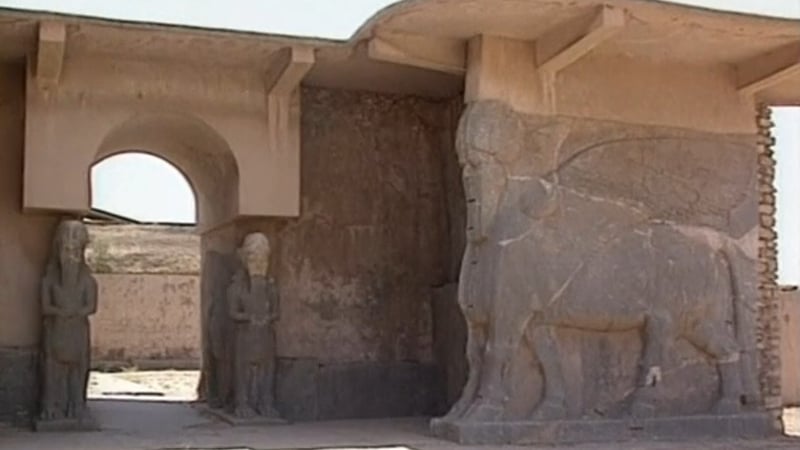
The head of UNESCO has condemned the destruction of the ancient Assyrian city of Nimrud in Iraq by the Islamic State group, saying it amounted to a "war crime".
Irina Bokova said: "We cannot stay silent. The deliberate destruction of cultural heritage constitutes a war crime, and I call on all political and religious leaders in the region to stand up against this new barbarity."
Islamic State fighters have looted and bulldozed the ancient city, the Iraqi government said, in their latest assault on some of the world's greatest archaeological and cultural treasures.
UNESCO Director-General condemns the destruction of Nimrud, an attack against the Iraqi people http://t.co/qMiew7AZpy pic.twitter.com/di78Alfl50
— UNESCO (@UNESCO) March 6, 2015A tribal source from the nearby city of Mosul told Reuters the ultra-radical Sunni Islamists, who dismiss Iraq's pre-Islamic heritage as idolatrous, had pillaged the 3,000-year-old site on the banks of the Tigris river.
The assault against Nimrud came just a week after the release of a video showing Islamic State forces smashing museum statues and carvings in Mosul, the city they seized along with much of northern Iraq last June.
"Daesh terrorist gangs continue to defy the will of the world and the feelings of humanity," Iraq's tourism and antiquities ministry said, referring to Islamic State by its Arabic acronym.
"In a new crime in their series of reckless offences they assaulted the ancient city of Nimrud and bulldozed it with heavy machinery, appropriating the archaeological attractions dating back 13 centuries BC," it said.
Nimrud, about 30km south of Mosul, was built around 1250 BC.
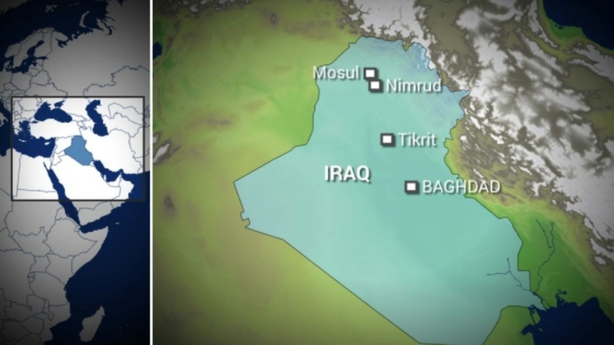
Four centuries later it became capital of the neo-Assyrian empire - at the time the most powerful state on earth, extending to modern-day Egypt, Turkey and Iran.
The White House expressed outrage at the destruction.
The National Security Council tweeted: "Deeply saddened by incomprehensible destruction of historical, cultural and religious artifacts in Iraq, including recent attacks in Nimrud."
A local tribal source said: "Islamic State members came to the Nimrud archaeological city and looted the valuables in it and then they proceeded to level the site to the ground."
"There used to be statues and walls as well as a castle that Islamic State has destroyed completely."
Many of its most famous surviving monuments were removed years ago by archaeologists, including colossal Winged Bulls which are now in London's British Museum and hundreds of precious stones and pieces of gold which were moved to Baghdad.
But the ruins of the ancient city remain at the northern Iraqi site, which has been excavated by a series of experts since the 19th century.
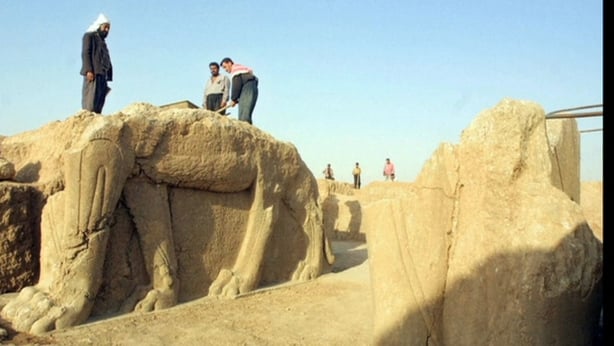
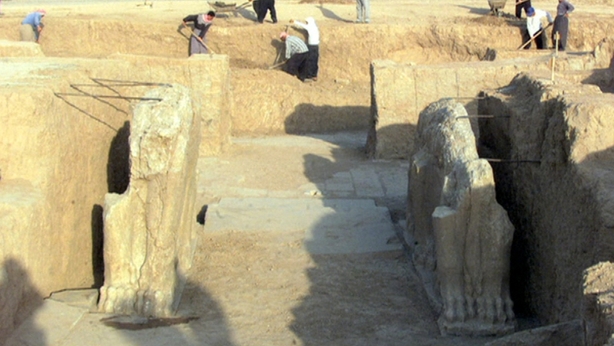
British archaeologist Max Mallowan and his wife, crime writer Agatha Christie, worked at Nimrud in the 1950s.
Archaeologists have compared the assault on Iraq's cultural history to the Taliban's destruction of the Bamyan Buddhas in 2001.
But the damage wreaked by Islamic State, not just on ancient monuments but also on rival Muslim places of worship, has been swift, relentless and more wide-ranging.
Last week's video showed them toppling statues and carvings from plinths in the Mosul museum and smashing them with sledgehammers and drills.
It also showed damage to a huge statue of a bull at the Nergal Gate into the city of Nineveh.
Archaeologists said it was hard to quantify the damage, because some items appeared to be replicas, but many priceless articles had been destroyed including artefacts from Hatra, a stunning pillared city in northern Iraq dating back 2,000 years.
Islamic State, which rules a self-declared caliphate in parts of Iraq and Syria, promotes a fiercely purist interpretation of Sunni Islam which seeks its inspiration from early Islamic history. It rejects religious shrines of any sort and condemns Iraq's majority Shia Muslims as heretics.
In July it destroyed the tomb of the prophet Jonah in Mosul. It has also attacked Shia places of worship and last year gave Mosul's Christians an ultimatum to convert to Islam, pay a religious levy or face death by the sword.
IS has also targeted the Yazidi minority in the Sinjar mountains west of Mosul.
Elsewhere, Iraqi forces today cleared Islamic State fighters from the town of al-Baghdadi near a key base where US Marines are training Iraqi military troops.
Iraqi Security Forces and tribal militia from the Anbar region also pushed the IS fighters from seven villages northwest of al-Baghdadi on the road to Haditha, the Combined Joint Task Force said in a statement.
