

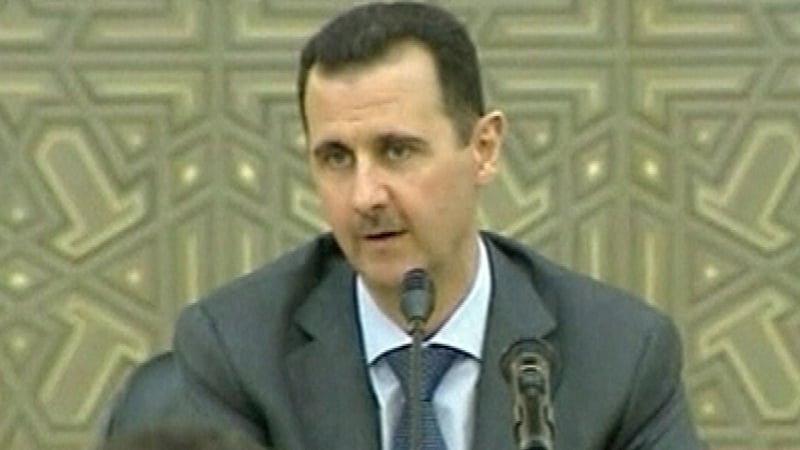
Syrian President Bashar al-Assad, facing a seven-month uprising against his rule, has said that he was willing to talk to the opposition.
In an interview with Russian television, President Assad said: "We will cooperate with all political powers, both those who had existed before the crisis, and those who arose during it."
He continued: "We believe interacting with these powers is extremely important."
His remarks came as Syrian officials were due to hold more talks in Qatar with delegates of the Arab League, which wants to convene a dialogue in Cairo between the Syrian authorities and their opponents.
A two-week deadline set by the Arab League for the planned dialogue to start expires today.
The United Nations says 3,000 people have been killed during the uprising.
Mr Assad said there had been "hundreds of deaths amongst the military, police and security forces".
"How were they killed?" Mr Assad said, "Were they killed during a peaceful demonstration? Were they killed by someone shouting? No they were killed by shooting. So we are dealing with armed men."
Earlier, President Assad warned that Western intervention would cause an "earthquake" across the region, as Arab ministers held talks aimed at ending the violence in Syria.
After almost 100 people died in the bloodiest two days of the uprising against his rule, Mr Assad warned of "another Afghanistan" if foreign forces intervened in Syria as they had in Libya.
Speaking to the Sunday Telegraph, Mr Assad said: "Syria is the hub now in this region."
He said "It is the fault line, and if you play with the ground you will cause an earthquake - do you want to see another Afghanistan, or tens of Afghanistans?" he asked.
He added: "Any problem in Syria will burn the whole region. If the plan is to divide Syria, that is to divide the whole region."
The Arab League team opened talks in Doha with a Syrian delegation led by Foreign Minister Walid Muallem, bolstered by strong support for the bloc's mediation efforts from China, one of two governments with Russia which earlier this month vetoed UN Security Council action against Damascus.
The Arab ministerial delegation led by Qatar aimed to try to reach "serious results and an exit to the Syrian crisis," a statement from the team said.
