


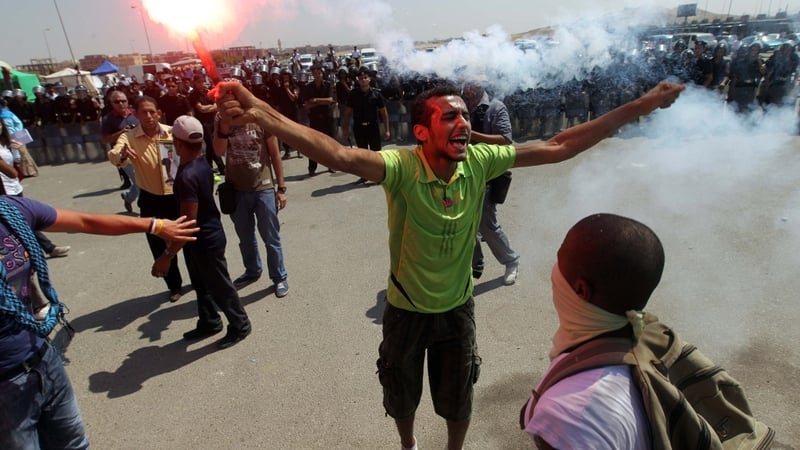
Egyptian protesters have forced their way into the Israeli embassy and thrown documents out its windows.
Witnesses said hundreds of documents flew from the building's windows in Giza, where demonstrators have also destroyed a wall around the mission building.
The protests are the latest in a series of altercations which signal increasing tension between the two countries.
Thousands of protesters had earlier converged on Tahrir Square to push the country's rulers for a timetable for reforms and an end to military trials for civilians.
Activists who spearheaded an uprising that ousted President Hosni Mubarak in February have been piling pressure on the ruling military council to fix a date for parliamentary and presidential elections.
They also want the interim rulers to get rid of senior officials who served under Mubarak.
Thousands converged on Tahrir Square, the epicentre of the pro-democracy protests that toppled Mubarak, after Friday prayers for what was billed as "Correcting the Path" protests.
Some later marched to the opposite bank of the Nile in Giza.
Demonstrators used hammers, large iron bars and police barricades to tear down the wall at the Israeli embassy, erected this month by Egyptian authorities after daily protests over the killing of five Egyptian border guards in Sinai.
Protesters scaled the embassy building, removed the Israeli flag for the second time in less than a month and burned it.
Giza's police chief said that two police vehicles were set alight near the Israeli embassy building during the protests. State television said four police vehicles were set on fire.
Egyptian police stood aside as activists tore down the concrete wall to the cheers of hundreds of demonstrators.
Israel Radio cut into its Sabbath programming with bulletins about the Cairo demonstrations.
Citing Foreign Ministry sources, it said the ambassador was safely at his official residence and that Israel was in contact with Egypt, the United States and European powers about the incident.
Israeli Foreign Minister Avigdor Lieberman said in a statement that he had gone to the ministry's situation room in Jerusalem to monitor events at the embassy.
Tensions between the two countries sparked a series of angry protests that reached a climax last month when a demonstrator scaled the building and removed the Israeli flag.
The five security men died during an Israeli operation against gunmen who had killed eight Israelis.
Egypt threatened to withdraw its ambassador from Tel Aviv. Israel has stopped short of apologising, saying it is still investigating how the Egyptian troops were killed.
Protesters also demonstrated outside the Interior Ministry, near Tahrir Square, pelted the building with stones and scrawled graffiti denouncing the head of the ruling military council, Mohamed Hussein Tantawi.
State television said a fire broke out at a building used to store forensic evidence. Firefighters managed to put it out.
Fridays demonstrations were organised mostly by secular groups which had been pushing for reforms, a new constitution and an end to the trial of civilians before military courts.
Islamists, including the political party set up by the Muslim Brotherhood -- Egypt's best organised political force after the dissolution of Mubarak's National democratic Party -- have distanced themselves from the planned protests.
The country's military rulers have promised to hand back power to a civilian government after elections, which they said would be held before the end of 2011. The council has also facilitated the trial of Mubarak and several of his aides, including former Interior Minister Habib al-Adli, on charges of corruption or conspiring to kill some 850 demonstrators.
However many Egyptians remain sceptical.
