


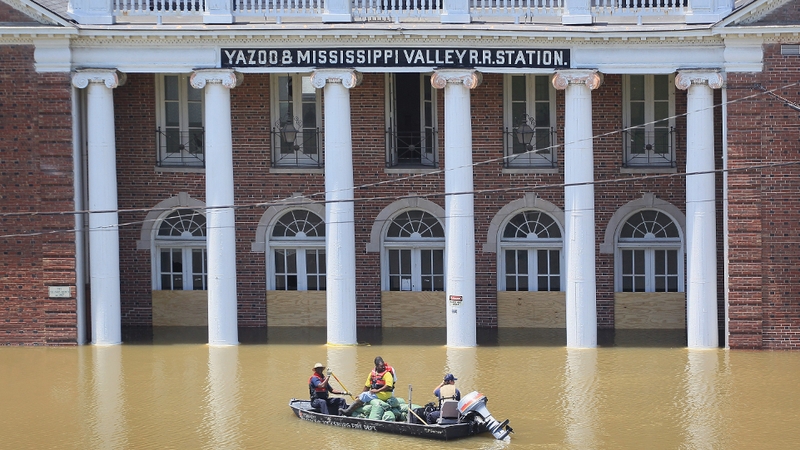
The US Army Corps have released water from a floodgate to ease pressure from the swollen Mississippi River, hoping to save cities by sacrificing small towns and farmland that face historic flooding.
Opening the Morganza Spillway completely would divert some 600,000 cubic feet of water every second -- about six times the daytime volume of Niagara Falls.
But in order to prevent a massive wave from being unleashed, officials said only one bay would be opened today, allowing 10,000 cubic feet per second, and one or two more bays opened tomorrow.
The Bonnet Carre spillway between the major urban areas of Baton Rouge and New Orleans will be at full capacity today, officials added, diverting 250,000 cubic feet per second into Lake Pontchartrain.
The 20-foot (six-meter) levees protecting New Orleans are now holding back the river at 17 feet, considered at flood stage. If the Morganza Spillway did not open, river levels were predicted to reach 19.5 feet.
The expected flooding of farmland and rural towns has prompted urgent evacuation orders.
New Orleans Mayor Mitch Landrieu said he was aware of the sacrifices residents of rural communities will be making to save more populous communities.
The Army Corps said its top priority was to protect people first, and property second.
According to flood projections, a flood as high as 15 feet (4.5 meters) was set to bear down on some communities at its height after the spillway is opened.
The American Red Cross is already readying shelters for thousands of expected evacuees.
So far, the major New Orleans port is continuing normal operations, while oil and gas companies have about 2,200 wells in the region at risk of flooding.
The worst floods to hit the central United States in more than 70 years have already swallowed up thousands of homes, farms and roads in Illinois, Missouri, Kentucky, Tennessee, Arkansas and Mississippi, and the mighty river is expected to remain above flood stage along hundreds of miles for many more days.
The American Red Cross said back-to-back disasters over the last two months has prompted it to launch 23 separate relief operations backed by over 7,700 relief workers in 18 states.
