


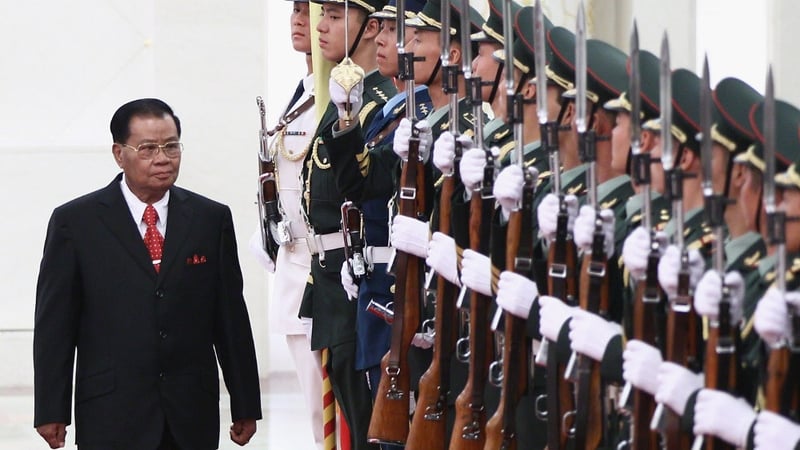
Than Shwe, who has ruled Burma, officially known as Myanmar, with an iron fist for almost two decades, has retired as head of the military after handing power to a nominally civilian government.
The 78-year-old has retired from the position of commander-in-chief of Burma's ‘Tatmadaw’ armed forces, days after handing power to a nominally civilian - but military-backed - government and president.
The ‘senior general’ had kept his plans shrouded in mystery since controversial November elections, which were slammed by critics as a strategy to disguise military power behind a civilian facade.
But while the former postman may withdraw from public view now that the junta is officially disbanded, few believe he will completely relinquish his grip on the impoverished nation.
Thailand-based Burma analyst Aung Naing Oo said the reclusive former leader is likely to continue to wield power behind the scenes.
'He will remain in charge or in the shadow of the government to an extent,' he said.
The military strongman knows the risks of retiring, having put his predecessor, the late dictator Ne Win, under house arrest in 2002 after his family members were convicted of plotting to overthrow the regime.
Than Shwe is famous for his reliance on soothsayers and reportedly gave government workers just hours to move from Yangon to the half-built new capital Naypyidaw in 2006 as the timing had been ordained by astrologers.
Unlike the leaders of some other pariah states, Burma's senior general - said to be a keen Manchester United fan - does not rely on a cult of personality to prop up his regime.
But what he lacks in charisma he has made up for with brute force - crushing uprisings, silencing dissent and locking up political prisoners, among them opposition leader Aung San Suu Kyi, his arch enemy, who was released from seven years of house arrest after the November election.
Mark Canning, the former British ambassador to Burma who has met the junta chief several times, has described him as ‘small, plump, slow moving and physically unimposing.
‘He projects no obvious sense of menace or intimidation. He's far from the image of a fire-breathing demagogue,’ Mr Canning says.
‘He gives every impression of being what he in fact is - someone who has manoeuvred himself from lowly beginnings to the top of the military pile, with guile, intrigue and, where necessary, force.’
Born in 1933 in a small town near Mandalay, Than Shwe enlisted in the army aged 20 as Burma emerged from colonial rule.
His first combat experience came as a young second lieutenant fighting separatist rebels, before being posted to a roving psychological warfare unit and rising swiftly through the ranks.
The military seized control of the country post-independence in a 1962 coup.
Than Shwe took the helm in 1992 after previous dictator Ne Win stepped down in the wake of a failed 1988 student-led uprising.
Burma's armed forces are believed to have doubled in size over the past two decades with an estimated 350,000 to 400,000 personnel and experts say its position of strength means it is unlikely to leave the political scene.
‘The officer corps as a sub-class of society... has come to view themselves as the ruling class, feeling they are eternally entitled to rule,’ said activist and academic Maung Zarni, of the London School of Economics.
