

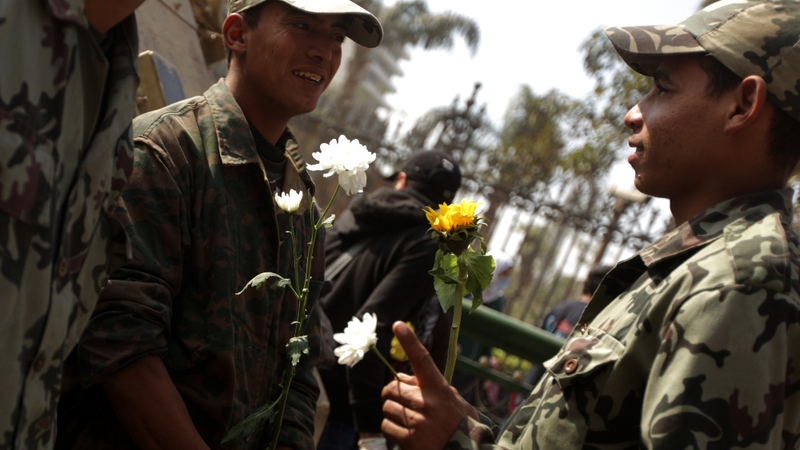
Egypt's new military rulers told the nation they were committed to civilian rule and democracy after Hosni Mubarak's overthrow.
In a move to reassure Washington and Israel the military also said they would respect all treaties.
Pro-democracy activists in Cairo's Tahrir Square have vowed to stay there until the Higher Military Council accepts their agenda for democratic reform.
In another move to restore order, the army said it would ‘guarantee the peaceful transition of power in the framework of a free, democratic system which allows an elected, civilian power to govern the country to build a democratic, free state’.
Commenting after the army statement, Egypt's Islamist Muslim Brotherhood said that it was not seeking power and praised the efforts of the new army rulers to transfer power to civilians.
Crowds celebrated in Tahrir Square while protest organisers urged the army to meet demands including the dissolution of parliament and the lifting of a 30-year-old state of emergency used by Mubarak to crush opposition and dissent.
It remains to be seen what appetite the military has for a quick transition to genuine parliamentary democracy.
The military council gave few details of a ‘transitional phase’ and gave no timetable for presidential or parliamentary elections.
The tumultuous events in Egypt sent shock waves abroad.
Mr Mubarak was believed to be at his residence in the Red Sea resort of Sharm el-Sheikh, his future unclear.
Al Arabiya has said the army will soon dismiss the cabinet and suspend parliament.
The head of the Constitutional Court would join the leadership with the military council, which was given the job of running the country of 80 million people.
A carnival air lingered in the capital's Tahrir Square, where the army dismantled checkpoints and some makeshift barricades were removed. Volunteers proudly swept the square.
Eighteen days of rallies, resisting police assaults, rubber bullets, live rounds and a last-ditch charge by pro-Mubarak hardliners on horses and camels, had brought improbable success.
US President Barack Obama said ‘nothing less than genuine democracy’ would satisfy Egyptians. ‘This is not the end of Egypt's transition. It's a beginning. I'm sure there will be difficult days ahead,’ he said.
Washington has pursued a sometimes shifting line since the anti-Mubarak protests began wary of losing a bulwark against militant Islam but keen to back political freedom.
Saudi Arabia, which had supported Mubarak throughout, said it welcomed the peaceful transition of power.
