


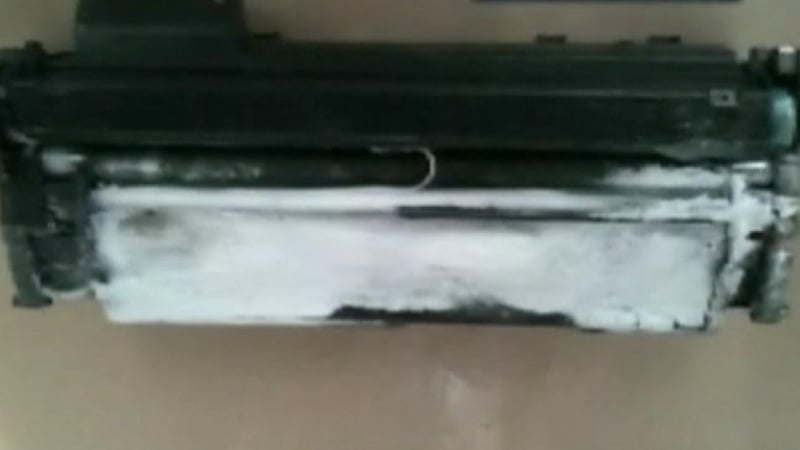
The woman suspected of being involved in a plot to send parcel bombs on US bound planes has been freed.
A family member and a government official said the woman, believed to be in her 20s had been released.
A Yemen government official said that 'another woman had used her name and ID and authorities are looking for that woman.'
Governments, airlines and aviation authorities around the world are reviewing security after two parcel bombs sent from Yemen were intercepted on planes in Dubai and Britain on Friday.
Yemeni police arrested the woman after tracing her through a telephone number she had left with a cargo company.
Dozens of students had staged a sit-in in the courtyard of Sanaa University's engineering faculty calling for her release.
The student was the only person to be arrested so far in connection with the bomb plot, and her release will renew pressure on Yemen from the US and others to hunt down the perpetrators and fight Islamic militancy.
Meanwhile, an alleged Saudi bombmaker has emerged as the main suspect behind the two parcel bombs sent from Yemen, a US official said, as a Gulf airline source said one of the parcels travelled on a passenger plane.
Ibrahim Hassan al-Asiri, an alleged al-Qaeda bombmaker born in Saudi Arabia but based in Yemen, as a 'leading suspect' in the parcel bomb plot.
'Al-Asiri's past activities and explosives' experience make him a leading suspect,' the source said, speaking on condition of anonymity.
There are indications he may have had a role in past AQAP (Al-Qaeda in the Arabian Peninsula) plots, including the attempted assassination of a Saudi official and last year's failed Christmas Day attack.
Mr Asiri, the 28-year-old son of a retired soldier, is considered the AQAP's chief bombmaker and is thought to be in regular contact with radical Yemeni-US cleric and key terror suspect Anwar al-Awlaki.
US Counter-terrorism chief John Brennan said there was no intelligence indicating there were any additional parcel bombs from Yemen, although he refused to rule out the possibility.
He also said evidence suggested the same person built the intercepted parcel bombs and the device worn by the 'underwear' bomber Umar Farouk Abdulmutallab who botched an attack on a flight to Detroit on Christmas Day 2009.
