


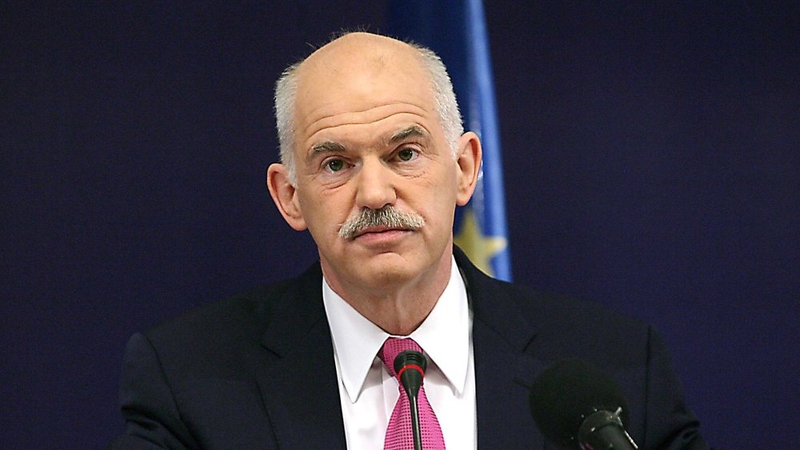
Greece's Prime Minister George Papandreou has vowed in a keynote speech to maintain his government's austerity drive, as 20,000 protestors marched against the economic measures.
‘I lead this battle without thinking of the political cost,’ the prime minister, a socialist, told visitors to the Thessaloniki International Fair. ‘It is a battle for the survival of Greece.
‘Either we fight it all together, or we sink,’ he added.
An estimated 20,000 people demonstrated outside the event against the austerity programme, which has already seen swingeing cuts in public sector spending.
The government would push ahead with its programme, Mr Papandreou insisted.
It would move to bring order to the hospital sector; to shake up the heavily indebted railway service; and to liberalise the energy market, doing away with the state power company's monopoly, he said.
Mr Papandreou also confirmed plans to liberalise the road haulage industry, a policy that in July led to a week-long strike by truckers.
At a demonstration earlier yesterday, the road haulage unions announced a new, open-ended strike from tomorrow.
Mr Papandreou promised to set aside €3.5bn of mainly European money to ensure that the jobless and other vulnerable groups would be protected.
The government is also keen to cut the red tape to make it easier to do business and thus encourage investment, research, innovation and sustainable development, he added.
But Spiros Papaspirou, leader of the civil servants union ADEDY, told the protestors outside: ‘The country is not saved from bankruptcy if the people themselves are bankrupt.’
And in a sign of the growing gulf between the prime minister and his critics, scuffles broke out earlier as he arrived at the venue to make his speech. Police used tear gas against a group of youths among the protestors.
Earlier, five separate marches converged on the Thessaloniki International Fair, the venue for Mr Papandreou's speech, as it was opening.
An extra 4,000 officers were drafted in from around the country to police the rally.
They made several arrests in the course of the day, including one person who allegedly tried to throw a shoe at the prime minister.
Saturday's protests were called by the main trades unions and left-wing parties, who accuse Papandreou's government of seeking to roll back worker rights.
The government has already pushed ahead with unpopular reforms to the country's pensions system, cuts in civil servants' salaries and tax rises.
The unions have responded with six general strikes this year and have promised more industrial unrest in the coming months.
The government's tough programme was agreed in May in return for a €110bn bailout from the European Union and the International Monetary Fund.
That became necessary after the socialist government announced that the public finances were crippled, with debt approaching €300bn - estimated at 13.6% of gross domestic product.
The IMF said on Friday it would provide Greece with a further €2.57bn in its second instalment of the rescue package after Athens met tough demands to cut public spending.
The strong police presence in Thessaloniki Saturday was a reflection of the violence at some of the previous protests: in May, three people died after the Athens bank they worked in was fire-bombed.
