


Chile's 33 trapped miners have spoken for the first time with their loved ones after 24 days underground.
'To hear his voice was a balm to my heart,' said Jessica Chille after speaking to her husband, Dario Segovia.
Limited to one minute per miner, the wives, mothers and fathers lined up for their first person-to-person conversations since a cave-in on 5 August blocked the miners' exit from the San Jose gold and copper mine.
'I didn't break down until I told him: ciao, my little boy, we will see each other,' said Alicia Campos, after speaking to her son Daniel Herrero.
'His voice is the same. He's not good but not so bad either,' she said.
The conversations were morale boosters for miners who must wait three to four months to be rescued.
Until now, the miners and their families have only been able to exchange written messages and video images relayed through narrow probe holes.
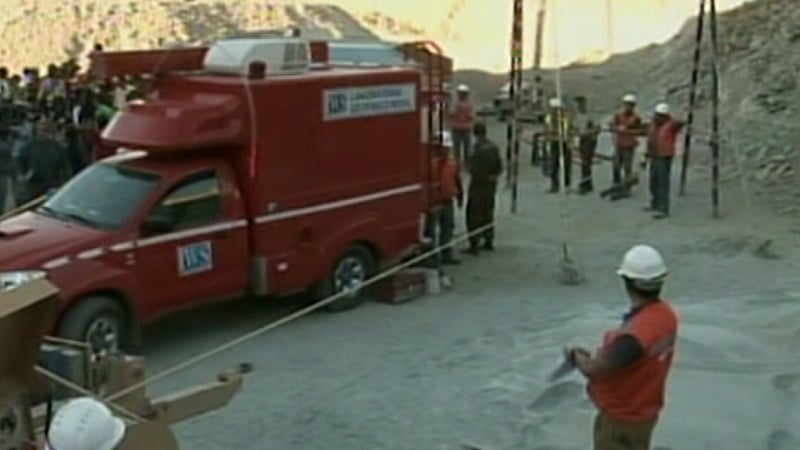
Out of sight of family and media, engineers finished assembling a powerful Strata 950 drill to bore through more than 700 metres of rock and earth to reach the miners.
A delay in the arrival of a missing part set back the schedule by several hours but 'drilling will begin on Monday', Mining Minister Laurence Goldborne told reporters.
'The shaft we're drilling to the shelter will go down 702 metres in a straight line,' the engineer in charge of the rescue operation, Andre Sougarret, told reporters.
The 30-tonne machine will first bore a hole 35cm in diameter and then enlarge it with a reamer to 66cms.
Under optimal conditions, the state-of-the-art Australian-designed drill is capable of advancing 20 metres a day.
Mr Goldborne said that other options had been looked at in hopes of rescuing the miners more quickly, but he said: 'There is no technology available that would enable us to perform the rescue in one or two months.'
His remarks followed reports that President Sebastian Pinera was pressuring rescuers to get the miners out before 18 September, the bicentennial anniversary of Chile's independence from Spanish colonial rule.
